What Happens When a Post Tension Slab Tendon Is Cut
Every calculation behind a post tension slab assumes that each tendon is intact, stressed and continuous from anchor to anchor. A plumber's saw, a demo crew's core drill or a misread drawing can break that assumption in a second. In our experience across Dallas-area projects, the first 24 hours after a severed PT tendon determine whether the repair is a controlled $800 fix or a multi-thousand-dollar slab replacement discussion.
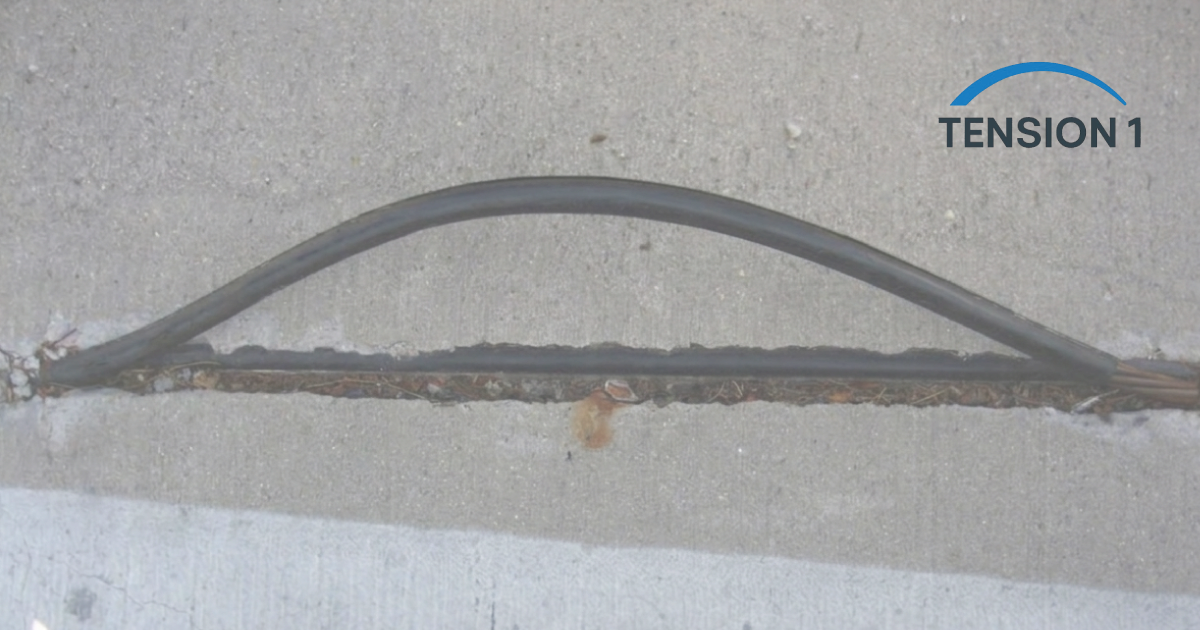
The reason is mechanical. A standard 0.5 in. strand is jacked to about 33 kip, which is 80 percent of its 41.3 kip breaking strength under ASTM A416, and most of that force remains after losses. In an unbonded system, nothing ties the strand to the concrete between the anchors. One cut releases the force along most of the tendon length. That leaves cracking, added deflection and, near columns, reduced punching shear margin. Pouring a patch over the exposed strand end is not a repair, and it will not hold.
This guide covers the protocol for the first hours and the repair paths that hold up in review. For the wider diagnostic picture, see the 5 warning signs your post-tension slab needs immediate expert repair.
Step 1: Stop Work and Secure the Zone
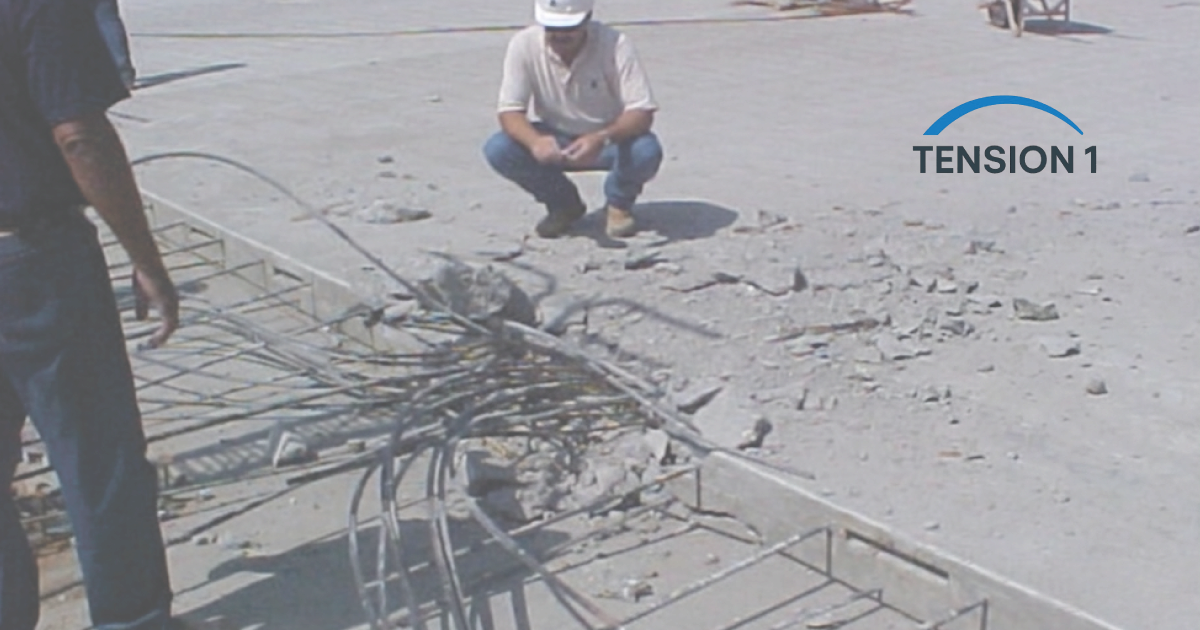
Stop all trades in the affected bay the moment a tendon is cut. A freshly cut strand can retract violently or be driven out through the slab edge at an anchor. The danger zone is therefore in line with the tendon at both slab edges, not only around the cut. Keep people away from both anchor ends and from the area below an elevated slab until the strand has stopped moving.
Then photograph everything before anyone touches the debris. That includes the cut face, both pockets, the reinforcing around the cut, and the slab surface in both directions.
Immediate On-Site Documentation Checklist
- Tendon identification from the PT shop drawings, if available
- Cut location: grid line or room, distance from the nearest support, floor level
- Stressing end location and approximate tendon length
- Direction and distance of strand retraction
- Condition of adjacent tendons within 24 in.
- Date, time, trade involved and supervisor present
Step 2: Assess the Structural Impact Before Calling a Repair Crew
Not every cut tendon has the same consequence. The severity depends on where the tendon sits in the layout, how much of the balanced load it carries, and how much redundancy the slab has. Before any repair crew arrives, the engineer of record (EOR), or a licensed engineer with access to the original PT design, needs to review it.
That review weighs three things. The first is whether the remaining tendons still provide the minimum average precompression: 125 psi for two-way elevated slabs under ACI 318-19, or the PTI minimum for a slab-on-ground foundation. The second is whether the cut tendon belongs to a band over the columns, which carries most of the load into the supports, or to the distributed direction. The third is how the eccentricity of the remaining prestress changes along the affected span.
Quick Severity Classification We Use in the Field
| Severity | Condition | Immediate Action Required |
|---|---|---|
| Low | Middle-strip tendon, >3 adjacent tendons intact, no visible cracking | Document and schedule repair within 7 days |
| Moderate | Column-strip tendon OR middle-strip with 2 or fewer adjacent intact tendons | Restrict live load in bay, repair within 48 hours |
| High | Column-strip tendon adjacent to support, visible cracking, or multiple tendons cut | Shore the bay immediately, halt occupancy, notify EOR |
This is a field screening tool, not a structural determination. Shoring, occupancy and slab adequacy are decisions for the EOR or a licensed engineer.
Homeowners face the same sequence, only shorter. Call a licensed professional engineer with post-tension experience first. A specialized PT repair contractor comes second, and the trade that caused the cut does not do the repair. Before any further opening, the tendons must be located by ground-penetrating radar or X-ray, as described in PTI DC80.2-10 for openings in existing unbonded slabs.
Step 3: Choose the Right Repair Technique
Four repair paths exist for a severed unbonded tendon. The right one depends on access, retraction distance and whether both strand ends can be recovered.
Option A: Inline Coupler Splice
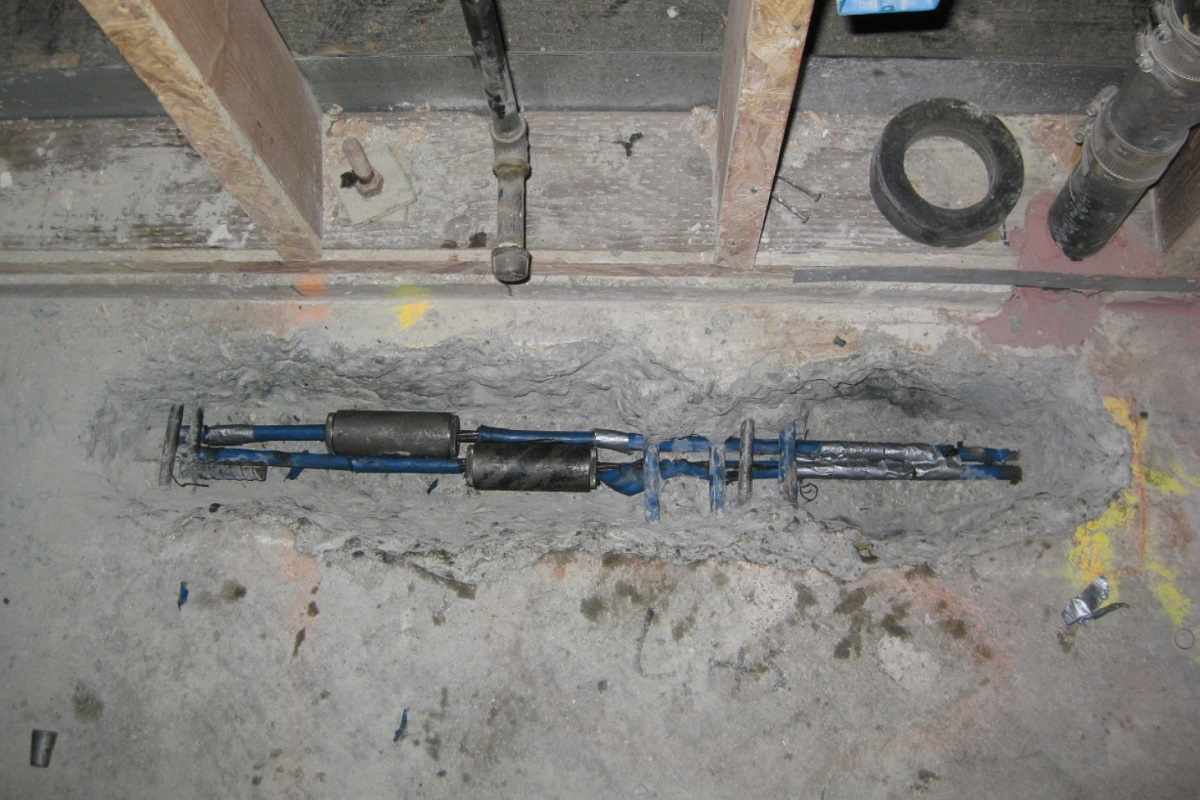
When retraction is short and both ends can be reached through a small chase, a mechanical coupler joins the strand, which is then restressed and the pocket regrouted. Done correctly and confirmed by an elongation check, it restores the tendon to its design force.
What Worked On-Site
On a two-story Dallas residential slab, a plumber cut a tendon at mid-span. The retraction was 4 in. We exposed both ends with a 10 in. chase, installed a PTI-compatible inline coupler, restressed to the original 33 kips using a hydraulic mono-jack, and regrouted the pocket. Total on-site time: 6 hours. Total cost: approximately $850 for labor and materials.
What Did Not Work
On a different project with a retraction of 11 in., the contractor attempted the same inline splice without first confirming the free length remaining on each side. The coupler could not develop the full prestress because the bonded zone was too short. We had to abandon the splice and move to Option C.
Option B: Supplemental Tendon
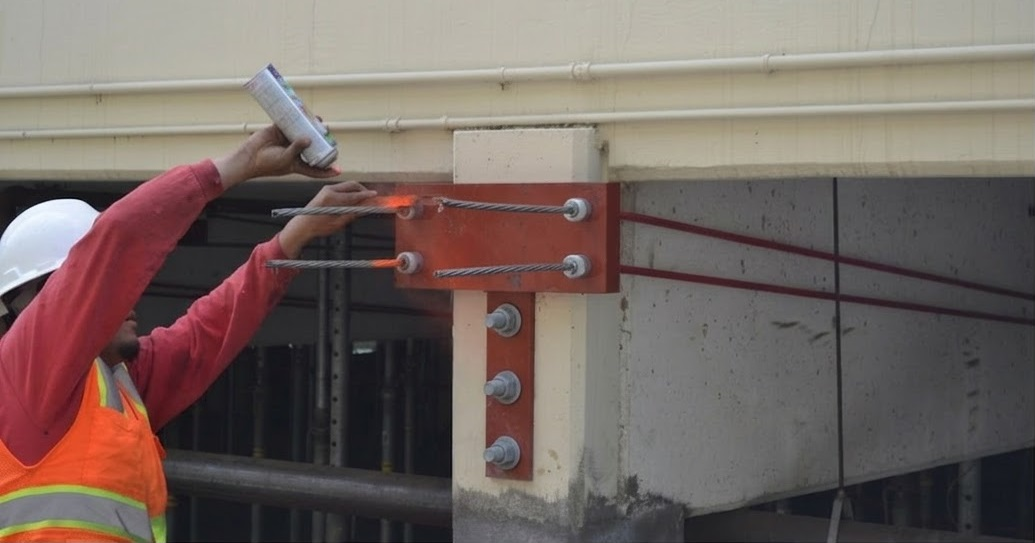
When a strand end has retracted past a support or cannot be recovered without major demolition, a new tendon can be installed beside the damaged one. It goes in through a saw-cut chase, with new anchors, and is stressed from a temporary pocket. It must be designed to replace the lost prestress, not simply added to the system.
Option C: Passive Reinforcement or CFRP
In low-severity cases, the EOR may approve epoxy-anchored rebar or carbon fiber reinforced polymer (CFRP) strips bonded to the slab. This does not restore prestress. It adds passive capacity, and CFRP design follows ACI 440.2R-17. We only recommend it after the EOR has confirmed in writing that the loss of prestress is acceptable.
Option D: Abandon in Place
Where the analysis shows the slab performs adequately without the tendon, the EOR may approve leaving it abandoned. The pockets are then resealed and the decision is recorded in writing. It is the cheapest path, and it is only valid with that analysis behind it.
Step 4: Execute and Document the Post Tension Slab Repair
A repair without documentation has no engineering standing for future inspections, sales or modifications. Every repair we oversee closes with this file:
- Pre-repair GPR scan confirming the position of adjacent tendons
- Photographs of the strand ends before and after preparation
- Coupler data sheet showing compliance with the anchorage and coupler requirements of PTI M10.2-17
- Jack gauge readings at seating, full stress and lock-off
- Measured versus calculated elongation. ACI 318 requires the cause of a discrepancy over 7 percent to be found
- Grout product data, with grouting date and time
- Inspection log signed by the responsible party
The full execution method, including the elongation calculation and pocket grouting, is in our step-by-step guide to fixing a severed post-tension tendon.
What a Cut Tendon Repair Costs, and What Drives It
Post tension cable repair cost in Texas runs from under $1,000 for a simple splice to over $15,000 for multi-tendon damage with shoring and engineering review. The ranges below are what we have observed on Dallas-area projects.
| Repair Scenario | Typical Cost Range (DFW) | Key Driver |
|---|---|---|
| Inline coupler splice, single tendon, <8 in. retraction | $700 to $1,200 | Access and labor time |
| New supplemental tendon, single bay | $1,800 to $4,500 | Chase cutting and re-stressing |
| CFRP soffit reinforcement, per 10 linear ft | $600 to $1,100 | Material cost and epoxy prep |
| Shoring, GPR scan, and EOR review package | $2,500 to $6,000+ | Scope and engineering hours |
| Multi-tendon damage, post-repair slab analysis | $8,000 to $15,000+ | Extent of damage and documentation |
Source: TensionOne project records, Dallas-Fort Worth. These are budgeting ranges, not quotes. For an estimate by damage type and region, use the post-tension slab repair cost calculator or see the average cost per square foot for post-tension slab repair.
Get a Second Opinion on the Repair Plan
If a tendon has been cut on your project or in your home and you already have a repair proposal, our expert technical consulting reviews it with you in a virtual meeting. We look at the photos, the drawings and the quote, and tell you which questions to ask before work starts. Regular monitoring prevents many of these incidents, as covered in whether post-tension slabs require regular professional inspection.
TensionOne provides independent structural engineering support. Deliverables are prepared for review and use by a licensed Professional Engineer, and TensionOne does not issue PE-stamped documents. This article does not diagnose any specific slab.
References: ACI 318-19, Building Code Requirements for Structural Concrete (current edition ACI CODE-318-25), American Concrete Institute. ACI 440.2R-17, Guide for the Design and Construction of Externally Bonded FRP Systems for Strengthening Concrete Structures. PTI M10.2-17, Specification for Unbonded Single Strand Tendons. PTI DC80.2-10, Guide for Creating Openings and Penetrations in Existing Slabs with Unbonded Post-Tensioning. ASTM A416, Standard Specification for Low-Relaxation, Seven-Wire Steel Strand for Prestressed Concrete.