
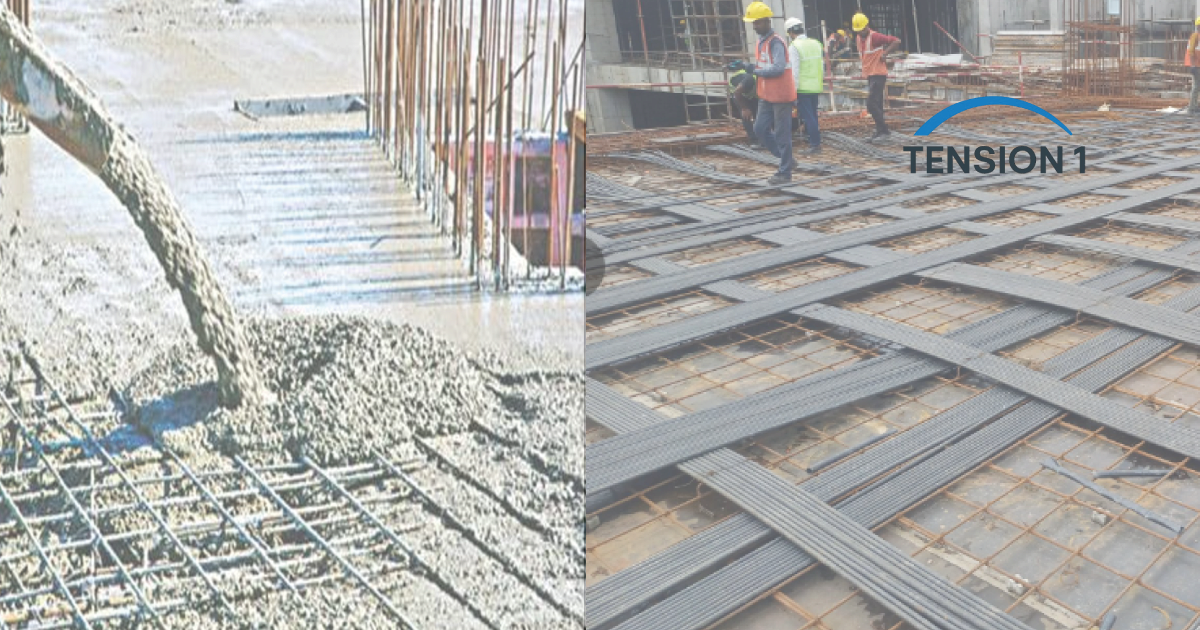
When we evaluate a post tension slab design against a conventional reinforced concrete slab, the structural conversation dominates: span capability, deflection control, cracking behavior. That is the right instinct. But a second evaluation is quickly gaining ground on project submittals in Texas and across the U.S.: the embodied carbon footprint of each system.
This matters because concrete production accounts for roughly 4 to 8 percent of global CO2 emissions, and cement is the single most carbon-intensive ingredient in that mix. The more concrete volume your slab requires, and the more mild steel reinforcement it consumes, the heavier its carbon bill becomes. For design teams pursuing LEED credits, owners under sustainability pressure, or contractors bidding public-sector work in Texas with green building criteria, that bill is increasingly visible.
In this article, we break down the embodied carbon comparison between post-tensioned and standard RC slabs using actual material takeoffs and recognized carbon intensity factors. We will show you where the PT system wins clearly, where the differences are marginal, and what you should communicate to your client or general contractor when this topic comes up.
For a broader understanding of how PT slabs work structurally before diving into the carbon math, read our Ultimate Guide to Post-Tension Slabs: Advantages, Design, and Longevity.
What Embodied Carbon Actually Measures in a Concrete Slab
Embodied carbon refers to the total CO2-equivalent (CO2e) greenhouse gas emissions generated during the extraction, manufacture, and transportation of construction materials. It is distinct from operational carbon, which tracks emissions from building use over time.
For a concrete slab, the embodied carbon inventory includes three primary contributors:
- Portland cement in the concrete mix, the largest single source of CO2e per unit of concrete
- Coarse and fine aggregates, with lower but nonzero carbon intensity
- Steel reinforcement, either mild rebar or post-tensioning strand, each with distinct carbon intensities per pound
The carbon intensity of concrete varies significantly based on the mix design and cement replacement rates. A standard 4,000 psi normal-weight concrete mix carries approximately 0.18 to 0.22 lb CO2e per lb of concrete. High-strength mixes used in PT design, often 5,000 psi or above, carry higher cement content per cubic yard but that increase is offset by the volume reduction PT enables.
PT strand (typically 270-ksi low-relaxation per ASTM A416) has a higher carbon intensity per pound than mild rebar (ASTM A615), but the total mass of strand in a PT slab is substantially lower than the rebar mass it replaces. That net exchange is where the carbon advantage begins.
We evaluated this comparison by calculating material takeoffs for a typical 20-ft by 25-ft bay office slab (one-way and two-way configurations) under a 50 psf live load per ASCE 7, applying standard carbon intensity factors from published Environmental Product Declarations (EPDs) and the Embodied Carbon in Construction Calculator (EC3) database. All values are indicative and project-specific EPDs should be used for final LCA submissions.
The Carbon Math: Where Post Tension Slab Systems Reduce Footprint
The structural logic of prestressing directly translates to a carbon logic. By introducing pre-compression into the concrete section, PT allows engineers to use thinner slabs with less rebar. Both reductions cut embodied carbon in parallel.
Concrete Volume Reduction
A conventional RC slab spanning 20 ft under typical residential or light commercial loading typically requires 9 to 11 inches of thickness to satisfy ACI 318 deflection criteria. An unbonded PT slab spanning the same distance can be detailed at 6 to 7 inches, a reduction of roughly 30 to 35 percent in section depth.
Over a large floor plate, that reduction in thickness compounds quickly. On a 10,000 sq ft floor plate, the difference between a 10-in RC slab and a 6.5-in PT slab represents approximately 290 cubic yards less concrete. At a carbon intensity of roughly 400 lb CO2e per cubic yard for a standard mix, that is approximately 116,000 lb CO2e avoided per floor. That number is not theoretical; it reflects the direct outcome of the tendon force balancing a portion of the dead load and flattening the deflection curve.
The mechanism behind this thickness reduction is explained in detail in our article on how post-tensioning prevents cracking and deflection in long-span concrete structures.
Mild Steel Replacement
In a standard RC slab, the mild rebar serves both structural and crack-control functions. In an unbonded PT slab, the post-tensioning tendons carry the primary bending demand. ACI 318-19 Section 8.6 still requires minimum bonded reinforcement for crack control and integrity, but the total mild steel weight drops significantly compared to a fully conventionally reinforced equivalent.
The carbon intensity of steel production varies. Electric arc furnace (EAF) rebar can run as low as 0.30 lb CO2e per lb, while basic oxygen furnace (BOF) production reaches 1.0 lb CO2e per lb. PT strand, typically manufactured in dedicated strand plants, has its own EPD values in the range of 0.40 to 0.60 lb CO2e per lb. Even at comparable carbon intensity per pound, replacing 1.2 lb/sq ft of rebar with 0.25 lb/sq ft of PT strand produces a net reduction.
Comparison Table: PT Slab vs. RC Slab Material Intensity
| Parameter | PT Slab (Unbonded) | Conventional RC Slab | Difference |
|---|---|---|---|
| Concrete volume (typical 8-in slab) | ~3.1 cu ft/sq ft | ~4.7 cu ft/sq ft | -34% |
| Rebar (mild steel) | Minimal — PT tendons replace most | ~1.0–1.5 lb/sq ft | Up to -60% |
| Embodied carbon (CO2e/sq ft) | ~18–22 lb CO2e | ~28–36 lb CO2e | ~-33% |
| Slab thickness (20-ft span) | 6–7 in | 9–11 in | -30 to -36% |
| Dead load on columns/walls | Lower | Higher | Structural benefit |
| Water demand (mix design) | Lower (less volume) | Higher | Indirect reduction |
Table 1. Indicative material and carbon intensity comparison for a 20-ft span slab under 50 psf LL. All CO2e values are approximate and should be verified with project-specific EPDs.
Figure 1. Grouped bar chart comparing a 20-ft span unbonded PT slab against a conventional RC slab across three key embodied carbon metrics: slab thickness (in), steel reinforcement intensity (lb/sq ft, displayed at ×10 scale for readability), and total embodied carbon (lb CO2e/sq ft). Mid-range indicative values used. Verify with project-specific EPDs for formal LCA submissions.
Limitations and Conditions Where the Carbon Advantage Narrows
The carbon advantage of a post tension slab is not uniform across all project types. Several conditions reduce or neutralize it:
- Short spans below 15 ft: RC slabs become competitive in thickness because deflection is less critical. The PT system's volume advantage largely disappears at short spans.
- High-strength concrete requirements for both systems: If the RC design also specifies 5,000 psi concrete for other structural reasons, the per-yard carbon intensity gap between the two mix designs closes.
- Heavier PT anchorage hardware: PT end anchors, stressing pockets, and bearing plates add steel weight with their own carbon content. On a small slab, this can represent a non-trivial percentage of the total steel carbon budget.
- Repair and replacement scenarios: If PT tendon repairs are needed over the slab's service life, the associated concrete cutting, patching, and material use represent deferred embodied carbon not captured in the initial construction LCA. This is a relevant consideration for expansive clay soil conditions common in North Texas.
The interaction between PT slab design and expansive clay soils in Texas is addressed in our article on post-tension foundations 101: preventing slab movement and cracking in expansive clay soils.
How to Present This Data to Your Client or General Contractor
On most commercial projects in Texas, the structural engineer does not initiate the carbon conversation. It typically comes from the owner's sustainability consultant, a LEED prerequisite checklist, or a general contractor responding to a green building requirement in the project specs. When that conversation reaches the structural team, the PT design needs to be documented in a format the sustainability reviewer can use.
In our experience, three outputs are consistently requested:
- A material quantity comparison (concrete cubic yards and steel tonnage) for the PT design versus the baseline RC design, broken down by slab zone
- A reference to published EPDs for the concrete and steel products specified, or alternatively, the use of industry-average values from the EC3 database with a clear disclosure of that approach
- A narrative explanation of why the PT design meets the intent of the MRc credit category, particularly addressing the structural rationale for the mix design and tendon profile selected
We have prepared this documentation on multiple projects and can confirm that the PT system consistently demonstrates a 25 to 35 percent reduction in slab embodied carbon relative to the RC baseline when the span and loading conditions favor PT design. The documentation effort is moderate and manageable within a standard structural deliverable package.
For projects where the slab system choice also affects long-term maintenance and longevity, our comparison of bonded vs. unbonded post tension slab systems: maintenance, longevity, and what actually fails in the field provides the operational side of that decision.
All embodied carbon values cited in this article are indicative estimates based on industry-average EPD data. Project-specific EPDs from your concrete supplier and steel fabricator should be used for any formal Life Cycle Assessment (LCA) or LEED submission. Consult your sustainability consultant and structural engineer of record for project-specific evaluations.
Frequently Asked Questions
Does a post tension slab always have lower embodied carbon than a reinforced concrete slab?
Not always. The carbon advantage is most pronounced on spans above 18 ft under moderate to heavy loading. For short spans below 15 ft or in cases where both systems use high-strength concrete, the difference narrows. The net carbon outcome should be evaluated on a project-specific basis using actual material takeoffs and EPD data.
What carbon intensity factor should I use for PT strand in an LCA submission?
Use the Environmental Product Declaration (EPD) published by your specific PT supplier when available. If a plant-specific EPD is not available, the EC3 database provides conservative industry-average values for prestressing strand. Confirm with your sustainability consultant which reference is acceptable for your project's certification pathway.
Does ACI 318 address embodied carbon in PT slab design?
ACI 318-19 does not address embodied carbon directly. It governs structural design for strength and serviceability. The carbon accounting is performed separately under sustainability frameworks such as LEED v4.1 MRc Material Ingredients or project-specific LCA protocols. The structural design choices made under ACI 318, such as slab thickness and tendon profile, are the inputs that determine the carbon outcome.
Can I use a lower-cement mix to reduce the carbon footprint of a PT slab?
Yes, and this is increasingly common. Supplementary cementitious materials (SCMs) such as fly ash or slag cement can replace a portion of Portland cement and reduce the per-yard carbon intensity of the mix. However, the mix design must still meet the minimum compressive strength requirements for PT design, typically 3,500 psi at stressing and 5,000 psi at 28 days. Verify mix performance with your local Texas ready-mix supplier and structural engineer of record.
Is embodied carbon reporting required on Texas commercial projects?
As of the date of this article, Texas does not have a statewide mandate for embodied carbon reporting on standard commercial projects. However, projects pursuing LEED certification, projects funded through federal programs, or projects with specific owner sustainability requirements may require whole-building LCA documentation. This requirement is project-specific and should be confirmed in the project specifications and owner's sustainability brief.
Need PT Slab Drawings and Calculations for Your Project?
Need PT Slab Drawings and Calculations for Your Project?
At TensionOne, we prepare complete post-tensioned slab drawings and calculation notes for contractors, architects, and small engineering firms across Texas. From tendon layout to elongation schedules, we handle the technical package so your project stays on schedule.
Request a Freelance ConsultationTensionOne provides structural engineering support services. All deliverables are prepared for review and use by a licensed Professional Engineer. TensionOne does not provide PE-stamped documents directly.
References: ACI 318-19: Building Code Requirements for Structural Concrete, American Concrete Institute. ASTM A416: Standard Specification for Low-Relaxation Seven-Wire Strand for Prestressed Concrete, ASTM International. ASTM A615: Standard Specification for Deformed and Plain Carbon-Steel Bars for Concrete Reinforcement, ASTM International. ASCE 7-22: Minimum Design Loads and Associated Criteria for Buildings and Other Structures, American Society of Civil Engineers. EC3: Embodied Carbon in Construction Calculator, Building Transparency.
About the Author: Joseph is a Civil Engineer and Founder of TensionOne LLC, specializing in post-tensioned slab design, structural calculations, and tendon layout for projects across Texas and internationally. All content is based on field experience and published engineering standards. No PE-stamped structural guarantees are expressed or implied by this article.