
Introduction
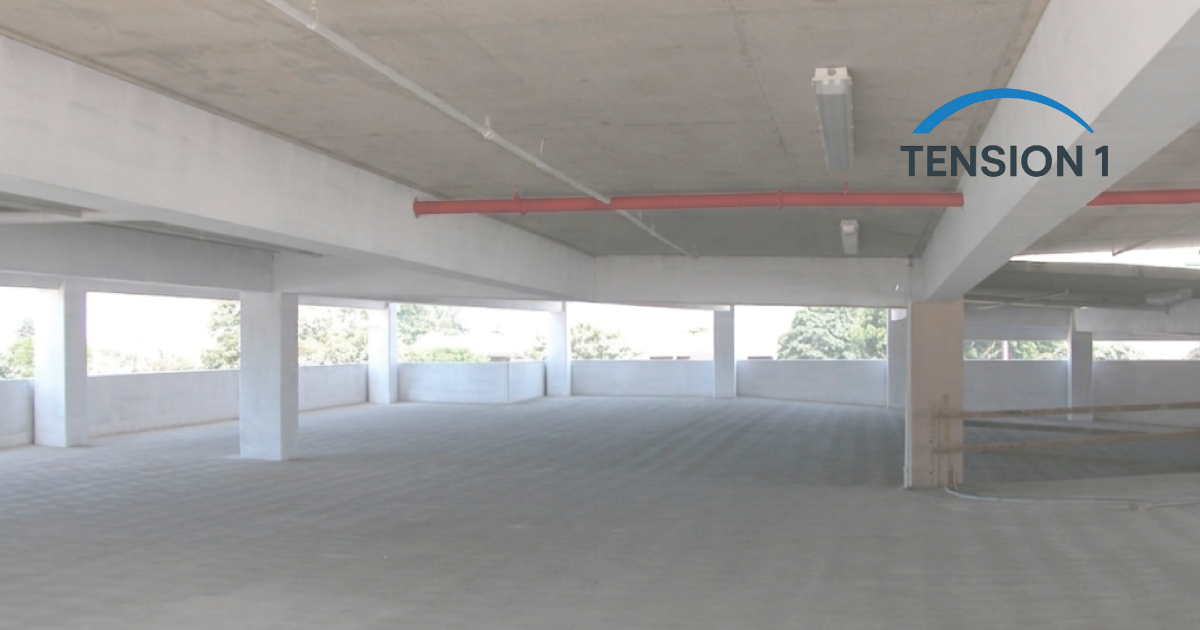
Every parking garage project begins the same way: the owner wants more floors, the architect wants clear height, and the structural engineer is handed a column grid with far too much spanning distance and an aggressive cost target. That is the structural reality of parking garage design, and it is also exactly where a post tension slab system earns its keep.
Parking structure designs in Texas, the most common structural complaint is dead load accumulation from deep conventional reinforced concrete slabs. A 14 in flat slab at every level adds up fast, sacrificing clear height, increasing column and foundation loads, and driving material costs in a direction nobody wants. The financial consequences are real: when you reduce usable clear height below ramp and parking aisle requirements, you trigger redesigns, add structural steel, or eliminate an entire level from the program.
A post tension slab solves that problem structurally, not architecturally. In this article, we walk through how PT slab systems work in parking garage applications, how to quantify the ROI, and what on-site conditions determine whether the system delivers on its promise. For a broader structural comparison, see our article on when PT wins the structural battle against reinforced concrete.
Why Parking Garages Are the Natural Application for PT Slabs
Parking structures push conventional reinforced concrete to its economic and structural limits. Long clear spans, repetitive bay layouts, vehicle live loads, and exposure to thermal cycling and chloride intrusion from deicers create a demanding set of conditions. Conventional RC slabs respond with depth, which costs money at every level of the structure.
Post-tensioned flat plate or flat slab systems are designed precisely for this scenario. The prestress force introduced through unbonded monostrand tendons allows the slab to carry the same loading at significantly less depth. According to the Post-Tensioning Institute (PTI DC80.3), unbonded monostrand systems are the dominant PT application in North American building structures, and parking garages represent one of their strongest use cases.
The Span-to-Depth Advantage
In a conventional RC flat slab designed for parking loads (typically 40 psf live load per ASCE 7 for standard parking, plus self-weight), bay spans above 35 ft require slab depths that become economically prohibitive. A 40 ft span RC flat plate can easily demand 14 in to 16 in of slab depth to satisfy ACI 318 deflection and shear requirements.
With a properly profiled post tension slab, the same 40 ft bay can be carried with a 7.5 in to 8.5 in flat plate, and spans up to 60 ft to 65 ft become structurally and economically viable. That is not theoretical: we have designed and reviewed PT parking slabs in this range, and the depth reduction is consistent when the tendon profile is optimized and the balanced load ratio is kept between 60% and 80% of the slab self-weight.
Clear Height: The Hidden Value Driver
In a five-level parking structure with a PT slab saving 6 in of depth per floor, the cumulative gain is 30 in of vertical building height that can be redistributed. That translates to either a reduced overall structure height (lower facade and ramp costs), a gained partial level, or improved clear height compliance in jurisdictions with minimum 7 ft 0 in requirements for accessible routes per IBC.
The owners who understand this figure immediately recognize the ROI. The ones who do not are often the same clients who specify conventional RC without running a structural cost model across all five levels.
How a Post Tension Slab Works in a Parking Structure: Methodology
We evaluated slab designs for parking garages by running full ACI 318-19 serviceability and strength calculations, including two-way shear (punching), flexural capacity, and long-term deflection under sustained load. Our basis for tendon layout and balanced load calculations follows ACI 318 Chapter 8 and is cross-referenced against PTI DC80.3.3 for unbonded systems.
The Monostrand System
Virtually all post-tensioned parking slabs in the U.S. use unbonded monostrand tendons, a system in which a single 0.5 in or 0.6 in diameter seven-wire strand is individually greased and sheathed in an HDPE duct. The strand is anchored at one end (dead end) and stressed from the other (live end) using a hydraulic jack after the concrete reaches the minimum transfer strength, typically 3,000 psi as specified per ACI 318 Section 26.10. For a deeper technical overview of what the system involves from a design standpoint, our article on calculating the ROI of post tension slabs on materials and formwork provides a direct cost breakdown.
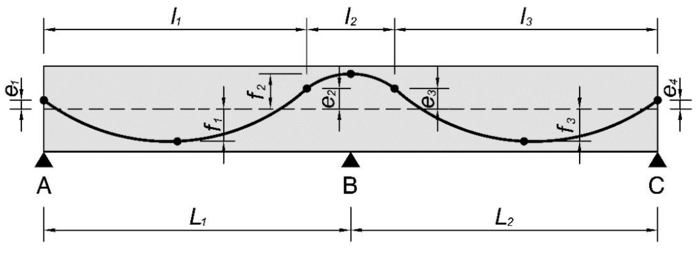
The tendon profile is parabolic within each span, with the strand draping low at midspan and rising toward the supports. This profile geometry generates an upward balanced load on the slab, counteracting a portion of the gravity loading before any mild steel reinforcement is engaged. The ratio of balanced load to total dead load is a primary design variable and directly controls slab behavior under service conditions.
Punching Shear Considerations
One area where post-tensioning provides a measurable structural benefit in parking garages is two-way shear (punching) at column heads. The in-plane compressive stress introduced by the PT tendons enhances the punching shear capacity of the critical perimeter per ACI 318 Section 22.6.5.5. In flat plate parking structures without drop panels or shear caps, this enhancement can eliminate the need for shear reinforcement at interior columns for moderate column loads, reducing both detailing complexity and pour time.
Quantifying the ROI: Where PT Parking Slabs Win Financially
The financial case for post-tensioning in parking structures is well-established, but the numbers need to be project-specific to be credible. We have summarized the key cost and performance metrics in the table below. For a head-to-head construction cost analysis, see our article PT vs. Rebar: a detailed cost and performance analysis for commercial builders.
PT vs. Conventional RC Slab: Parking Garage Performance Parameters
| Structural Parameter | Post-Tensioned Slab | Conventional RC Slab |
|---|---|---|
| Typical Bay Span | 60 ft to 70 ft | 30 ft to 40 ft |
| Slab Depth (flat plate) | 7 in to 9 in | 12 in to 16 in |
| Concrete Volume (per sq ft) | ~15% to 20% less | Baseline |
| Rebar (mild steel) | Reduced to min. per ACI 318 | Full design reinforcement |
| Formwork Duration | Shorter shoring cycle | Full curing period required |
| Building Clear Height Gain | 10 in to 14 in per floor | None |
| Typical Slab Weight (psf) | Lower self-weight | Higher self-weight |
| Long-term Deflection Control | Superior (prestress camber) | Dependent on rebar/depth |
Schedule Compression
In experience, the formwork and shoring cycle for a PT parking slab runs significantly shorter than a comparable RC slab. The stressing operation typically occurs at 3 to 5 days after pour, after which the PT slab can accept construction loads on a reduced shoring scheme. A conventional RC slab must achieve a higher percentage of 28-day strength before reshoring and form stripping are permitted. On a five-level structure, that cycle difference can represent 2 to 4 weeks of schedule savings.
Foundation and Column Load Reduction
A lighter slab means lighter columns, lighter foundations, and potentially reduced pile counts in Dallas-area projects with expansive clay soils. This downstream structural benefit is frequently overlooked in the initial cost comparison between PT and conventional RC. On Texas project, the reduction in column tributary dead load can allowed a downsizing of the drilled pier design by one diameter increment, which represented a measurable direct cost reduction.
Durability and Lifespan Considerations for PT Parking Slabs
Post tension slab lifespan in parking structures is a legitimate concern given the chloride exposure from vehicle traffic and deicing salts. Unbonded monostrand systems are susceptible to corrosion if the HDPE sheathing is compromised at any point during installation or if the anchorage pocket grout is inadequate. ACI 318-19 Table 20.6.1.3.1 provides minimum concrete cover requirements for PT systems in corrosive environments, and we recommend treating most parking garage decks as Exposure Class W2 or C1 at minimum. For a broader comparison of how PT performs against conventional rebar reinforcing in residential and commercial applications, see our article on post tension vs. rebar for residential construction.
The good news is that with correct installation and a quality corrosion inhibitor in the grease fill, unbonded monostrand systems in parking structures routinely perform for 40 to 60 years without major tendon intervention. The critical maintenance item is the anchorage pocket: if the pocket grout cracks and allows water infiltration, the live-end anchor and the first 12 in of strand are at risk. A periodic inspection program targeting visible pocket locations on the slab perimeter is a low-cost investment compared to tendon repair.
For a full structural and financial comparison between PT and conventional reinforced concrete, see our pillar article on Post-Tension vs. Reinforced Concrete: When Does PT Win the Structural Battle.
Frequently Asked Questions
What is the typical span-to-depth ratio for a post tension slab in a parking garage?
For flat plate PT slabs under standard parking loads (40 psf live per ASCE 7), a span-to-depth ratio of 40:1 to 45:1 is commonly achievable. At a 60 ft bay, that corresponds to a slab depth in the range of 7.5 in to 9 in. The exact value depends on the balanced load ratio, column geometry, and whether drop caps or beams are used at column lines.
How does a monostrand post tension system work?
A monostrand system uses individual 0.5 in or 0.6 in seven-wire strands, each greased and encased in a continuous HDPE sheath. The tendons are placed at a parabolic profile in the formwork, with the low point at midspan and high points near supports. After the concrete reaches transfer strength (typically 3,000 psi), a hydraulic jack stresses each strand to the design jacking force (commonly around 33 kip per 0.5 in strand), and the live-end anchor is locked off. The strand remains in permanent compression, counteracting a portion of the slab's gravity loads. See the Post-Tensioning Institute (PTI) for technical specifications on unbonded monostrand systems.
Are post tension slabs more expensive than conventional reinforced concrete in parking garages?
The installed PT subcontract cost is higher per square foot than placing mild steel alone. However, the net cost comparison shifts in PT's favor when you account for the reduced slab depth (less concrete volume), shorter formwork cycles, reduced column and foundation loads, and the structural value of the additional clear height per floor. Most cost analyses we have reviewed show PT is cost-competitive or favorable in parking structures with bay spans above 35 ft.
What is the expected lifespan of a post tension slab in a parking structure?
With proper installation, corrosion protection at the anchorage, and routine inspection of pocket grouting, unbonded monostrand PT parking slabs routinely achieve 40 to 60 years of service life. The dominant failure mechanism is corrosion at compromised anchorage pockets or sheathing damage during construction. ACI 318 and PTI DC10.5 provide the cover and inspection criteria to manage this risk.
What are the main disadvantages of post tension slabs in parking garages?
The primary operational constraints are: (1) stressing schedule dependency, as the PT subcontractor becomes a critical path item; (2) elongation tolerance requirements per PTI DC80.3, which demand qualified inspection; (3) increased permitting documentation in some jurisdictions; and (4) the need for coordinated core drilling restrictions after construction, since tendon locations must be documented and respected in any future slab penetrations.
Work With TensionOne on Your Next Parking Structure
Working on a Parking Structure? Let's Run the Numbers.
At Tension ONE, we prepare complete calculation packages and PT slab drawings for parking structures, podium decks, and commercial slabs across Texas. If you are a contractor, architect, or small engineering firm that needs a deliverable-ready PT slab design, reach out through our freelance services page.
Request a PT Slab Design PackageRelated Articles from TensionOne
TensionOne provides structural engineering support services. All deliverables are prepared for review and use by a licensed Professional Engineer. TensionOne does not provide PE-stamped documents directly.
References: ACI 318-19: Building Code Requirements for Structural Concrete, American Concrete Institute. PTI DC80.3.3: Specification for Unbonded Single Strand Tendons, Post-Tensioning Institute. ASCE 7-22: Minimum Design Loads and Associated Criteria, American Society of Civil Engineers. IBC 2021: International Building Code, International Code Council.
About the Author: Joseph is a Civil Engineer and Founder of TensionOne LLC, specializing in post-tensioned slab design, structural calculations, and tendon layout for projects across Texas and internationally. All content is based on field experience and published engineering standards. No PE-stamped structural guarantees are expressed or implied by this article.