Contractors and project managers ask us the same urgent question about a damaged post tension slab: "What is this going to cost me?" By then they have seen the cracked slab, read the inspection report, and heard the words "severed tendon" from the structural engineer. What they need is not a lecture on PT theory. They need a defensible number they can bring to an owner meeting or a budget conversation, fast.
Post-tension slab repairs are hard to price from generic sources. Most cost references cover concrete repair in general or report national averages, while a PT repair is priced on factors those references do not isolate: the number of tendons affected, access, the finishes to remove and replace, and the regional market in Dallas, Houston or Austin. The interactive estimator on this page is built around those factors, with published references such as RSMeans Building Construction Cost Data and the PTI repair guidance as its framework.
This article explains the method behind the estimator and the cost drivers to understand before committing to a repair scope. It also flags the point where a budget number stops being useful and a licensed engineer needs to take over.
| Damage type | Severity indicator | Typical cost range (DFW) | Urgency |
|---|---|---|---|
| Single tendon snap | Pop sound, floor crack at tendon line | $1,800 to $4,500 per tendon | Moderate |
| Multiple tendon snap | Progressive cracking, slab deflection | $3,500 to $9,000 per tendon | High |
| Active corrosion (anchor tail) | Rust staining, pocket spalling | $400 to $1,200 per pocket | Moderate |
| Full corrosion / tendon loss | Exposed strand, section loss >30% | $5,000 to $14,000 per tendon | Critical |
| Blowout / delamination | Spalled zone, hollow sound on hammer test | $12 to $35 per sq ft affected | Moderate |
| Anchor zone failure | Bearing plate displacement, grout loss | $1,500 to $6,000 per anchor | High |
| Corrosion inhibitor injection | Preventive (no active damage) | $2 to $6 per lin ft of duct | Preventive |
Source: Texas contractor quotes, cross-checked against RSMeans Building Construction Cost Data 2023. Houston and Gulf Coast projects carry an 8 to 12 percent regional adjustment in the estimator for humidity-driven corrosion remediation. These are budgeting ranges, not quotes.
[tool:pt-repair-cost-estimator]
How We Calibrated the Post Tension Slab Repair Cost Ranges
The unit costs are composite figures from three sources, not a contractor survey.
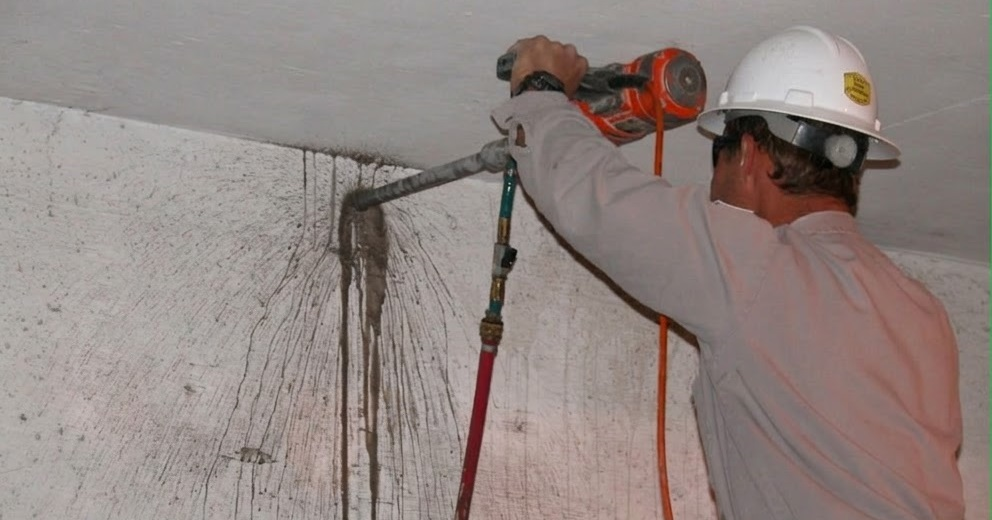
The first is RSMeans unit cost data for concrete repair, adjusted to Texas city cost indexes. Labor is the line that moves most. According to the U.S. Bureau of Labor Statistics (May 2023), cement masons and concrete finishers in the Dallas-Fort Worth-Arlington area earned a mean of $22.86 per hour, across about 6,050 jobs. That is a wage, not a billed rate. Burden, equipment, insurance and the premium for PT-specialty crews all sit on top of it, which is why repair bids look nothing like the wage tables.
The second is scope definition. PTI DC80.4-18, Guide Specification for Unbonded Post-Tensioning Repair, and PTI DC80.3/ICRI 320.6 (2024) provide the procedural backbone for what each repair must include.
The third is the spread between initial estimates and final invoices. On repair work, that spread is driven by what the opening reveals: how many tendons are actually damaged, how far corrosion has traveled, and what has to be removed and replaced to reach them.
The ±15% to ±25% range in the estimator output expresses that spread. It is a planning band, not a quote and not a statistical confidence interval. The estimator also applies a regional multiplier for Houston and Gulf Coast work. In high-humidity coastal environments, corrosion-driven repairs can require more surface preparation of the exposed steel, and more of the damage found on opening can call for complete tendon replacement rather than coupler repair. The repair engineer's on-site assessment decides which applies.
These ranges include surface preparation, corrosion treatment and patching. That is why they sit above the base pocket and tendon replacement figures in our pillar guide to the 5 warning signs your post-tension slab needs immediate expert repair. For a per-area view of the same costs, see the average cost per square foot for post-tension slab repair.
The Four Damage Categories in the Estimator
Tendon Snap
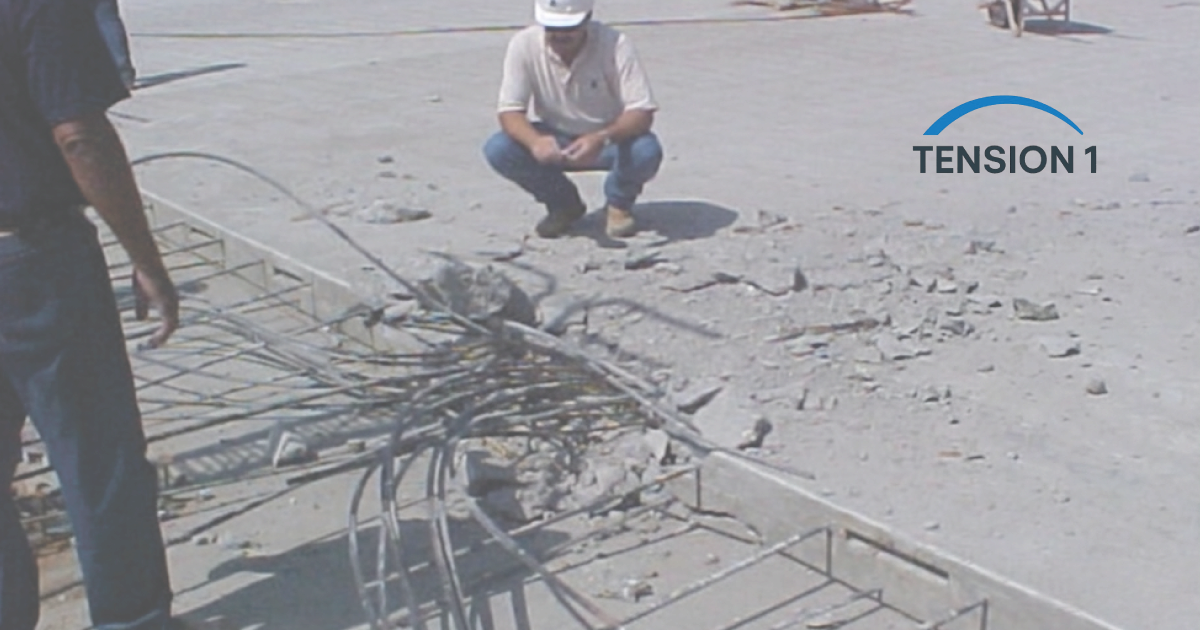
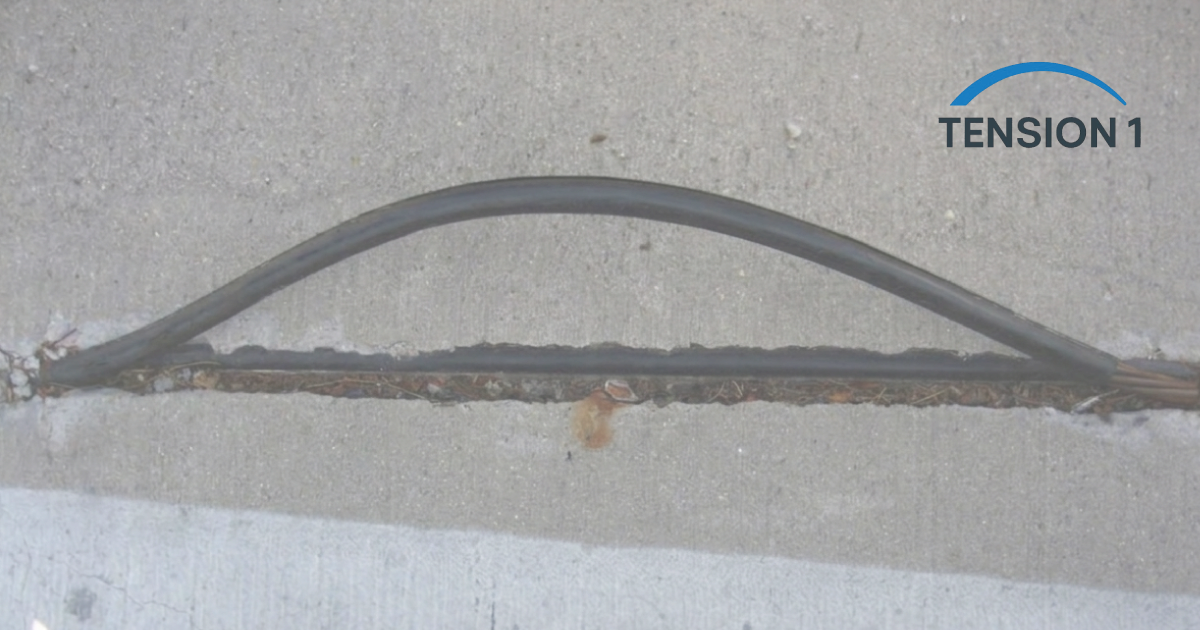
A snapped monostrand tendon is the repair type we handle most often in the field. The failure is abrupt: a loud pop, a crack along the tendon line, and sometimes the strand tail driven out of its pocket. The repair follows a fixed sequence. The break is located and a repair pocket opened. The strand is cut back to sound wire and a coupler or new anchor installed. The segment is restressed where geometry permits, and the concrete is patched.
In a standard North Texas residential slab (8 in. thick, good access, no congested reinforcement), a single snap runs $1,800 to $4,500 per tendon. With multiple failures, mobilization and engineering oversight are shared, but per-tendon labor does not drop in proportion. Multiple failures also typically trigger a structural adequacy review, adding $1,500 to $3,000 depending on scope. The full procedure is in our step-by-step guide to fixing a severed post-tension tendon.
Active Corrosion at Anchor Pockets
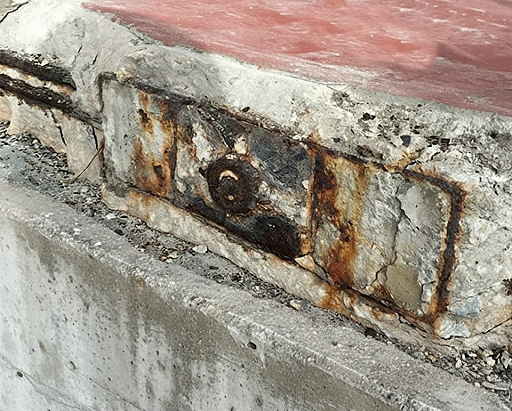
Corrosion in unbonded PT slabs most often starts at the anchorage. It begins where the sheathing ends at the pocket, or at a strand tail left exposed at the slab edge. We have seen anchor pockets on 1980s residential slabs in Dallas where the original grout cap had carbonated through, the steel tail had lost 40–60% cross-section, and the strand was still performing structurally because load redistribution to adjacent tendons had masked the deterioration for years.
Early-stage remediation is straightforward. The pocket is chipped out and the steel cleaned. A corrosion-inhibiting compound goes on, followed by a new encapsulation cap, and the pocket is patched with a compatible repair mortar under the design approach of ACI CODE-562-21. This runs $400 to $1,200 per pocket in Texas. When section loss reaches the strand itself, the engineer decides whether the anchor can be repaired in place or the tendon must be replaced.
Blowout and Delamination
A blowout is the sudden release of a snapped strand into the cover concrete. Delamination is the slow version: corrosion products expand and split the cover away from the slab, leaving a hollow zone you can find with a hammer tap. Both are concrete removal and replacement jobs around live tendons. The cost driver is not material. It is the careful edge preparation that keeps the chipping from damaging adjacent strands.
We have found that hydrodemolition is worth the equipment mobilization cost on jobs over roughly 80 sq ft of affected area, because it eliminates the impact risk to adjacent tendons entirely. For Texas jobs, blowout and delamination repairs run $12 to $35 per sq ft of affected area.
Anchor Zone Failure
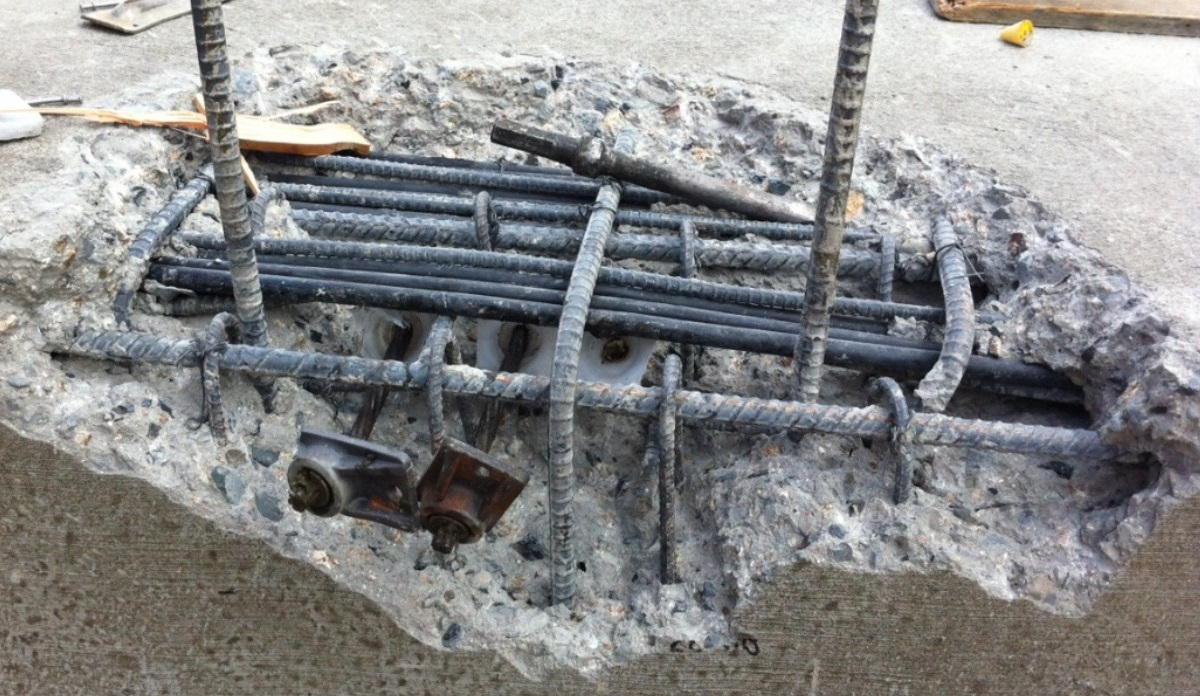
This is the most structurally significant category. The bearing plate has shifted, the pocket has disintegrated, or the concrete behind the plate has crushed under the tendon force. These repairs are expensive because they usually require shoring the panel first, and because the reconstruction happens while surrounding tendons stay live.
Carbon fiber reinforced polymer (CFRP) confinement of the rebuilt anchor zone, designed per ACI 440.2R-17, can restore local bearing capacity without removing the full concrete volume. We have used this approach on post-tensioned transfer slabs in multi-family construction in Austin where access constraints made conventional reconstruction impractical. CFRP adds cost (roughly $800 to $1,500 per anchor in materials and installation), but it can reduce the overall project timeline significantly.
What Drives Cost Up and What Keeps It Down
What Worked On-Site
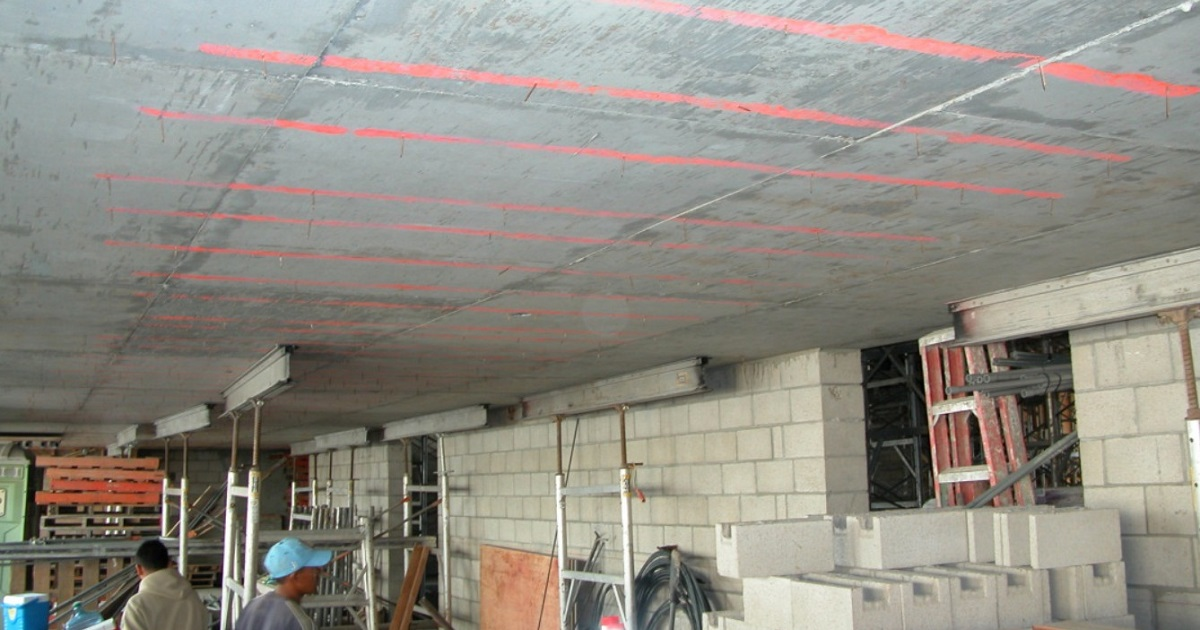
On a repair project involving four snapped tendons in a DFW commercial slab, pre-locating all tendon runs using GPR scanning before any concrete cutting reduced the total project cost by approximately $4,200 compared to an initial scope that had assumed two additional tendons would need to be cut back. The GPR scan cost $900. That is the clearest return-on-investigation number we have documented.
Bundling corrosion remediation with tendon snap repair on the same mobilization consistently reduces unit costs. When we have multiple damage types on a single slab, running them as one subcontractor visit versus two separate calls typically saves $1,200 to $2,500 in mobilization alone.
What Did Not Work On-Site
Generic concrete patching contractors without PT-specific experience tend to underestimate the saw-cut and core clearance requirements around live tendons. On one Austin project, a repair contractor unaware of the clearance required around live tendons cut into a live tendon while preparing the patch perimeter, converting a $3,800 repair into a $9,200 emergency replacement.
Self-consolidating grout products not formulated for restrained conditions can develop shrinkage cracks within 30 days of placement in Texas summer conditions. Specifying a non-shrink grout meeting ASTM C1107 Grade C is a non-negotiable line item on every repair specification we produce.
When the Estimator Stops Being Useful
The estimator is built for budgeting and early scope framing. It is not a structural assessment. Three conditions mean you should put it aside and call a licensed professional engineer:
- More than three tendon failures in one slab panel: the redistribution of force needs a structural analysis, not a cost estimate.
- Corrosion beyond the anchor: rust on the sheathing or on strand between anchors means the tendon's remaining capacity is unknown until tested or replaced.
- Deflection or cracking that does not fit shrinkage or temperature: something larger than a local repair may be at work.
In those situations, the most expensive move is to proceed without an engineer. The second most expensive is to wait. If a tendon was just cut, follow the emergency protocol for a cut post-tension tendon before thinking about cost. Many of the scopes in this estimator start as small defects that an inspection would have caught. Our article on whether post-tension slabs require regular professional inspection covers how often to look.
Repair Drawings and Calculations for Your PT Repair Project
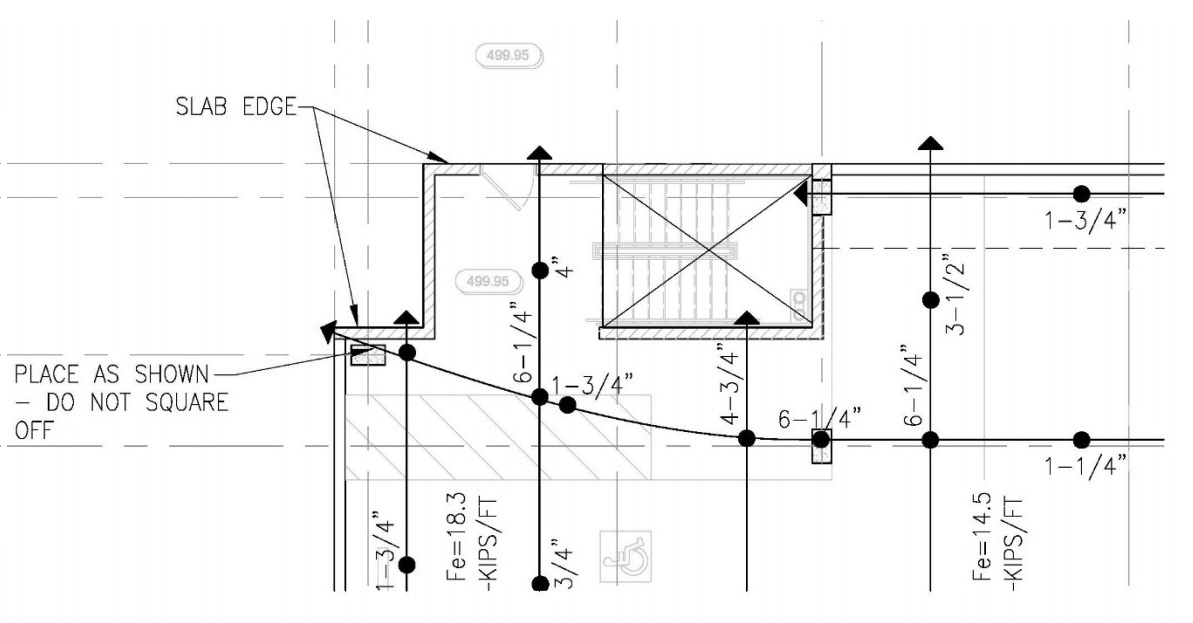
Once you are past budgeting, the repair needs documentation the engineer of record can review and seal. That covers repair drawings, calculation notes and the stressing records. Through our post-tension slab design, optimization and diagnostics services, we prepare that documentation for contractors, project managers and small engineering firms who need a PT specialist without the overhead of a large consultancy. Sealing and approval remain with the licensed engineer on the project.
All cost figures in this article are budgeting estimates from contractor quotes, cross-checked against RSMeans data. They are not quotes. This article is not a PE-stamped structural opinion or a guarantee of any kind.
References: ACI CODE-562-21, Assessment, Repair, and Rehabilitation of Existing Concrete Structures, American Concrete Institute. ACI 440.2R-17, Guide for the Design and Construction of Externally Bonded FRP Systems for Strengthening Concrete Structures. PTI DC80.3/ICRI 320.6 (2024), Guide for Evaluation and Repair of Unbonded Post-Tensioned Concrete Structures. PTI DC80.4-18, Guide Specification for Unbonded Post-Tensioning Repair. SSPC-SP 6/NACE No. 3, Commercial Blast Cleaning, AMPP. ASTM C1107, Standard Specification for Packaged Dry, Hydraulic-Cement Grout (Nonshrink). U.S. Bureau of Labor Statistics, Occupational Employment and Wages, May 2023, SOC 47-2051.