
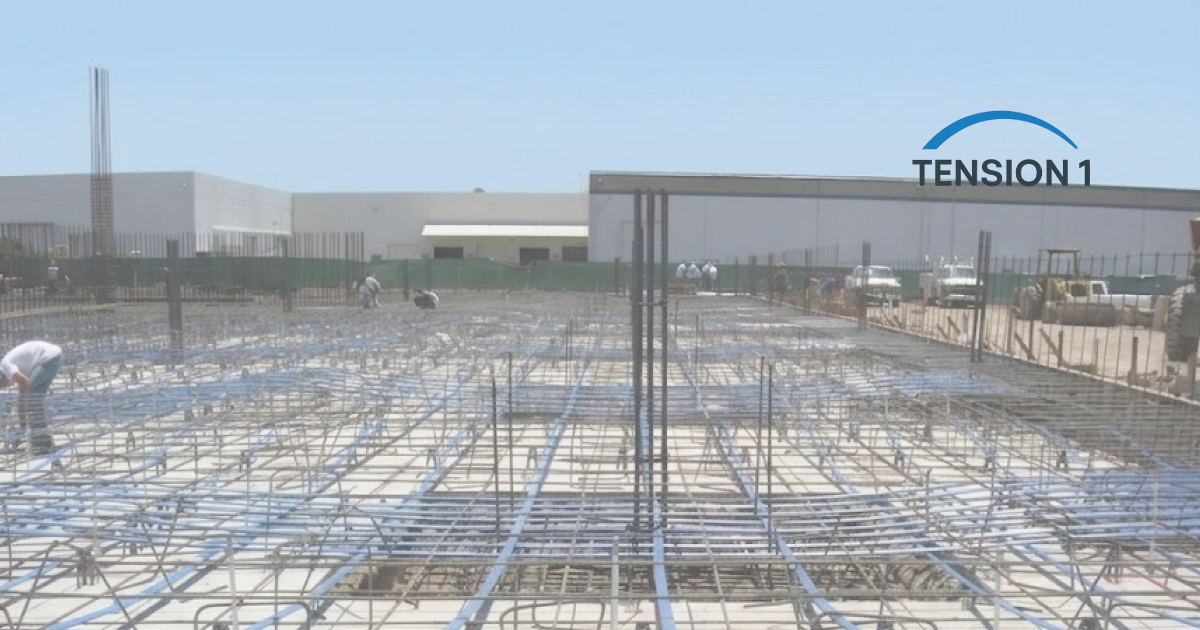
Every structural engineer who works with architects on commercial or mixed-use projects in Texas has heard the same request: extend the overhang, eliminate that column, open the facade. The first structural response is almost always deeper reinforced concrete or heavier steel. Both answers carry the same set of consequences: greater floor-to-floor heights, increased gravity loads on the foundation, and a project budget that starts to unravel at the structural line items. This is precisely where the post tension slab offers a solution that goes beyond incremental improvement.
Excessive section depth and uncontrolled deflection are not theoretical problems. Consider a common scenario for mixed-use construction in the Dallas market: an architect proposes a 26 ft cantilever at the podium level. Running the calculation with a conventional reinforced concrete beam, the required section depth can exceed 28 in — eliminating the mechanical plenum and the floor-to-ceiling height on the level below in a single design decision. In that kind of situation, the financial consequence is the loss of a complete rentable level due to overall building height restrictions on the site.
Recalculating the same geometry with an unbonded PT flat plate and a draped tendon profile, slab depth drops to approximately 9.5 in, the cantilever clears 26 ft cleanly, and the project moves forward. This article breaks down the structural logic behind that result, documents what works and what consistently fails in PT cantilever execution based on field observations from the Texas construction market, and provides a direct comparison between post-tensioned and reinforced concrete systems for long-overhang applications.
The Structural Case for Post-Tensioned Cantilevers
How PT Changes the Mechanics of a Cantilever
A cantilever is fixed at one end and free at the other. The fixed end carries the full negative moment — and in a reinforced concrete section, that is the governing demand that drives both slab thickness and top-steel congestion. In conventional RC design, the engineer has two variables: section depth and reinforcement ratio. The section must grow deeper as the span increases, and there is no mechanism to reduce the net demand before the concrete cracks.
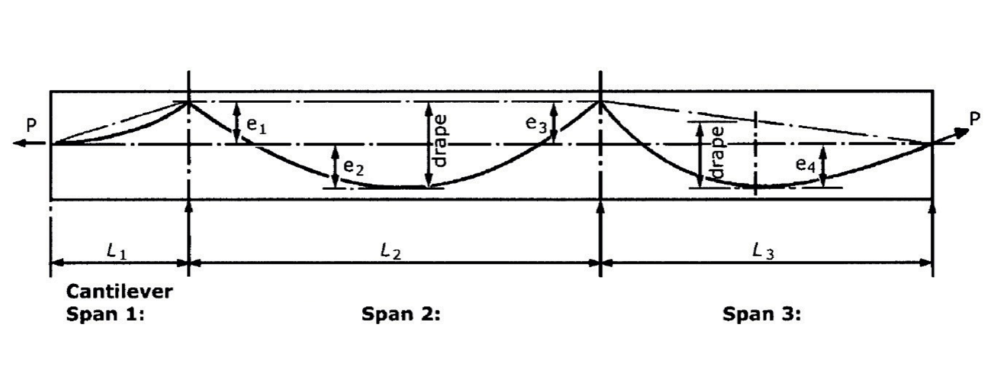
Post-tensioning introduces a third variable: an active compressive force applied along a deliberately profiled tendon. At the cantilever zone, the tendon is positioned near the top of the slab and follows a reverse-parabolic drape. The eccentricity between the tendon and the section centroid generates an upward equivalent load that partially counteracts the dead load and reduces the net negative moment demand at the root. Based on the load-balancing methodology per ACI 318-19 Section 26.10, a properly proportioned tendon profile can balance 60 to 80% of the slab self-weight in the cantilever zone — leaving a substantially reduced residual demand for passive reinforcement to handle.
For example, on a 26 ft post-tensioned cantilever slab with a 9.5 in thickness and 0.5 in diameter unbonded monostrand at 4 ft-6 in on center, the calculated reduction in governing root moment compared to a reinforced concrete baseline of the same span can reach 35 to 40%. That reduction in peak demand is what allows the slab section to remain thin, the column layout to remain open, and the architectural program to remain intact.
Span-to-Depth Ratios That PT Makes Achievable
ACI 318-19 Table 8.3.1.1 establishes the baseline for non-prestressed two-way slabs. For post-tensioned flat plates under normal loading conditions, PTI DC80.3-20 references span-to-depth ratios in the range of 40 to 50. For cantilever conditions specifically, those ratios tighten because the free end has no passive restraint and long-term deflection governs serviceability rather than strength.
The controlling serviceability check is long-term deflection under sustained load, calculated per ACI 318-19 Section 24.2.4 using the effective moment of inertia method and the long-term multipliers from ACI 209R. For a typical 26 ft unbonded PT cantilever in a podium application, the calculated tip deflection under sustained dead plus 25% of live load is substantially lower than the equivalent RC section — for example, reducing from approximately 1.3 in to 0.4 in. That margin determines whether an architectural finish tolerance can be met without building compensating camber into the formwork.
Post-Tension vs. Reinforced Concrete for Cantilevers: A Direct Comparison
The table below compares the two structural systems on the parameters that matter most for a cantilever application. The comparison assumes a 26 ft cantilever, a 9 ft typical bay, 100 psf superimposed dead load, and 50 psf live load. The PT option uses 0.5 in diameter Grade 270 unbonded monostrand stressed to 33 kip per strand after concrete reaches 3,500 psi. The RC option uses f'c = 5,000 psi and Grade 60 reinforcing. All checks are governed by ACI 318-19.
| Parameter | Reinforced Concrete | Post-Tensioned Slab |
|---|---|---|
| Practical cantilever span | Up to ~8 ft | 20–35 ft (with proper design) |
| Slab thickness | Thicker — deeper section required | 20–30% thinner |
| Crack control | Passive — rebar reaches yield | Active — compression applied by PT |
| Deflection management | Reactive — post-crack effective inertia | Pre-emptive — camber via tendon profile |
| Self-weight on columns | Higher | Lower (thinner slab) |
| Governing code reference | ACI 318-19 Ch. 8 | ACI 318-19 Ch. 26 / PTI DC80.3-20 |
| Typical Texas market usage | Low-rise residential, short spans | Mid-rise, commercial, podium slabs |
For a broader comparison of structural efficiency and material consumption between the two systems, including embodied carbon implications on Texas job sites, see our article on post tension slab vs reinforced concrete: the embodied carbon comparison that actually matters on site.
Field Observations: What Works and What Does Not in PT Cantilever Execution
The observations below are based on common patterns seen across PT cantilever projects in the Dallas and broader Texas commercial construction market. They reflect the structural decisions and coordination failures that consistently surface between the design phase and the stressing operation.
What Works On-Site
- A draped tendon profile in the cantilever zone produces measurable upward camber that offsets dead load deflection before live load is applied — for example, on a 26 ft cantilever with a 9.5 in slab, calculated tip deflection under sustained load can drop from 1.3 in (RC baseline) to approximately 0.4 in, bringing the section well within ACI 318-19 serviceability limits.
- Eliminating a mid-span column through PT cantilever design can free 1,200 to 1,500 sq ft of leasable floor area per level, depending on the structural grid — a direct financial return that is rarely captured in schematic-phase cost comparisons.
- Thinner slab sections — 9.5 in versus a projected 12–14 in with conventional RC for the same span — reduce gravity load on the lateral system and foundations. For a typical 8-story podium in Dallas, that reduction in floor dead load is not negligible at the foundation level.
- When the stressing operation is executed on a trained crew and elongation records are taken per PTI DC80.3, tendon force can consistently land within +/- 7% of design across all bands — a level of construction quality that is achievable with proper pre-pour inspection and clear shop drawing communication.
What Does Not Work
- A common coordination failure in the Dallas market: a tendon band running within 0.5 in of a large-diameter MEP penetration that was added by the mechanical contractor after tendon shop drawings were issued. For example, on a podium slab project with multiple trades, a late MEP penetration at the cantilever root can force a costly tendon re-profile during construction — a risk that is entirely preventable with a formal BIM coordination round before concrete is placed.
- Forming crews on conventional RC projects regularly underestimate falsework demand under PT cantilever conditions. Because PT cantilevers develop their full structural capacity only after stressing and after concrete reaches the minimum transfer strength, premature shoring removal is a genuine failure risk. A written stripping sequence issued by the engineer of record — specifying minimum f'c at transfer and a defined stressing schedule before shoring can be released — is not optional.
- Edge conditions at the free cantilever tip are routinely under-designed in abbreviated PT flat plate reviews. Torsional demand at the exposed edge, governed by ACI 318-19 Section 22.7, requires closed stirrups or hairpin bars at the perimeter edge beam. This detail is frequently absent on preliminary drawings and surfaces only during permit review — adding both cost and schedule impact when caught late.
The MEP coordination issue described above is not isolated to a single project type. It reflects a systematic gap in how PT tendon shop drawings are distributed in the Texas commercial market, particularly on design-build projects where structural and mechanical drawings are issued on different schedules. This coordination dynamic is discussed further in the context of long-span PT performance in our article on how post-tensioning prevents cracking and deflection in long-span concrete structures.
Critical Design Considerations for PT Cantilever Slabs
Tendon Profiling at the Cantilever Root
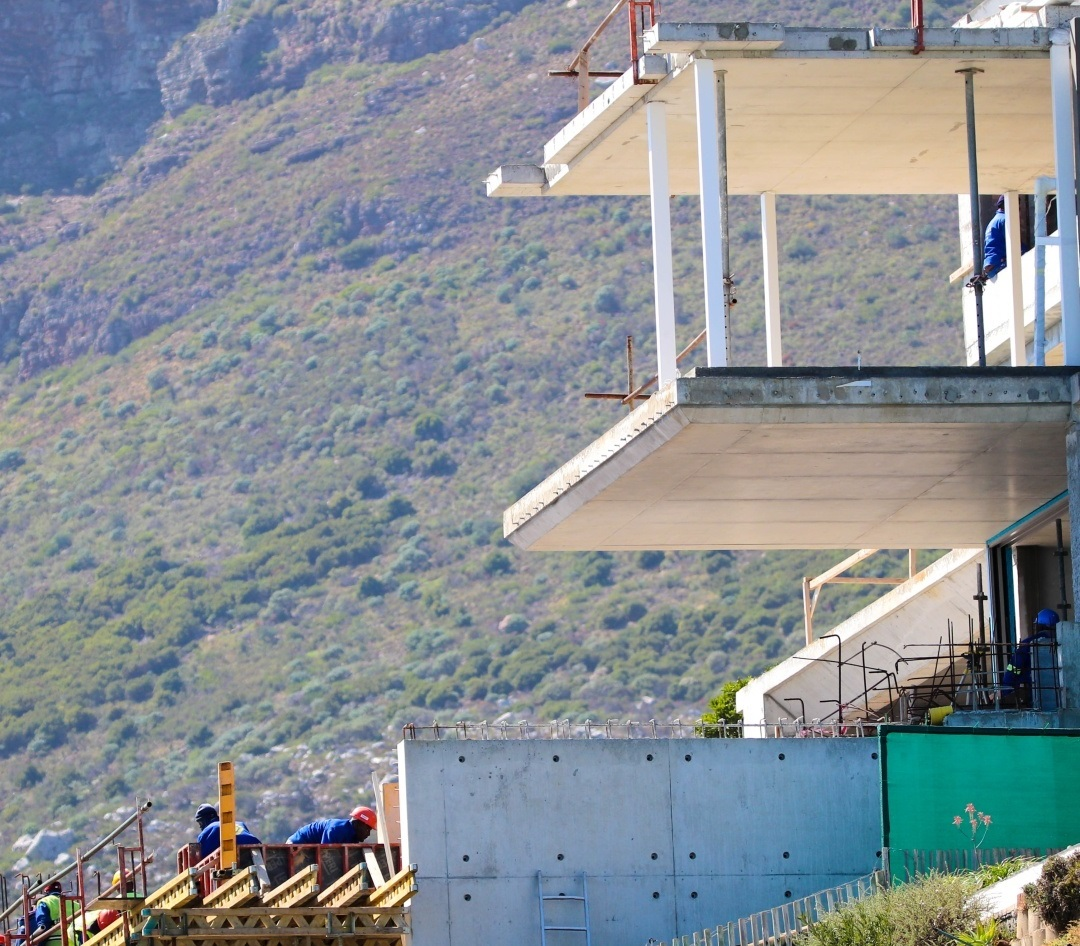
The cantilever root is the most congested zone in the slab cross-section. Top-of-slab mild steel for negative moment resistance shares the same depth as the PT tendons, which must maintain their maximum eccentricity — closest to the top face — to generate the largest counter-moment against the root negative demand. The minimum clear spacing requirements of ACI 318-19 Section 25.8 and the cover requirements of Section 20.6.1, combined with PTI DC80.3 cover provisions, must be checked at every tendon band crossing in this zone.
For example, on a 9.5 in slab with 0.75 in clear cover to the tendon sheath and No. 5 bars at the top face, the available depth for tendon placement can be as narrow as 1.5 in between the tendon centerline and the bar. A tendon-rebar interference check at the cantilever root — produced as a table or section detail in the shop drawing package — is one of the most effective quality-control tools available during the design review phase.
Edge Conditions and Torsional Demand at the Free Tip
The free end of a PT cantilever slab is routinely underdesigned in standard flat plate work. When the cantilever terminates at an exposed edge — a fascia condition typical in podium buildings with curtain wall systems — the slab edge develops a torsional demand from the eccentric gravity load of the cantilevered section. ACI 318-19 Section 22.7 governs torsion design, and closed stirrups or hairpin bars at the perimeter edge beam are generally required to resist that demand.
In architectural applications where the edge beam geometry is minimized for visual reasons, for example to support a glass curtain wall facade, the engineer should model the edge beam explicitly and not treat it as a simple line load on the slab boundary. The torsional stiffness assumption directly affects the distribution of cantilever demand back to the supporting columns, and the difference between a stiff and a flexible edge condition is not negligible in a 26 ft cantilever scenario.
Serviceability: Vibration and Long-Term Creep
Long-span PT cantilevers — particularly in occupancies with hard floor finishes, open plans, and low structural damping — can be susceptible to pedestrian-induced vibration. ACI 318-19 does not prescribe a vibration check directly for slabs, but AISC Design Guide 11 (adapted for concrete) provides a widely accepted methodology for checking natural frequency against serviceability thresholds. For a PT cantilever exceeding approximately 20 ft in a mixed-use or hospitality occupancy, a vibration check should be included in the design scope. It is consistently absent from schematic-phase structural narratives and becomes a cost item when raised by the peer reviewer.
Long-term creep in post-tensioned slabs is more complex than in conventionally reinforced sections because the sustained compressive prestress accelerates creep strain under service conditions. ACI 209R provides the basis for long-term deflection multipliers. On cantilever applications, it is more accurate to apply ACI 209R multipliers explicitly rather than using the simplified factor of 2.0 from ACI 318-19, particularly when the cantilever represents more than 40% of the slab span.
For additional context on how PT manages long-term serviceability in problematic subgrade conditions common in North Texas, see our overview on post-tension foundations and slab movement control in expansive clay soils.
Bonded or Unbonded PT for Cantilever Slabs?
In the Texas building market, unbonded monostrand is the dominant PT system for elevated slabs, and that applies to cantilever applications as well. Bonded systems using grouted metal duct are more common in bridge and heavy civil work. The structural argument for bonded PT in cantilever conditions is that at ultimate flexural strength, the full cross-section acts as a composite unit and the system does not rely solely on the integrity of end anchors. In a bonded system, if one tendon is damaged, adjacent tendons and the grouted duct provide a degree of residual resistance that unbonded systems do not replicate.
That said, the construction complexity and cost premium of bonded post-tensioning rarely justify its use in building slab cantilevers in the Texas market. Unbonded monostrand, properly specified per PTI DC80.3-20, performs reliably in cantilever conditions provided three conditions are met: minimum mild steel supplementing tendon capacity at the root per ACI 318-19 Section 26.8; full corrosion protection of the anchorage assembly (particularly critical at exposed edge conditions and in coastal or high-humidity environments); and a tendon layout that avoids sharp curvature transitions at the root zone, which can cause local stress concentrations in the sheathing.
For a detailed comparison of long-term field performance between bonded and unbonded systems, including the failure modes most commonly seen in the field, see our analysis of bonded vs unbonded post tension slab systems: maintenance, longevity, and what actually fails in the field.
Frequently Asked Questions
How long can a post-tension slab cantilever realistically extend?
For unbonded PT flat plates, cantilever spans in the range of 20 to 35 ft are structurally achievable when tendon profiles, slab thickness, and edge conditions are properly engineered per ACI 318-19 and PTI DC80.3-20. Spans beyond that range require a detailed serviceability study covering vibration, long-term creep, and potential supplemental structural steel at the cantilever root. The span limit is not a fixed number — it depends on tributary load, slab depth, and the accepted deflection tolerance for the architectural finish.
Does a PT cantilever slab require more mild steel reinforcement than a standard PT flat plate?
Yes, but not uniformly distributed across the slab. The cantilever root sees high negative moment demand, so top-of-slab mild steel reinforcement is concentrated in that zone to satisfy the minimum bonded reinforcement requirements of ACI 318-19 Section 26.8. The cantilever tip, by contrast, requires careful attention to torsional and longitudinal edge effects. A secondary reinforcement check at the free edge is always warranted regardless of the PT design — this step is frequently absent in abbreviated plan reviews and becomes a correction item at permit submission.
Is ACI 318-19 sufficient for designing PT cantilever slabs, or is PTI DC80.3 also required?
ACI 318-19 governs the structural design — Chapters 7, 8, and 26 are directly applicable to PT flat plates with cantilever conditions. PTI DC80.3-20 provides specific detailing and specification requirements for unbonded single-strand systems, including minimum cover, anchorage zone requirements, and corrosion protection. For a cantilever application, both documents should be referenced together. Any conflict between their requirements needs to be resolved and documented before issuing construction drawings.
What are the most critical construction risks during a PT cantilever slab pour?
Premature shoring removal is the primary risk. Until tendons are stressed and concrete has reached the minimum transfer strength — typically 75% of the specified f'c or as explicitly stated on the structural drawings — the slab has no PT-derived capacity and relies entirely on falsework for its cantilever load path. The stressing sequence also matters: for example, on a wide-bay cantilever, stressing one tendon band before adjacent bands can introduce unintended in-plane eccentricity. A formal written construction sequence from the engineer of record, covering minimum concrete strength at transfer and stressing order, is not optional on cantilever PT projects.
Can a conventional RC slab be extended with PT to create a new cantilever?
Adding a PT cantilever extension to an existing RC slab is technically feasible, but the connection at the existing slab edge governs the design. The transfer of tendon anchorage forces into the original structure must be fully verified — the existing slab edge was almost certainly not designed for that force. The original rebar layout, concrete strength, and condition of the edge zone all need to be assessed before any extension design is initiated. This type of project requires an independent structural assessment as a prerequisite.
Work with TensionOne on Your Next Cantilever Project
TensionOne prepares complete post-tensioned slab drawing packages and calculation notes for cantilever, flat plate, and podium slab projects. Whether the project is a commercial podium in Dallas, a mixed-use mid-rise in the DFW corridor, or a long-span transfer slab for an architecture firm requiring a specialist, we can step in as a focused technical resource.
Scope typically includes: tendon layout and profile drawings, serviceability and ultimate limit state calculations, stressing schedule, and elongation documentation template. Engage TensionOne on a freelance post-tension slab assignment.
Need Drawings and Calculation Notes for a PT Cantilever Project?
Submit a project inquiry with your slab dimensions, loading requirements, and timeline. We will provide a scope and fee within two business days.
- Tendon layout and profile drawings
- Serviceability & ultimate limit state calculations
- Stressing schedule
- Elongation documentation template
Related Reading on TensionOne
References: ACI 318-19: Building Code Requirements for Structural Concrete, American Concrete Institute. PTI DC80.3-20: Specification for Unbonded Single Strand Tendons, Post-Tensioning Institute. ACI 209R: Guide for Modeling and Calculating Shrinkage and Creep in Hardened Concrete, American Concrete Institute.
About the Author: Joseph is a civil engineer and founder of Tension ONE LLC. With field experience spanning complex PT projects in Africa and Europe, he specializes in PT slab design, serviceability checks, tendon profiling, and on-site stressing coordination for the U.S. construction market, with a focus on Texas.