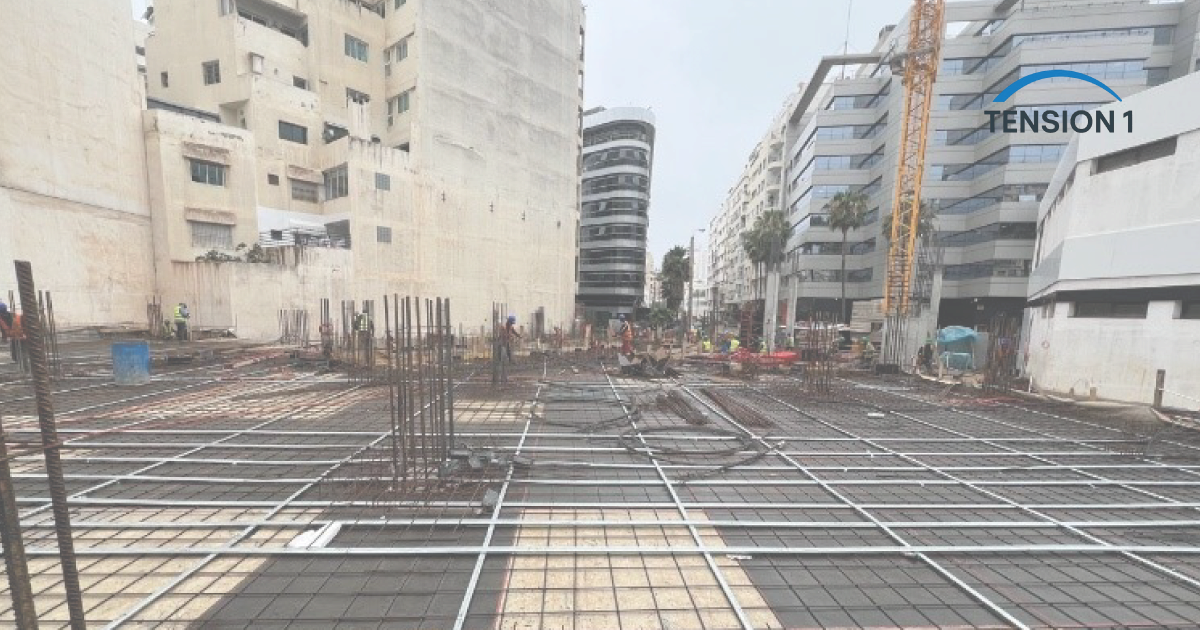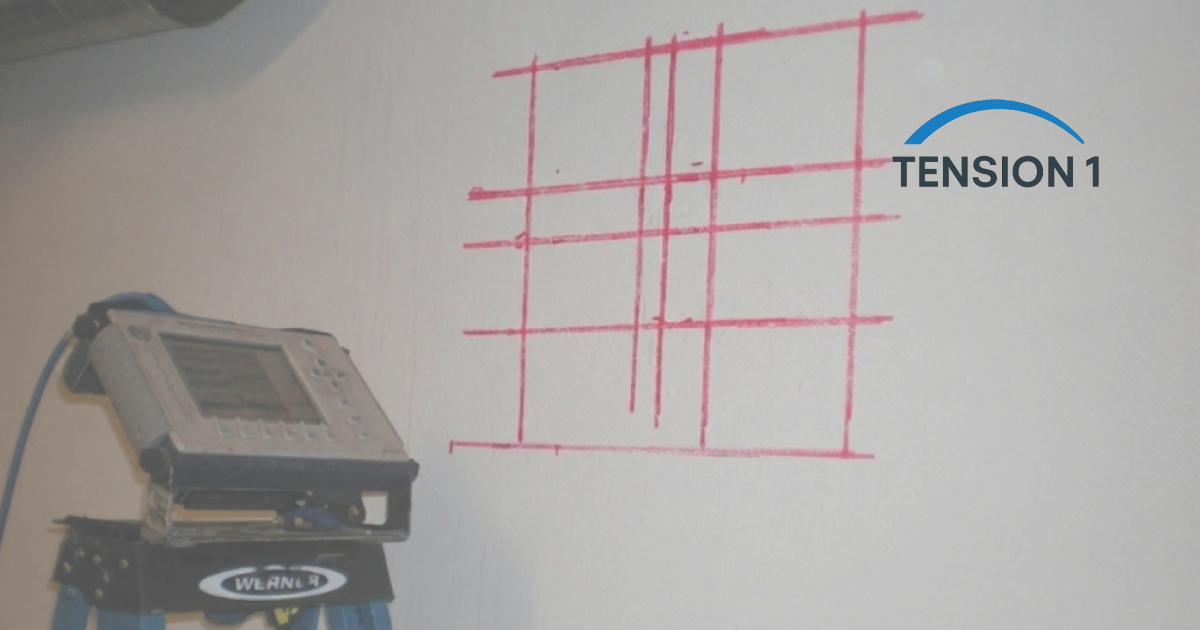
Anchorage placement is one of the most consequential detailing decisions in any post tension slab, and one of the most misunderstood. Badly placed anchors leave uneven precompression, more cracking at service loads and a slower, costlier stressing operation.
The consequences go beyond cosmetic cracks. Overstressed bearing zones lead to edge splitting and blowouts during stressing. On a large commercial pour in the Dallas area, correcting a misplaced pocket layout required partial saw-cutting and re-pouring of the slab edge, which added two weeks to the schedule and new inspections with the engineer of record.
Below: how anchorage position controls a post tension slab from the moment stressing starts, and the layout rules we apply.
What an Anchorage Does Inside a Post Tension Slab
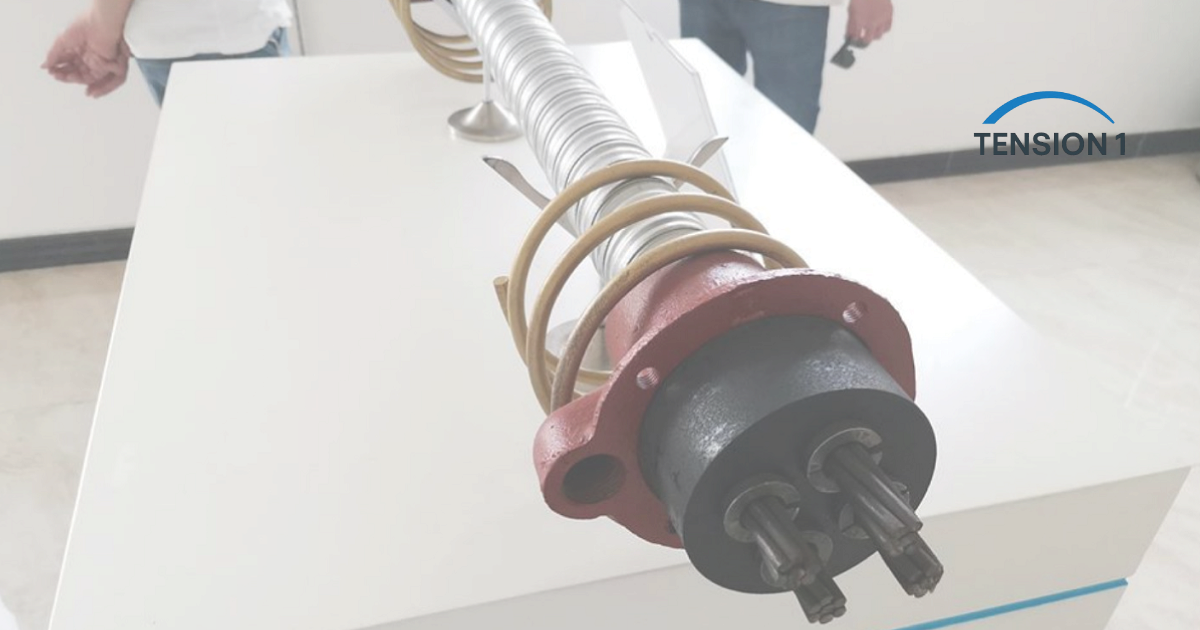
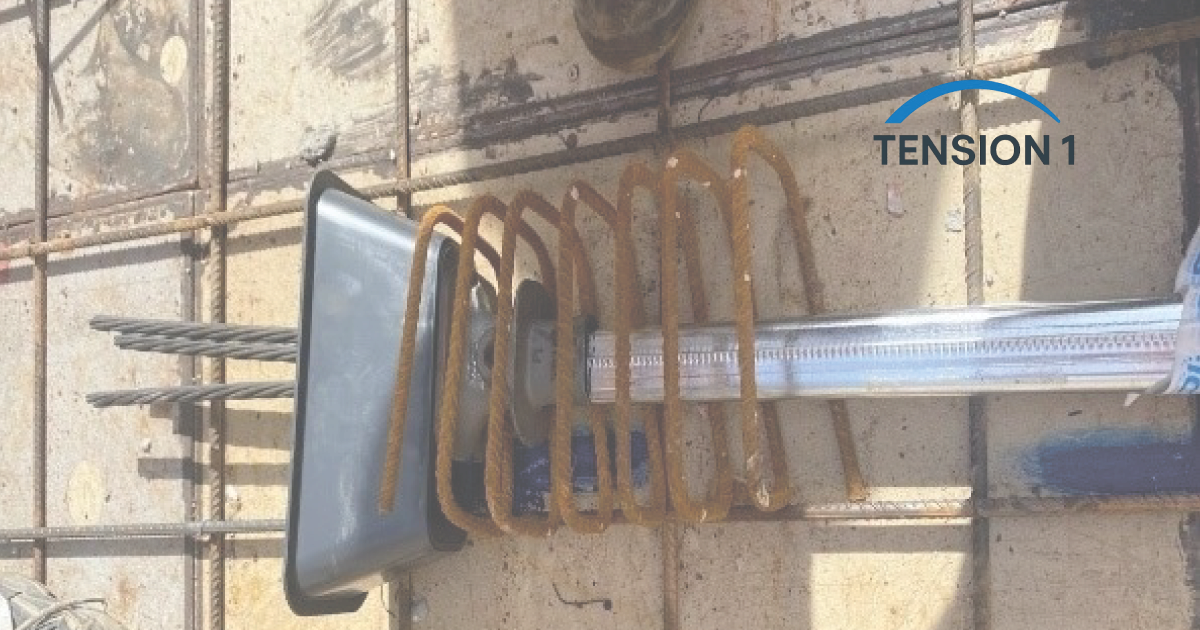
In an unbonded monostrand system, the anchorage is the only mechanical connection between tendon and concrete. A 0.5 in, 270 ksi strand is stressed to about 33 kip at the jack, the limit of 80 percent of tensile strength in ACI 318-19 Table 20.3.2.5.1, and that force passes into the concrete through a small cast anchor. A Portland Cement Association design article (2005) puts a typical monostrand anchor at about 2-1/4 in by 5-1/4 in, so the local stresses are high. It calls for accurate placement, well-consolidated concrete, few nearby penetrations and reinforced anchorage zones.
Behind the anchor, the force fans out over a distance roughly equal to the member depth, and the transverse bursting tension in that region opens splitting cracks if the zone is under-reinforced or anchors are too close. ACI 318-19 treats this as an anchorage zone, with a local zone right behind the plate and a general zone around it; the design basis comes largely from research at the University of Texas at Austin on anchorage zones in post-tensioned members.
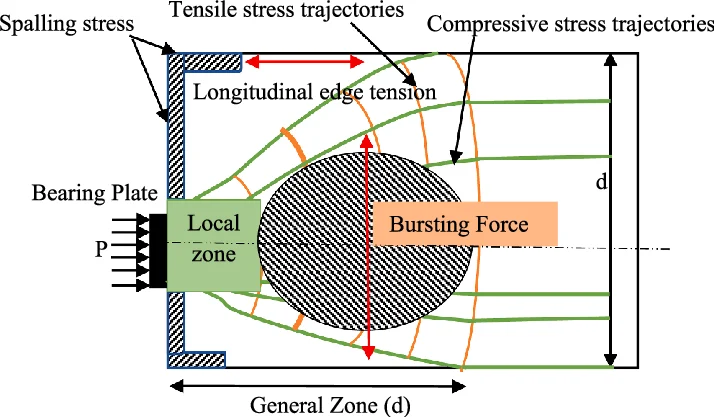
Three things anchorage position controls in a post tension slab
- Live end: the edge concrete takes the full jacking load, often at early age.
- Dead end: anchored at the fabrication plant and cast in. It carries the same tendon force for the life of the slab, so its location matters just as much.
- Profile: anchor elevation is the starting point of the tendon's drape. Shift it, and the balanced load moves with it.
How Anchorage Placement Drives Post Tension Slab Load Distribution
A post tension slab carries load through direct precompression and the upward load of the curved tendon. Both depend on where tendons are anchored and routed.
In two-way flat plates, the common layout bands tendons along the column lines in one direction and distributes them in the other. The PCA article describes it as industry practice under ACI 318: it aligns the prestress with the load path to the columns, and anchor layout must follow it.
Drape and balanced load
For a parabolic profile, the balanced load is w = 8 P a / L squared, where a is the drape. Anchors at slab ends are usually set near the section centroid so they add no moment at the edge, according to the PCA article. Set them at the wrong height and the drape changes.
In a project involving a 7 in PT flat plate with 20 ft bays and 1.5 in cover requirements, shifting the live-end anchorage seat 0.75 in lower than the design elevation reduced the theoretical drape from 3.25 in to 2.5 in. That 23 percent loss of drape meant a 23 percent loss of upward balanced load: the slab was under-balanced against the design without any change in tendon count or spacing.
Column strips and punching shear
ACI 318-19 Section 22.6.5.5 lets the designer count the vertical component of the prestress force, Vp, and the precompression in the two-way shear strength of a prestressed slab. That benefit depends on tendons actually passing through the critical section over the column; the PCA article notes ACI requires at least two tendons through that section in each direction. If a misplaced anchor flattens the profile near a column, the Vp contribution disappears, and only shop drawing review will catch it.
Practical Post Tension Slab Anchorage Layout Rules
Edge spacing and jack access
Pockets must give the jack clear access along the whole stressing edge of the post tension slab; anchors too close together slow the cycle and risk poor seating. We use a minimum of 18 in center to center between anchors along a stressing edge as a workable field baseline for standard monostrand. Where banded tendons are tighter over columns, check that the anchorage zone reinforcement accounts for the overlap of adjacent bursting zones.
Stagger live and dead ends
Putting every live end on one edge runs the whole sequence from one location and loads that edge with the bursting demand of every tendon. Alternating live ends between opposite edges spreads the demand and allows split stressing sequences, as long as each side has reached the transfer strength the specification requires before its tendons are stressed.
Check plates against the rebar
Where mild steel runs alongside the tendons, coordinate bearing plates with the rebar before the pour. A plate that lands on a bar intersection needs the bar adjusted before concrete, not after. A pre-pour interference check removes that delay.
What Worked on Site and What to Watch
We reviewed anchorage practices across several post tension slab projects using stressing logs, elongation records and post-stressing crack surveys.
What worked on site
- Coordinating pocket locations with formwork panel joints reduced edge blowouts by removing weak points in the edge board at the bearing zone.
- Pre-marking anchor chair positions on the deck before rebar placement reduced placement errors and conflicts with transverse bars in the column strip.
- Color-coding anchor chairs for live and dead ends sharply reduced orientation errors by ironworkers on large pours where the layout drawing was not at hand.
What to watch
- Setting all anchors at one height regardless of band direction produced different elongation patterns in banded and distributed tendons, which made it hard to separate real losses from profile errors at inspection.
- Grouping dead ends at interior boundaries with no edge access meant grinding out the concrete face to re-stress a tendon whose elongation fell outside tolerance.
- Skipping the plate-rebar interference check in drop cap zones left plates that could not seat flush against the form, and the shimming was not reflected in elevation control.
From Anchors to Stressing Day
Post tension slab anchor layout sets up the stressing operation covered in our contractor's checklist for stressing and grouting procedures and post-tension slab stressing safety protocols. Span and thickness, which fix the drape you are protecting, are in the maximum recommended span for a residential post-tension slab. Anchor zones also set the no-go areas for every later penetration, see how to locate and avoid post-tension cables before drilling and 5 mistakes when cutting into a post-tension slab.
The governing code edition and project documents take precedence over this article, and sealing and approval belong to the licensed engineer of record. Our sourcing rules are in our editorial policy. We prepare tendon layouts, anchor schedules and profile drawings with the anchorage interference check built in, as independent technical support for your engineer of record. See our post-tension slab design, optimization and diagnostics services.