
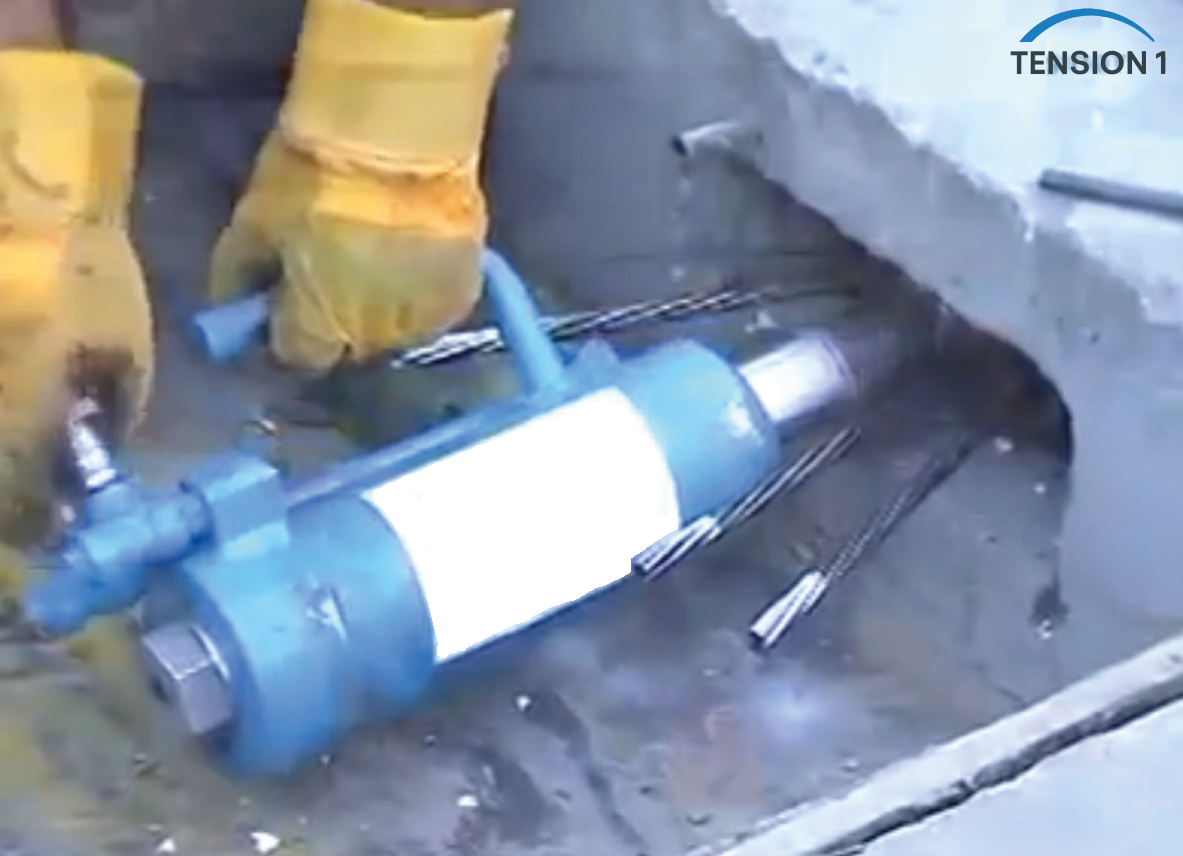
Every post tension slab failure we review traces back to the same root cause: a breakdown somewhere in the stressing or grouting sequence. This field-tested checklist walks you through every critical step, from concrete strength verification to elongation confirmation and grout vent closure, aligned with ACI 318-19 and PTI DC80.3.
1. Introduction: When the Slab Fails, the Checklist Gets Blamed
Every post tension slab we review that has developed premature cracking, excessive deflection, or tendon-related corrosion failures has one thing in common: a breakdown somewhere in the stressing or grouting sequence. The problem is rarely the PT system itself. Unbonded monostrand and grouted bonded post-tensioning are robust, well-engineered systems when installed correctly. The problem is execution, specifically the gap between what the structural drawings specify and what actually happens on the slab the morning the stressing crew arrives.
That gap has real financial consequences. Tendon repairs on a 20,000 sq ft commercial slab in Dallas can run well past $80,000 once you factor in saw-cutting, patching, re-stressing, and construction delays [VERIFY with current local contractor pricing]. Disputes over who missed the elongation check, or who approved grouting before the concrete reached its required transfer strength, can stall a project for months.
We built this checklist from experience coordinating post-tensioning operations on residential foundations, podium decks, and commercial slabs across Texas and beyond. It is structured to give general contractors, structural drafters, and engineering technicians a clear, step-by-step reference that aligns with ACI 318-19, PTI DC80.3, and standard post tension slab installation process requirements.
2. Understanding the Stakes: What Goes Wrong When Stressing Is Rushed
The Most Common Field Failures We Have Seen
Most post-tensioning failures do not announce themselves dramatically at the time of stressing. They appear six to eighteen months after occupancy, often triggered by environmental exposure or loading that the system was never able to resist because the tendons were not properly stressed or protected from the start.
After reviewing as-built PT slabs across the Dallas-Fort Worth area, the following failure modes account for the overwhelming majority of post-installation problems:
- Tendon under-stress: Actual elongation falls short of the design elongation, and nobody documents the discrepancy. The tendon delivers less precompression than calculated, reducing crack control and increasing deflection under service loads.
- Anchorage seating loss not accounted for: On unbonded systems, the wedge seating loss (typically 3/8 in to 1/2 in per live end) must be subtracted from the gross elongation reading to get the net elongation. Crews that skip this step routinely report false compliance.
- Grout voids in bonded systems: Incomplete grouting of the duct leaves steel exposed to moisture and chloride ingress. A void as small as 4 in of ungrouted duct in a wet exposure condition can initiate corrosion within two to three years.
- Stressing before adequate concrete strength: PTI DC80.3 and project specifications typically require a minimum compressive strength (commonly 3,000 psi for initial partial stressing) before any jack load is applied. Stressing into green concrete can cause local crushing at the anchorage bearing plate.
These are not theoretical risks. They are the exact mechanisms we have traced in field investigations. Understanding them reframes stressing and grouting from a routine trade activity into a critical-path structural operation.
3. Pre-Stressing Checklist: What to Verify Before the Jack Touches the Anchor
Concrete Strength Verification
Before any stressing operation begins, confirm that the in-place concrete compressive strength meets the minimum threshold stated in the project specification. This is typically verified using field-cured cylinder breaks tested at a certified laboratory. Do not rely on age alone. A slab poured during a Texas summer heat wave will cure differently than one poured in January.
The required strength at stressing is project-specific, but values of 2,500 psi to 3,500 psi for initial stressing and 4,000 psi to 5,000 psi for final full stressing are common in Texas residential and commercial work [VERIFY against project specification]. Confirm these values on the structural drawings and obtain written documentation of the break results before the crew mobilizes.
Tendon Layout and Specification Verification
Walk the slab and verify the following against the PT shop drawings:
| Item | What to Check | Tolerance |
|---|---|---|
| Tendon spacing | Measured center-to-center, banded and distributed | Per structural drawings |
| Tendon profile height | Chair height at supports and midspan | +/- 3/8 in |
| Live-end pocket location | Accessible, not obstructed by edge forms; confirm orientation | Confirm orientation |
| Dead-end anchor embedment | Fully cast into concrete, tail trimmed per spec | Per PTI DC80.3 |
| Sheathing integrity | No tears, punctures, or exposed strand on unbonded tendons | Zero defects |
Post tension cable specifications for unbonded monostrand in residential and light commercial work in Texas typically follow ASTM A416, Grade 270, Low Relaxation, with a 0.5 in nominal diameter strand. Confirm the material certifications (MTRs) are on file from the PT subcontractor before concrete placement, not after.
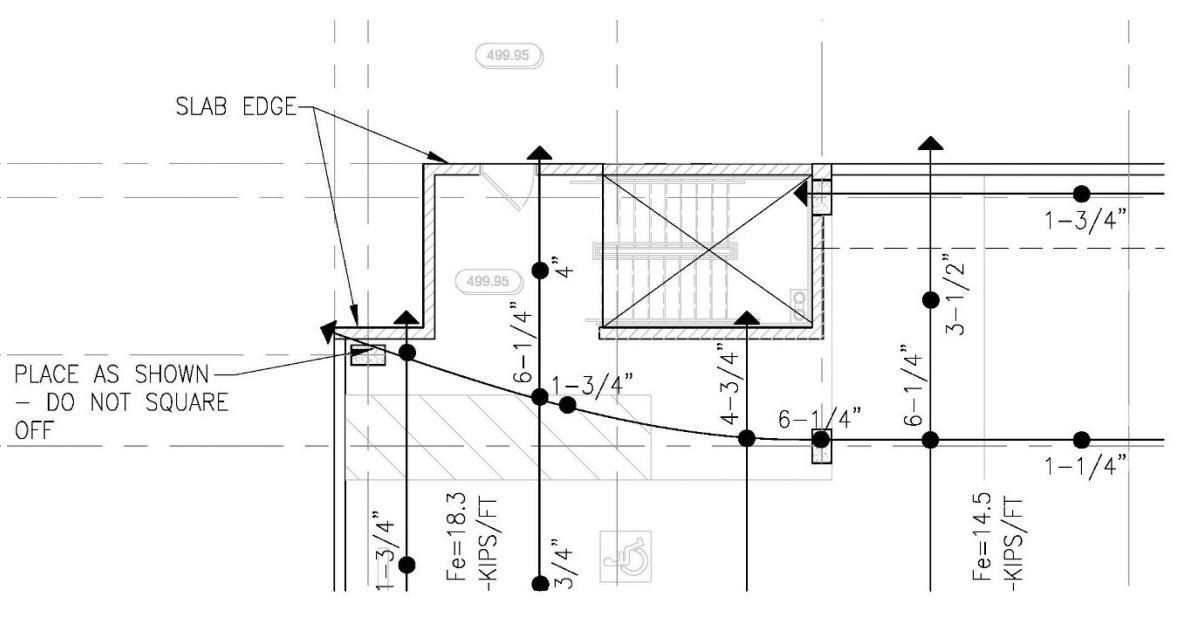
Stressing Equipment Calibration
The hydraulic jack used for stressing must have a current calibration certificate. Calibration should be traceable to a certified load cell and valid within the last twelve months, or less if the jack has been repaired or dropped. We have observed stressing operations where the gauge indicated a 15% higher reading, resulting in every tendon on the floor being under-stressed by that margin. No one caught it because no one asked for the calibration report.
Confirm the following before the jack is deployed:
- Current jack calibration certificate (date and calibrating laboratory on file)
- Gauge pressure corresponding to the design jacking force (calculated from jack area, not estimated)
- Bleed valve functional; jack seals not leaking
- Correct nose piece for the anchor system being used
4. Stressing Procedures: A Step-by-Step Field Protocol
Establish the Stressing Sequence
The structural engineer of record (EOR) or the PT subcontractor's engineer typically specifies a stressing sequence. For slabs with banded tendons in one direction and distributed in the other, the common sequence is to stress the banded direction first, followed by the distributed tendons. Departing from the specified sequence without engineering approval can introduce unintended load imbalances.
Measure and Record the Initial Tendon Length
Before applying any pressure, mark the strand tail at the live-end anchor with a reference line. Measure the exposed tail length from the anchor face. Record this as the initial reading (L1). This baseline measurement is what makes the elongation calculation meaningful.
Apply Load in Increments
Apply the jack pressure in two to three increments, pausing at each stage to verify the strand is moving freely. A sharp increase in pressure without corresponding elongation usually indicates a kink in the tendon profile, a draped chair that has shifted, or a strand that is not properly seated in the wedge. Do not continue stressing through a stuck tendon. Investigate first.
Calculate and Verify Net Elongation
At full jacking force, record the final tail length (L2). The gross elongation equals L2 minus L1. Subtract the seating loss confirmed from the jack calibration data and anchor type to get the net elongation. Compare the net elongation to the theoretical elongation calculated by the PT subcontractor for that specific tendon.
Trim Tails and Patch Pockets
Once elongation is confirmed and accepted, trim the strand tail to the depth required by the specification (typically 1 in to 1.5 in recessed from the slab face). Patch the pocket with non-shrink grout or the mix specified in the drawings. Do not use standard concrete patch mortar unless the specification explicitly allows it.
Process Flowchart
PT Slab Stressing Procedure at a Glance
5. Tendon Elongation Checker
Use this field tool to instantly verify whether a tendon's measured elongation falls within the accepted tolerance. Enter the values from your elongation log and the tool will flag pass or fail against the +/- 7% acceptance window per PTI DC80.3.
Interactive Field Tool
Tendon Elongation Checker
Enter your measured values to verify net elongation compliance. All inputs in inches (in). Results are calculated per the standard formula: Net Elongation = (L2 - L1) - Seating Loss.
Typical: 3/8 in to 1/2 in for unbonded monostrand anchors.
This tool is a field reference aid only. It does not constitute a structural engineering assessment or EOR approval. All elongation discrepancies outside the acceptance window must be reviewed by the licensed engineer of record for the project. Acceptance tolerance may differ from the 7% default; always verify against the project specification.
6. Grouting Procedures for Bonded PT Systems
Bonded post-tensioning, where the strand runs inside a metallic or HDPE duct and is grouted after stressing, is less common in Texas residential construction but is widely used in parking structures, bridges, and transfer slabs. The grouting operation is the single most consequential quality-control activity in a bonded PT system. A tendon that is properly stressed but inadequately grouted will corrode.
What Worked On-Site
- Using a continuous grout pump with a pressure gauge at the injection port: This is the only reliable way to verify that grout is being driven through the duct rather than merely filling a void near the inlet. We specify a minimum outlet pressure of 10 psi [VERIFY] maintained for at least 1 minute at each vent before closure.
- Staging grout from low to high: Gravity matters. Grouting from the lowest point in the tendon profile and venting from high points eliminates air pockets at the peaks of the tendon drape.
- Pre-wetting HDPE ducts: On bonded systems using plastic duct, we dampen the duct interior with clean water immediately before grouting to reduce grout bleed-water absorption.
What Did Not Work
- Batching grout by volume estimates rather than weight: Grout mixed too wet has excessive bleed, which leaves voids as the water evaporates. Grout mixed too dry blocks the pump. We now require water-to-cementitious ratio to be tracked by weight batch on every pour, not estimated by feel.
- Closing vents too early: On a parking structure project, a crew closed the high-point vents the moment grout appeared at the outlet. Subsequent coring revealed voids up to 14 in long at the peak of the drape. Vents must stay open until consistent, lump-free grout flows without interruption for a minimum dwell period per PTI specifications.
Grout mix design should comply with PTI DC10.5 or the project-specific grouting specification. Use only PTI-certified or pre-approved thixotropic PT grout with a maximum water-cementitious ratio of 0.44 [VERIFY against PTI DC10.5].
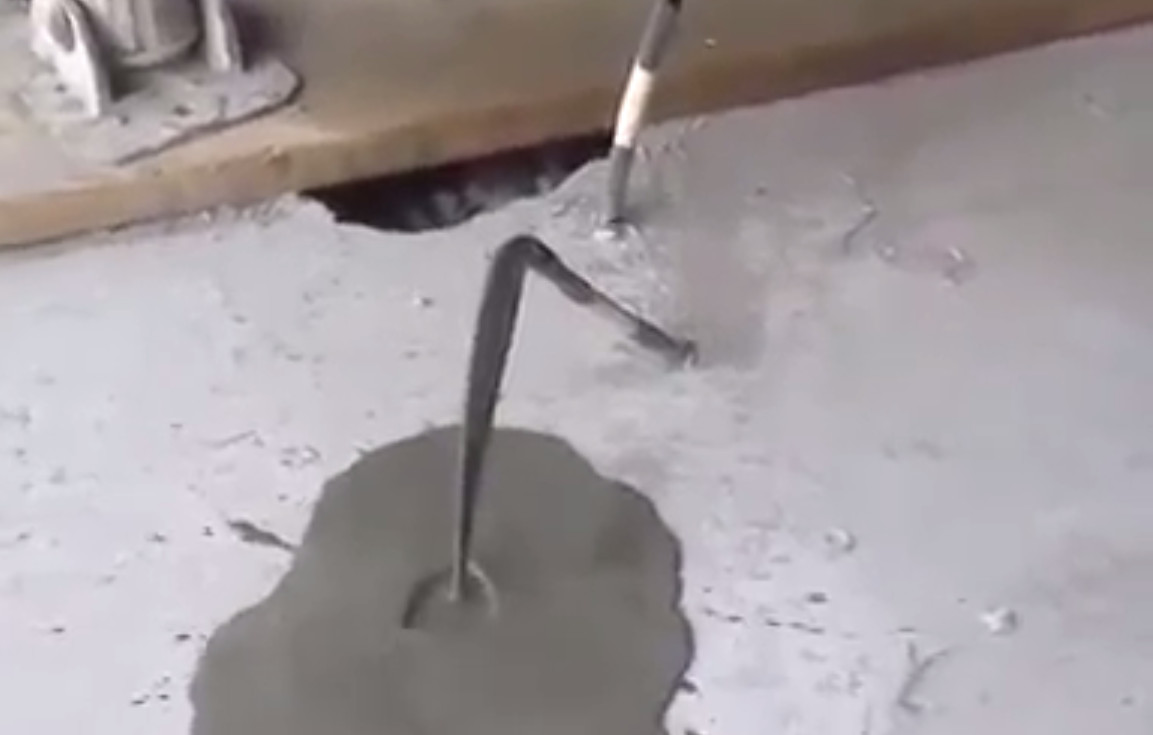
7. Post-Stressing and Post-Grouting Quality Control
Documentation Package
Every PT stressing and grouting operation should generate a traceable documentation package. This package is not optional paperwork. It is your primary defense in any future dispute about slab performance, and it is the minimum standard of care expected on a properly documented post tension slab installation process.
At a minimum, this package must include:
- Concrete cylinder break results confirming transfer strength
- Jack calibration certificate (current)
- Elongation log for every tendon (ID, theoretical elongation, measured elongation, deviation %)
- List of tendons flagged for review and EOR disposition
- Grout batch records (mix design, w/cm ratio, batch time, injection log per duct)
- Photographic record of anchor pockets before patching
Visual Inspection Protocol
Before the slab is released for loading, walk the perimeter and verify:
- All live-end pockets are patched and flush
- No exposed strand tails are protruding beyond the patch
- No grout bleed marks at unintended locations (indicating duct rupture)
- Slab soffit (if visible from below) shows no wet marks or grout bleed-through
Any anomaly observed during this walkthrough should be photographed, logged, and submitted to the EOR for review before the floor is loaded.
8. Frequently Asked Questions
How soon after stressing can we load a post tension slab?
Loading is permitted only after the concrete has reached the full compressive strength specified for final stressing and all elongation values have been confirmed and accepted. The structural drawings will specify the minimum strength for live load application. In practice, this is typically 5,000 psi or the 28-day design strength, whichever governs. Do not allow construction loads such as material stockpiles or equipment on the slab until these conditions are met and the EOR has given written approval.
What causes low elongation readings even when the jack pressure is at the correct level?
Low elongation at correct gauge pressure typically indicates one of three conditions: higher-than-expected friction losses along the tendon profile (caused by profile deviations, chair displacement, or strand kinking); incorrect baseline measurement before stressing began; or a jack calibration error. Each requires a different resolution, and none should be dismissed without EOR review.
Is grouting required for unbonded PT systems?
No. Unbonded monostrand systems rely on the factory-applied corrosion-inhibiting coating and continuous HDPE sheathing for tendon protection. There is no field grouting operation for unbonded systems. Grouting applies exclusively to bonded post-tensioning, where strand runs in open or corrugated duct.
What is the allowable deviation from theoretical elongation before a tendon is rejected?
PTI DC80.3 and most project specifications set this at +/- 7% of the theoretical elongation for individual tendons. Some specifications allow a wider band for very short tendons where friction losses are negligible. Any tendon outside the acceptance window must be documented and reviewed by the EOR. Rejection and re-stressing is possible in some cases; in others, supplementary reinforcement may be required instead.
Can grouting be performed in cold weather?
Yes, but with precautions. Grout placed below 40 deg F will hydrate slowly and may not achieve adequate strength before freezing if ambient temperatures drop. PTI grouting specifications require grout temperature at placement to be between 50 deg F and 90 deg F, and the duct to be above 40 deg F. In Texas, cold-weather grouting is rarely a sustained concern, but winter morning pours in Dallas can require water pre-heating if temperatures drop overnight.
9. Work With TensionOne on Your Next PT Slab Project
Getting the stressing sequence and grouting procedures right is only as reliable as the drawings and calculation notes behind them. If your project needs a complete PT slab package, including tendon layout plans, elongation calculation sheets, stressing records templates, and grouting specifications prepared by a structurally focused engineer with hands-on PT experience in Texas, we can help.
Need PT Slab Drawings and Calculation Notes for Your Project?
At TensionOne, we provide freelance preparation of drawings and calculation notes for post-tensioned slabs, from residential PT foundations in Dallas to commercial podium decks and parking structures statewide. Every deliverable is built on the same field-tested standards reflected in this checklist.
Request a Freelance AssignmentWe review your project scope, confirm deliverables, and provide a clear turnaround timeline. No guesswork, no generic templates.
Services Available to GCs, Architects, and Engineering Firms Across Texas
- PT Slab Drawing Packages : tendon layout plans, profile schedules, stressing calculations, and complete detailing per ACI 318-19
- Elongation Calculation Sheets : pre-formatted logs aligned with PTI DC80.3 for field use and as-built documentation
- Grouting Specifications : project-specific grouting procedures for bonded PT systems, including mix design criteria per PTI DC10.5
- PT Diagnostics and Review : assessment of existing slabs exhibiting cracking, deflection, or suspected tendon distress
- Digital Engineering Tools : calculation spreadsheets and templates for PT slab design and construction verification
External references: ACI 318-19 Building Code Requirements for Structural Concrete is available from the American Concrete Institute. PTI DC80.3 and PTI DC10.5 are available from the Post-Tensioning Institute. ASTM A416 is available from ASTM International. ASCE 7-22 is available from the American Society of Civil Engineers.
This article is intended as a field reference guide and does not constitute a PE-stamped engineering opinion or project-specific structural recommendation. All design decisions should be reviewed and approved by the licensed engineer of record for your project.