
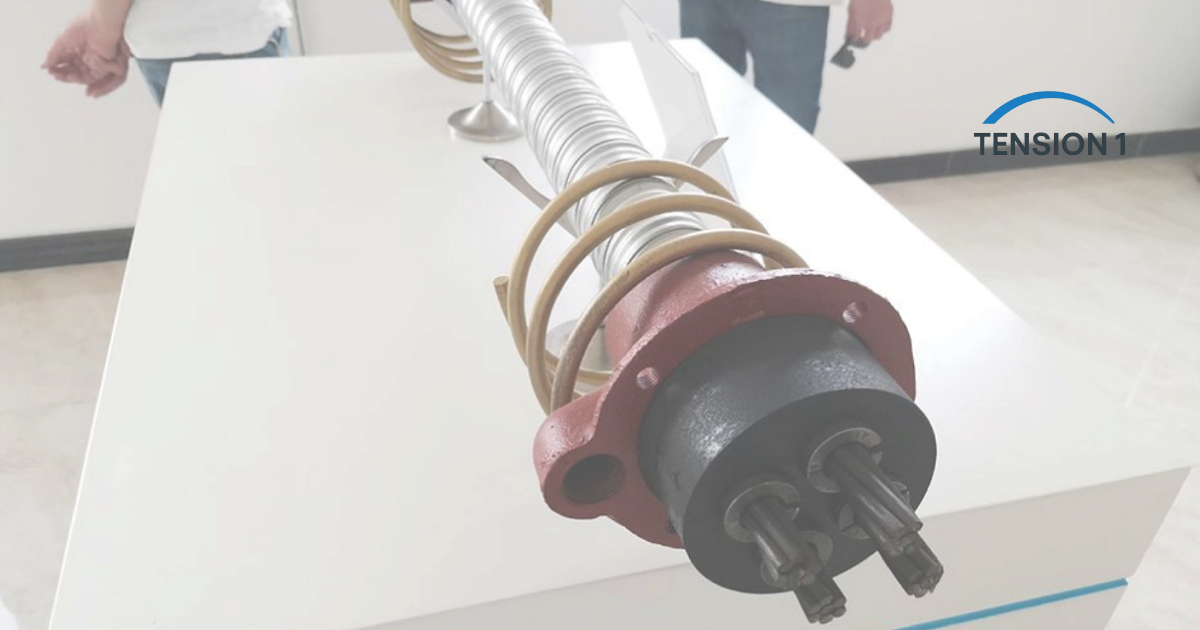
Stressing a post-tension slab is one of the highest-risk field operations in concrete construction. The tendons carry jacking loads that can exceed 33 kip per strand, and a single procedural failure at the live end can result in a brittle, explosive failure with no warning whatsoever.
The consequences go beyond personal injury. An anchor blowout or incorrect elongation can compromise the entire slab panel, triggering re-work costs, schedule delays, and liability exposure that no contractor in Dallas or anywhere else in Texas wants to absorb.
Based on experience in stressing operations on residential and commercial PT slabs, we have seen how a disciplined, step-by-step safety protocol eliminates preventable incidents and keeps a project on track. This article lays out the exact sequence we follow, referenced directly against ACI 318-19 and PTI DC80.3-17 so your crew has a code-backed framework, not just a checklist from someone's memory.
For the full stressing and grouting workflow, including elongation calculation templates and hold-point checklists, see our complete contractor guide: A Contractor's Checklist: Ensuring Proper Stressing and Grouting Procedures for PT Slabs.
How a Post-Tension Slab Works: The Mechanics Behind the Risk
Before addressing safety, it is worth understanding why stressing is inherently hazardous. If you already know how post-tension slabs work, skip ahead to the protocol section below.
A post-tension slab uses high-strength steel strands, typically 0.5-in. diameter, 7-wire strand conforming to ASTM A416 Grade 270, encased in a plastic sheath with corrosion-inhibiting grease. This is what the industry calls an unbonded monostrand system, and it is by far the most common configuration for residential and light commercial slabs in Texas.
The strand runs from a dead-end anchor cast into one edge of the slab, through the slab thickness following a parabolic or harped profile, to a live-end anchor at the opposite edge. After the concrete reaches the specified compressive strength, typically a minimum of 3,000 psi confirmed by cylinder breaks, a hydraulic jack is threaded onto the tail of the strand at the live end.
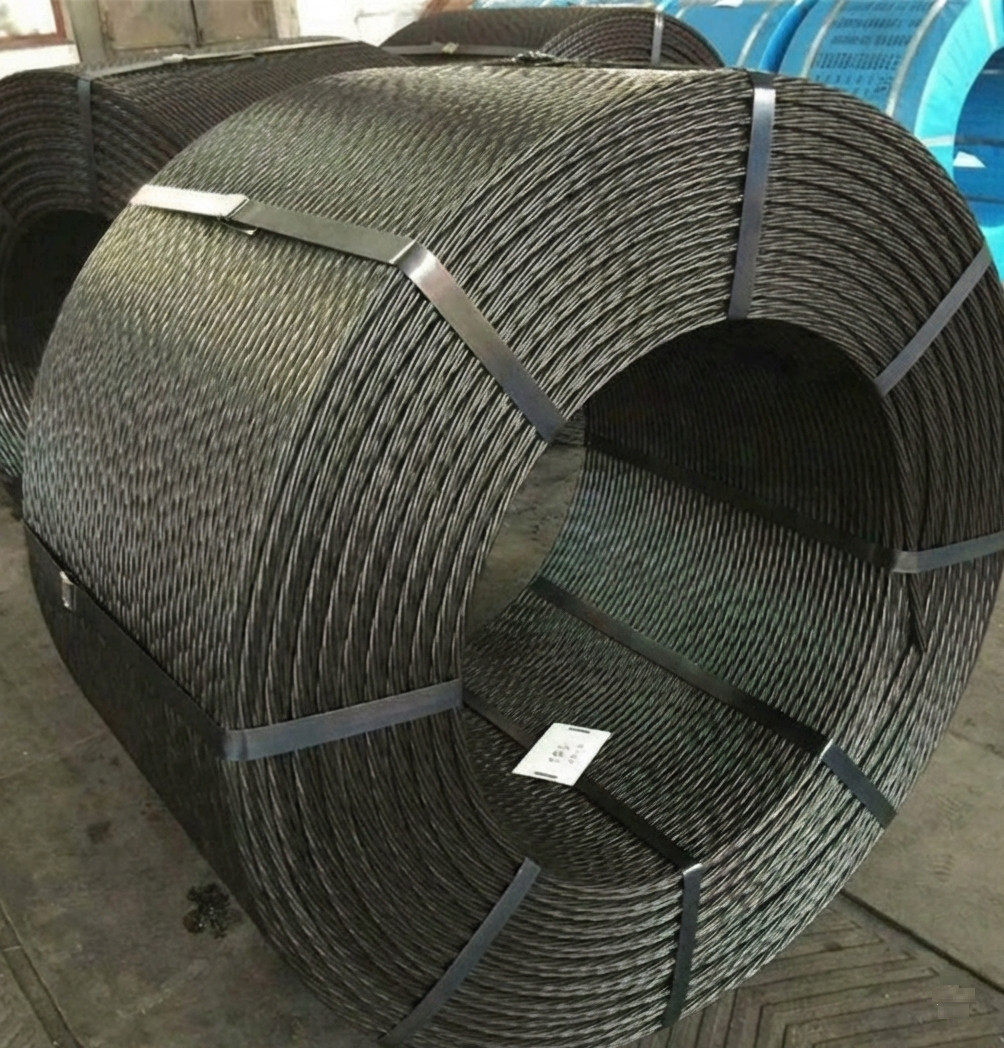
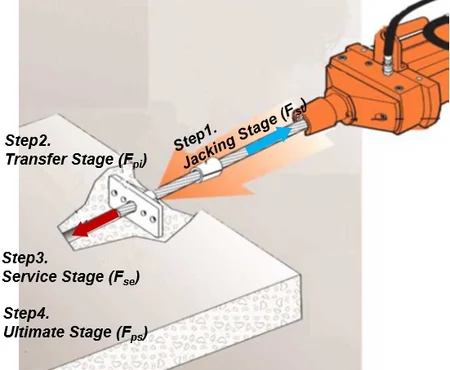
The jack applies a precise tensile load, elongating the strand and transferring a compressive preload into the concrete. That preload is what controls deflection, reduces cracking, and allows a thinner slab than an equivalent conventionally reinforced design.
What Is a Monostrand Post-Tension System?
A monostrand system stresses one strand at a time, as opposed to a bonded multi-strand system where tendons run inside metallic ducts and are grouted after stressing. Monostrand unbonded PT dominates the Texas slab market because it is faster to install, does not require a grouting crew, and is well-suited to the expansive clay soils common in the Dallas-Fort Worth area.
The tradeoff is that the load path between the strand and the concrete depends entirely on the integrity of the bearing plate and wedge assembly at each end. This is precisely why live-end zone safety is non-negotiable.
Pre-Stressing Safety Protocol: What Must Be Verified Before the Jack Goes On
We evaluate every PT stressing operation by walking through a structured pre-stress checklist before the first jack application. This section details the steps we follow and the specific code requirements that back them.
1. Concrete Strength Verification
This is the gate condition. Per ACI 318-19 Section 26.10.2, stressing cannot begin until the concrete has reached the compressive strength specified in the contract documents for that operation. On most Texas residential projects, the engineer of record specifies 3,000 psi as the minimum early-stress strength.
We confirm strength using field-cured cylinders tested by an accredited laboratory, never by age alone. Relying on assumed 7-day or 3-day strengths without cylinder data is a shortcut that has caused anchor blowouts on Dallas-area projects. Do not skip the break.
2. Shop Drawing Review and Tendon Layout Inspection
Before stressing, the field supervisor must compare the installed tendon layout against the approved PT shop drawings. Check tendon spacing, the stressing end designation (every drawing identifies which end is the live end), chair heights at supports and mid-span, and the condition of the sheathing.
Any sheathing damage longer than 6 in. must be repaired with compatible sleeve tape before concrete is placed. If the slab is already poured and sheathing damage is suspected, document the location and flag it for the engineer of record.
3. Stressing Equipment Calibration
The hydraulic jack and pressure gauge must be calibrated as a matched set within the preceding six months. PTI DC80.3-17 Section 8 sets the maximum acceptable error at plus or minus 2 percent of the applied load. We require a calibration certificate on-site before stressing begins.
One observation from our stressing operations: gauge condition matters as much as calibration date. A gauge with a cracked lens or sticky needle can produce consistent readings at low pressure and drift significantly above 70 percent of jack capacity. Inspect the gauge dial before every operation, not just the certificate date.
Live-End Zone Safety: The Non-Negotiables During Stressing
This is where the protocol becomes most critical. The zone directly behind the live-end anchor is the danger area during every pull.
Establishing the Exclusion Zone
No personnel are permitted within the stressing trajectory behind the jack during load application. We establish a minimum 10-ft clear zone behind every live-end anchor, marked with physical barriers and posted warning signs. This requirement aligns with general OSHA post-tensioning guidelines under 29 CFR 1926 Subpart Q and mirrors PTI industry safety guidance.
In experience, the most common violation of this rule is not intentional recklessness. It is the second worker who walks behind the jack to hand the stressor a wrench or read a measurement while the jack is still under load. Brief the entire crew, not just the person operating the jack.
Jack Seating and Initial Load Application
Seat the jack squarely against the bearing plate. Eccentric seating creates an off-axis load on the strand that produces uneven wedge seating, inconsistent elongation readings, and in extreme cases, premature wedge failure. Use a centering adapter or coupler cone where the anchor pocket geometry does not allow flush seating.
Apply load in stages. Our standard procedure is to bring the jack to approximately 10 percent of the design jacking force, pause, and confirm that the elongation measurement is tracking in the expected direction before continuing. This step is consistent with PTI DC80.3-17 Section 8.4 requirements for progressive load application.
Elongation Measurement and Acceptance
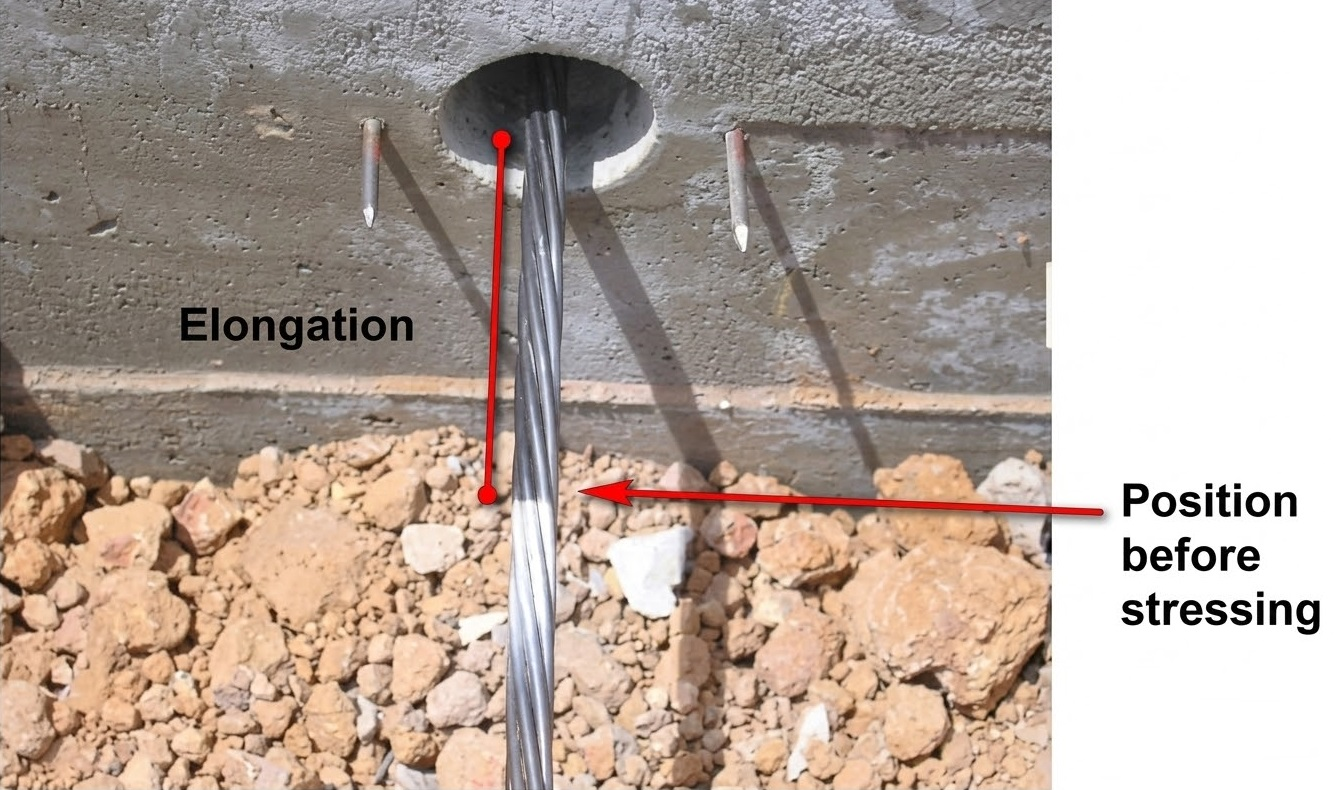
Elongation is the primary field verification that the strand has been stressed to the correct load. ACI 318-19 Section 26.10.3 requires that the measured elongation be within plus or minus 7 percent of the value calculated in the approved stressing schedule.
We record elongation at 25, 50, 75, and 100 percent of the specified jacking force. If the reading at any intermediate stage deviates more than the tolerance, we stop, release pressure, and investigate before proceeding. Possible causes include a friction spike from a kinked duct, a misidentified tendon on a complex layout, or a damaged chuck at the jack nose.
Do not extrapolate a short measurement to an assumed final elongation. A reading that is 15 percent low at 75 percent of load does not self-correct at 100 percent.
PT Slab Stressing Safety Protocol: Summary Table
The table below consolidates the protocol phases described above for use as a field reference.
| Protocol Phase | Key Requirement | Code Reference |
|---|---|---|
| Pre-stress Inspection | Verify tendon layout, profile, and anchorage hardware per approved shop drawings | ACI 318-19 Sec. 26.10 |
| Exclusion Zone | Minimum 10 ft clear behind live-end anchor; post warning signs on all approaches | OSHA 29 CFR 1926.752 |
| Stressing Equipment Cal. | Hydraulic jack calibrated within 6 months; max error +/-2% of applied load | PTI DC80.3-17 Sec. 8 |
| Initial Stress Check | Apply 10% of design jacking force; verify elongation reading before full load | PTI DC80.3-17 Sec. 8.4 |
| Elongation Tolerance | Measured elongation within +/-7% of calculated value; re-check if outside range | ACI 318-19 Sec. 26.10.3 |
| Tail / Excess Strand | Do not cut tails until elongation is approved and documented; min 1 in. tail left | PTI DC80.3-17 Sec. 9.2 |
| Documentation | Record jack pressure, gauge readings, and elongation per tendon on stressing log | ACI 318-19 Sec. 26.13 |
What Worked On-Site and What Did Not: Field Observations
- Holding a 5-minute pre-stress tailgate meeting with every member of the stressing crew, including concrete finishers who would be working nearby, eliminated unauthorized personnel in the exclusion zone on every project where we implemented it.
- Using a witness mark on the strand tail (a paint line drawn across the strand and bearing plate before jacking) gave us an immediate visual confirmation of strand movement independent of the jack gauge reading.
- Formatting the stressing log as a single-page per-tendon sheet, with columns for jack number, gauge pressure, and measured elongation at each load step, reduced data entry errors and made engineer review straightforward.
- Relying on the stressing subcontractor to self-document elongations without a representative on-site for the first pull. We found inconsistencies in the log format and missing intermediate readings, which required re-verification and delayed certification of the stressing package.
- Using a jack with a rated capacity too close to the design jacking force. We now specify a jack with at least 25 percent capacity above the maximum per-strand jacking force.
- Allowing tail cuts before the stressing log received written engineer approval. On one occasion, an out-of-tolerance elongation was discovered after tails had already been cut flush. The remediation required core drilling and mechanical coupler installation, which cost more than the entire stressing operation.
Not sure what span your residential slab can handle? See our analysis: What Is the Maximum Recommended Span for a Residential Post-Tension Slab?
Common Stressing Errors and How to Prevent Them
| Error | Consequence | Prevention |
|---|---|---|
| Stressing before concrete reaches required strength | Anchorage blowout, local crushing at bearing plate | Confirm 28-day strength or engineer-approved early-stress strength (typically 3,000 psi min) via break cylinders |
| Jack misalignment at anchorage pocket | Eccentric load on strand; uneven elongation | Use centering cone or coupler adapter; re-seat jack before applying load |
| Skipping intermediate elongation readings | Undetected friction loss or kink in duct | Record elongation at 25%, 50%, 75%, and 100% of jacking force |
| Cutting tails before log approval | No remediation path if elongation fails | Establish a written hold point: tails are cut only after field engineer signs off |
Frequently Asked Questions
When can stressing begin on a post-tension slab?
Stressing can begin once the concrete reaches the compressive strength specified by the engineer of record for the stressing operation, confirmed by cylinder breaks. On most Texas residential PT slabs, this is a minimum of 3,000 psi, though the design documents may specify a higher value. Age alone, such as 3 days or 7 days, is not a sufficient basis for initiating stressing. Refer to ACI 318-19 Section 26.10.2 for the governing requirement.
What should I do if the measured elongation is outside the plus or minus 7 percent tolerance?
Stop stressing that tendon immediately and release jack pressure. Do not cut the tail. Document the measured and calculated elongation values on the stressing log, then contact the engineer of record with the data. Common causes include excessive friction from a kinked or damaged sheath, an incorrect tendon identification on a complex layout, or a miscalculation in the theoretical elongation. The engineer will direct next steps, which may include re-stressing, supplemental reinforcement, or a detailed investigation.
What is the minimum exclusion zone behind a live-end anchor during stressing?
A minimum 10-ft clear zone must be maintained in the stressing trajectory behind every live-end anchor during load application. This zone must be physically barricaded and marked, and all personnel must be briefed before stressing begins. This is consistent with PTI safety guidance and OSHA 29 CFR 1926 Subpart Q standards applicable to post-tensioning operations. The exact regulatory reference should be verified against current provisions and your site-specific safety plan.
Can an uncalibrated jack be used if the contractor feels the readings are consistent?
No. PTI DC80.3-17 Section 8 requires the jack and gauge to be calibrated as a matched set within the preceding six months, with a maximum accuracy error of plus or minus 2 percent. Field judgment about gauge consistency is not a substitute for traceable calibration. Using an uncalibrated jack invalidates the elongation record and creates liability exposure for the contractor and the engineer of record.
What documentation is required after stressing is complete?
At minimum, the stressing record must include: the tendon identification number, the jack and gauge serial numbers, the calibration date, the design jacking force, the applied gauge pressure, and the measured elongation at each recorded stage. The record must be signed by the stressing operator and reviewed and approved by the field engineer before tails are cut. ACI 318-19 Section 26.13 governs the required content of PT stressing records.
Need PT Slab Drawings and Calculation Notes?
At TensionOne, we prepare complete post-tensioned slab design packages for contractors and small engineering firms across Texas, including tendon layout drawings, stressing schedules, elongation logs, and ACI 318 calculation notes. If you are managing a Dallas-area project and need a reliable freelance engineering partner, we are ready to support your team.
Request a Freelance PT Slab Assignment
We prepare production-ready post-tension slab design packages for contractors, engineering firms, and architects across Texas, coordinated with your project schedule and built on the field-tested standards covered in this article.
- Tendon Layout Plans and Profiles — one-way and two-way systems
- Service-Level and Ultimate Limit State Flexural Checks — per ACI 318-19
- Punching Shear Verification — at columns and slab edges
- Stressing Schedules and Elongation Log Templates
- As-Built Documentation — for engineer-of-record sign-off
If you are a structural drafter, engineering technician, or small firm seeking targeted PT slab support on a commercial project in the Dallas area, contact us through our freelance services page to discuss your project scope and timeline.
TensionOne provides structural engineering support services. All deliverables are prepared for review and use by a licensed Professional Engineer. TensionOne does not provide PE-stamped documents directly.
References: ACI 318-19: Building Code Requirements for Structural Concrete, American Concrete Institute. PTI DC80.3-17: Specification for Unbonded Single Strand Tendons, Post-Tensioning Institute. ASTM A416: Standard Specification for Low-Relaxation Seven-Wire Strand for Prestressed Concrete, ASTM International. OSHA 29 CFR 1926 Subpart Q: Concrete and Masonry Construction, U.S. Department of Labor.
This article is intended as a technical reference and does not constitute a PE-stamped engineering opinion or project-specific structural recommendation. All design decisions should be reviewed and approved by the licensed engineer of record for your project.