
Introduction
When a structural engineer starts laying out a 15-story mixed-use building in downtown Dallas, one of the earliest and most consequential decisions is the slab system. The choice between a post tension slab and conventional reinforced concrete (RC) directly shapes structural depth, floor-to-floor height, formwork cycles, and long-term service performance. Get it wrong at this stage, and the cost impact cascades through the entire project budget.
The problem is that this comparison rarely gets the technical depth it deserves. Most discussions stay at the surface: PT is lighter, RC is simpler. In practice, the efficiency gap between the two systems widens significantly as building height increases, bay spans grow, and superimposed loads compound. When a 1 in reduction in slab thickness saves 2 in per floor, a 20-story tower gains nearly 3.5 ft of additional leasable height or, alternatively, stays within zoning height envelopes while adding a full floor.
This article breaks down that gap with practical structural arguments, not generalities. We look at span capacity, slab depth, deflection control, load-balancing mechanics, formwork economics, and the timeline implications of each system, all anchored in the context of mid-to-high-rise construction in Texas.
Not sure which slab system fits your project? Walk through our Should I Use a Post Tension Slab? Decision Tree to get a structurally grounded starting point for your system selection.
Why Structural Depth Is the First Battleground
In high-rise construction, every inch of structural depth carries a direct real estate value. A thinner slab means a shorter floor-to-floor height, which translates to reduced cladding area, shorter elevator shafts, fewer column linear feet, and a lower building weight carried to the foundation. The impact compounds floor by floor.
For a conventional RC flat plate designed under ACI 318-19, Table 8.3.1.1 sets the minimum slab thickness at L/30 for two-way flat plates without drop panels, where L is the longer clear span. For a 28-ft bay, that yields a minimum slab of approximately 11.2 in, before deflection and punching shear verification. In practice, with live loads above 50 psf, slab thicknesses for RC flat plates in commercial high-rise applications commonly reach 10 to 12 in.
A post-tensioned flat plate over the same 28-ft bay, with a tendon profile optimized per PTI DC80.3 guidelines, routinely achieves serviceable performance at 7 to 8 in. That 3 to 4 in difference per floor is not academic. For a 20-story building with 9-ft floor-to-floor heights, the structural savings in concrete volume alone are material.
For a recent mixed-use project with 30-ft bays and a 65-psf superimposed load, the PT scheme reduced slab depth from 11 in to 7.5 in. Over 18 floors, that eliminated approximately 560 CY of concrete from the superstructure, not counting the foundation upsizing that would have been required under the RC option.
| Parameter | RC Flat Plate (ACI 318) | PT Flat Plate (ACI 318 / PTI DC80.3) |
|---|---|---|
| Typical slab thickness (28 ft bay) | 10 to 12 in | 7 to 8 in |
| Controlling limit state | Deflection (long-term) | Service load balancing + deflection |
| Two-way shear (punching) | Often governs — shear caps needed | Reduced by compression; less critical |
| Reinforcement type | Grade 60 rebar (ASTM A615) | 0.5-in or 0.6-in unbonded tendons + mild PT-compatible rebar |
| Code reference | ACI 318-19 Ch. 8 | ACI 318-19 Ch. 26 + PTI DC80.3 |
For a broader structural analysis of when PT wins over conventional RC on behavioral and material efficiency grounds, see our full comparison of PT vs. reinforced concrete structural behavior.
Load Balancing: The Mechanism That Separates PT from RC
This is where post-tensioned concrete stops being a variation of RC and starts operating on a different structural logic entirely. The load-balancing concept, formalized by T.Y. Lin in 1963 and embedded in current ACI 318 and PTI design practice, allows the engineer to select a target portion of the dead load to be directly counteracted by the vertical component of the tendon force.
In a two-way PT flat plate, the tendon is draped parabolically from a high point at the column to a low point at midspan. As the tendon is stressed to its lock-off force (typically 70% of GUTS per ACI 318-19 Section 26.10.3, which is 0.70 x 270 ksi for low-relaxation strand), the curvature of the tendon exerts an upward transverse load on the slab. This upward load, called the balanced load, directly offsets gravity. The designer typically targets 65 to 80% of the slab self-weight as the balanced load for flat plates in high-rise applications.
RC slabs carry the full gravity load in flexure from the first day of loading. There is no mechanism to pre-compensate for deflection. The implication for long-term deflections is significant: ACI 318-19 Section 24.2 permits a maximum long-term deflection of L/480 for elements supporting partitions susceptible to damage. For a 30-ft span, that is 0.75 in. Achieving this with RC alone typically requires either additional slab thickness or camber accommodations that complicate construction. With PT, the same limit is satisfied at a reduced slab thickness because the camber induced by tendon curvature pre-compensates for long-term creep and shrinkage deflections.
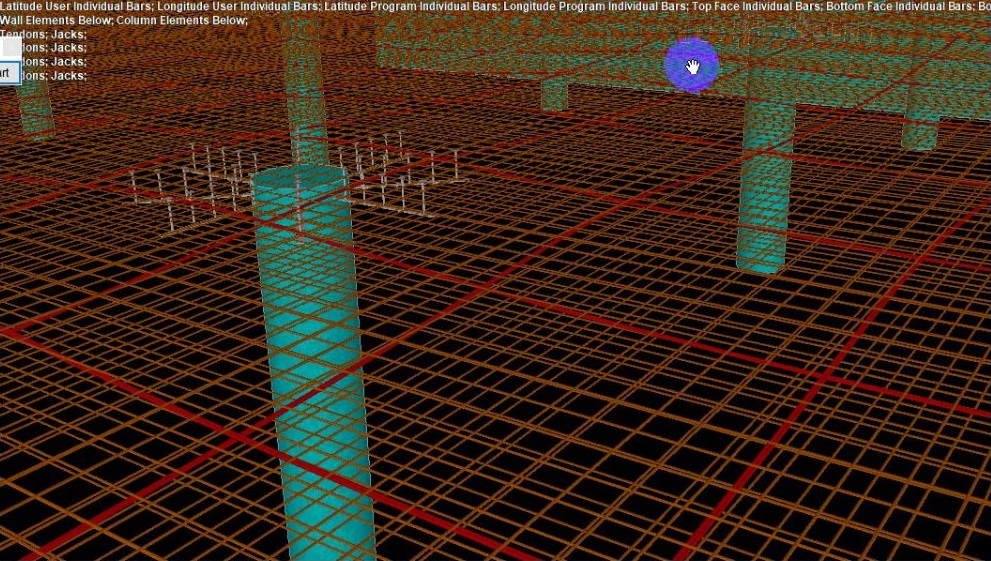
During a recent parking project, we evaluated two structural alternatives for the owner: a conventional beam-and-column system and a post-tensioned slab system. After conducting a complete study with detailed analysis and comparison, we concluded that the post-tensioned slab solution optimized the structure by reducing concrete quantities by approximately 30%, while also allowing the slab thickness to be reduced from 14 inches to 10 inches.
Formwork Cycles, Schedule, and the Real Construction Cost
The structural efficiency of a PT slab has a direct downstream effect on the construction program. In high-rise construction, the formwork cycle controls the critical path. A faster re-shore cycle means more floors per month, which means earlier revenue-generating occupancy. This is where PT versus RC diverges most visibly for the general contractor.
Formwork Cycle Duration
A conventional RC flat plate typically requires the following before stripping is possible: the concrete must reach approximately 3,000 psi for initial form stripping (per ACI 347 guidelines), and re-shores must remain in place until the slab can carry its full design load without shoring, usually achieved at 28-day strength. For 4,000 psi specified concrete in Dallas summer conditions, that cycle commonly runs 7 to 10 days.
A PT flat plate allows an earlier strip because the tendons are stressed before form removal. Typically, stressing begins at 75% of specified compressive strength (3,000 psi for a 4,000 psi mix per ACI 318-19 Section 26.10.2), which is commonly achieved in 3 to 5 days in Texas heat. Once stressed, the slab is post-compressed and largely self-supporting. Formwork can be stripped at that point, with only re-shores carried for a shorter duration. In practice, high-rise PT projects in Texas routinely run 4 to 5 day cycles per floor.
Quantified Schedule Impact
Assume a 20-story residential tower in Dallas. The RC scenario with a 9-day form cycle completes structural work in 180 days. The PT scenario with a 5-day cycle completes the same scope in 100 days. That is 80 calendar days saved on the critical path, which at a typical Dallas high-rise general conditions burn rate of $15,000 to $25,000 per day, represents $1.2M to $2.0M in saved general conditions alone, before accounting for earlier revenue from occupancy.
For a full breakdown of material and schedule savings across a PT slab project lifecycle, see our detailed ROI analysis for PT slab projects including materials and schedule savings.
What Worked and What Did Not: A Practical Assessment
What Worked on Site
- Span efficiency at 28 to 35 ft bays: PT flat plates delivered full serviceability compliance at 7.5 in. The same bay in RC required 11 in to satisfy ACI 318-19 long-term deflection limits, adding dead load and foundation demand.
- Punching shear: The precompression introduced by the tendons (typically 125 to 200 psi average slab compression in both directions) increases the concrete shear capacity at the column face. In a number of flat plate layouts, this eliminated the need for shear reinforcement or drop panels that would have been required in the RC equivalent, simplifying detailing and reducing formwork complexity.
- Slab crack control: The sustained compression in a properly designed PT slab suppresses flexural cracking under service conditions. For a commercial building with polished concrete floors, this was a significant long-term maintenance advantage that the owner valued explicitly.
- Coordination with MEP: The reduced slab depth freed vertical space for mechanical and electrical coordination in the plenum, which is a recurring pain point in tightly stacked high-rise floors.
What Did Not Work
- Tendon deviation at re-entrant slab corners: At irregular plan shapes with re-entrant corners, banding tendons correctly requires careful coordination between the structural engineer and the PT installer. On two-way banded-distributed systems, we have seen tendons deviated around openings in a way that significantly reduced the effective balanced load in adjacent bays. This requires explicit detailing on the tendon layout drawings, not just a note to "deviate around openings."
- Stressing access in tight core areas: On a narrow-core tower with a 12-ft wide core wall cluster, the stressing tails from distributed tendons running in both directions can create congestion issues at the slab edges. Planning the tail pockets and the stressing sequence early in the drawing set avoids conflicts with block-outs and embeds.
- Corrosion risk if sheathing is damaged: In unbonded PT systems, the corrosion protection of the strand depends entirely on the integrity of the HDPE sheathing and the grease coating. Physical damage during rebar placement or concrete pours can compromise that barrier. This is not a reason to avoid PT, but it is a reason to enforce field inspection protocols during concrete placement.
For a detailed cost and performance comparison of PT versus rebar for commercial construction applications, see our analysis on PT slab cost and performance for commercial builders. For the environmental dimension of this comparison, see our overview of the post-tension slab and its environmental advantage in reducing concrete volume.
When RC Still Makes Structural or Economic Sense
PT is not always the right answer. Recognizing the cases where RC performs comparably or better is part of an honest analysis.
- Short spans below 18 to 20 ft: At these spans, the RC slab thickness governed by ACI minimum thickness requirements is already thin. The efficiency gain from PT narrows and may not justify the additional installation cost of tendons, stressing equipment, and inspection overhead.
- Heavy industrial loads above 300 psf: At very high live loads, the PT tendon force required to meaningfully balance the load can exceed practical limits for a flat plate. A PT beam-and-slab system or waffle slab may be appropriate, but the comparison changes fundamentally.
- Projects with complex slab discontinuities: Heavily perforated slabs with large openings near column lines (mechanical penthouses, transfer decks with multiple block-outs) can make tendon routing impractical. In these cases, RC with carefully detailed shear reinforcement may be easier to execute correctly.
- Low-rise residential with small bays: For ground-supported or shallow residential slabs in suburban Texas, an RC mat or a PT slab on grade are often compared on different criteria. See our specific analysis of PT vs. rebar for residential construction.
- When PT is not viable due to site constraints: See our builder's guide to alternatives when post-tensioning is not the right fit for your project.
- Parking structures are a specific case where PT consistently wins on span efficiency. For the ROI breakdown, see our analysis of PT slab ROI in parking garage design.
Frequently Asked Questions
What is the typical span range where a PT flat plate outperforms a conventional RC flat plate in a high-rise?
PT flat plates begin to show a clear structural depth advantage at spans above 22 to 24 ft. Below that range, the ACI 318-19 minimum slab thickness for RC is already competitive. Above 28 ft, the advantage of PT in deflection control and slab thinness becomes decisive, particularly under sustained live loads typical of commercial occupancies.
Does ACI 318 require special inspection for PT slabs in Texas?
Yes. ACI 318-19 Chapter 26 and IBC 2021 Section 1705.3 require special inspection for post-installed anchors and for PT construction in high-rise structures. In Texas, this typically means a special inspector must verify tendon placement, elongation measurements, and grouting (if applicable). The specific requirements depend on the risk category and local jurisdiction. Always verify with the authority having jurisdiction (AHJ) for your specific project [VERIFY for local jurisdiction variations].
How does PT slab thickness affect fire resistance ratings in high-rise construction?
The fire resistance of a PT slab is governed by the cover to the tendons, not just the slab thickness. IBC Table 722.5.2.1 and ACI 318-19 Table 20.6.1.3.1 specify minimum cover for unbonded PT tendons based on the required fire resistance period. For a 2-hour fire resistance rating, minimum cover to unbonded tendons in slabs is typically 1 in for the bottom layer. This requirement can sometimes govern slab thickness in thin PT designs.
Can a PT slab be repaired if a tendon is found to be damaged after construction?
Yes, damaged unbonded PT tendons can be de-stressed, cut, and replaced using specialized repair procedures. The structural engineer of record must assess the local effect of the compromised tendon on the slab panel before repairs begin. PTI DC80.3 and PTI's technical notes provide guidance on tendon replacement methodology. This is a specialized operation and should not be attempted without engineering oversight.
What is the typical cost premium of a PT slab over a conventional RC flat plate for a Dallas high-rise?
In the current Dallas market, the installed cost of the PT system (tendons, stressing, and inspection) typically adds $1.50 to $2.50 per square foot to the direct slab cost compared to an RC flat plate of equivalent span. However, this premium is routinely offset by the savings in concrete volume, reduced slab self-weight (foundation savings), and shortened formwork cycle time. The net economic result depends on project scale, span, and height. For a full breakdown, see our ROI analysis for post tension slabs.
Need Engineering Drawings and Calculation Notes for Your PT Slab?
At TensionOne, we provide freelance structural engineering services specifically for post-tensioned slab systems, including tendon layout drawings, serviceability and strength calculations per ACI 318 and PTI DC80.3, elongation sheets, and coordinated as-built documentation. If you are a contractor, architect, or small engineering firm working on a high-rise or commercial project in Texas and need a specialist to prepare or review your PT slab package, we are available for assignment.
Scope typically includes: tendon layout drawings, serviceability and ultimate limit state calculations per ACI 318 and PTI DC80.3, stressing schedule, and elongation documentation template. Engage TensionOne on a freelance post-tension slab assignment.
Submit a Project Inquiry
Send us your slab dimensions, loading requirements, and timeline. We will provide a scope and fee within two business days.
- Tendon layout and profile drawings
- Serviceability & ultimate limit state calculations
- Stressing schedule
- Elongation documentation template
Related Articles in the Cost and Comparison Series
References: ACI 318-19: Building Code Requirements for Structural Concrete, American Concrete Institute. PTI DC80.3: Standard for Unbonded Single Strand Tendons, Post-Tensioning Institute. ASCE 7-22: Minimum Design Loads and Associated Criteria for Buildings and Other Structures, American Society of Civil Engineers. IBC 2021: International Building Code, Chapter 17 Special Inspections, International Code Council.
About the Author: Joseph is a civil engineer and founder of Tension ONE LLC. With field experience spanning complex PT projects in Africa and Europe, he specializes in PT slab design, serviceability checks, tendon profiling, and on-site stressing coordination for the U.S. construction market, with a focus on Texas.