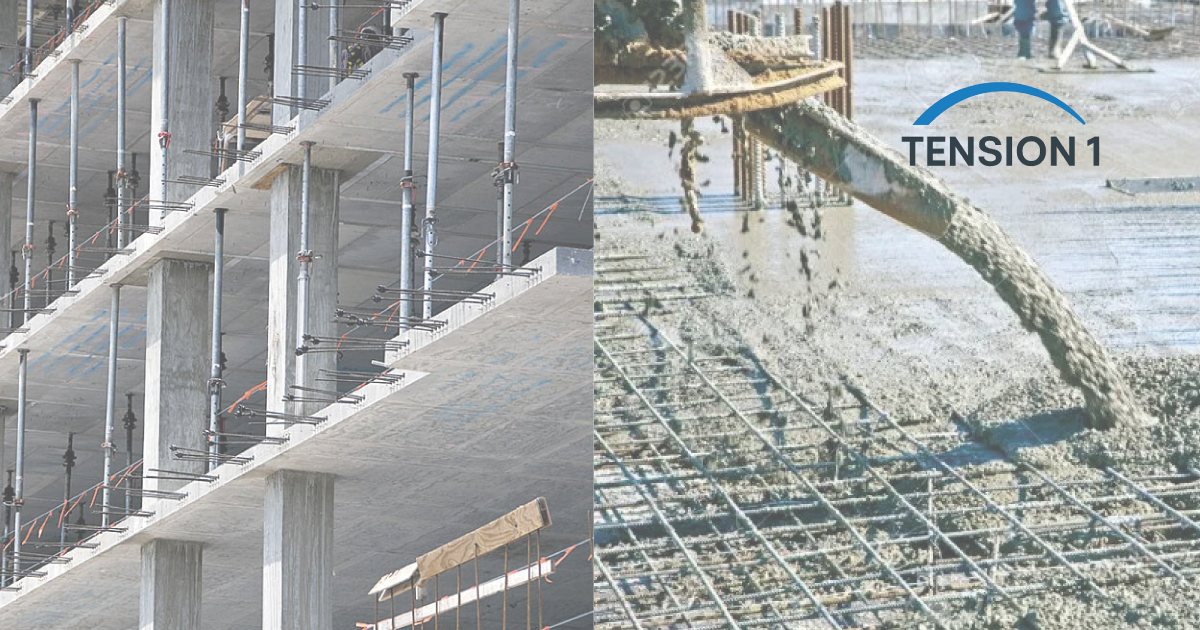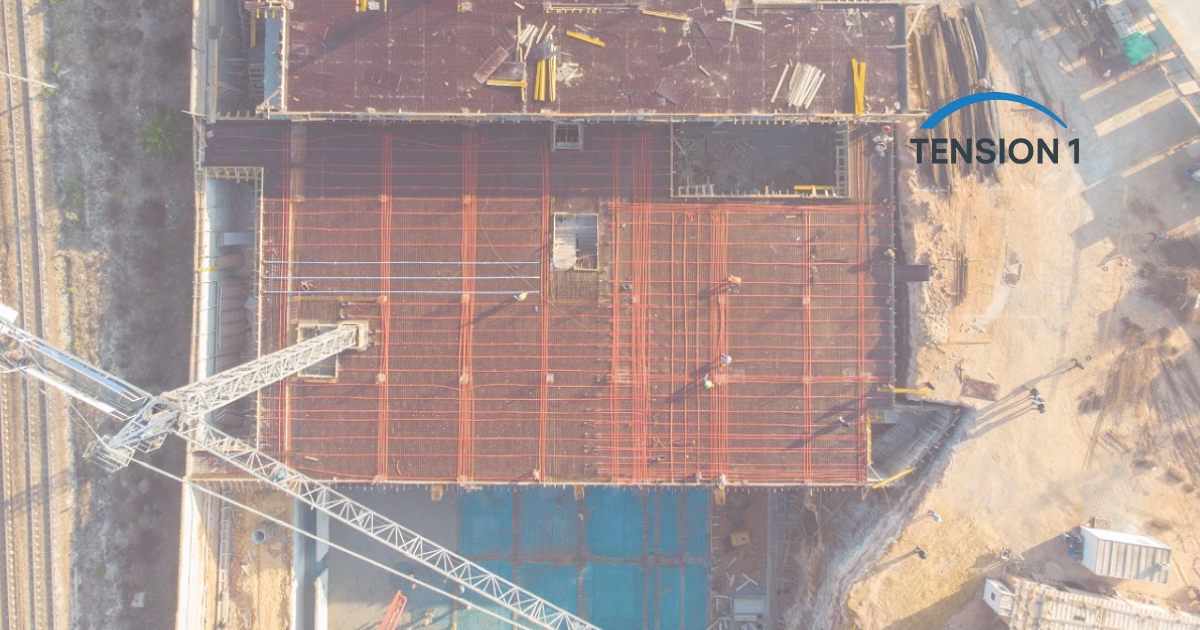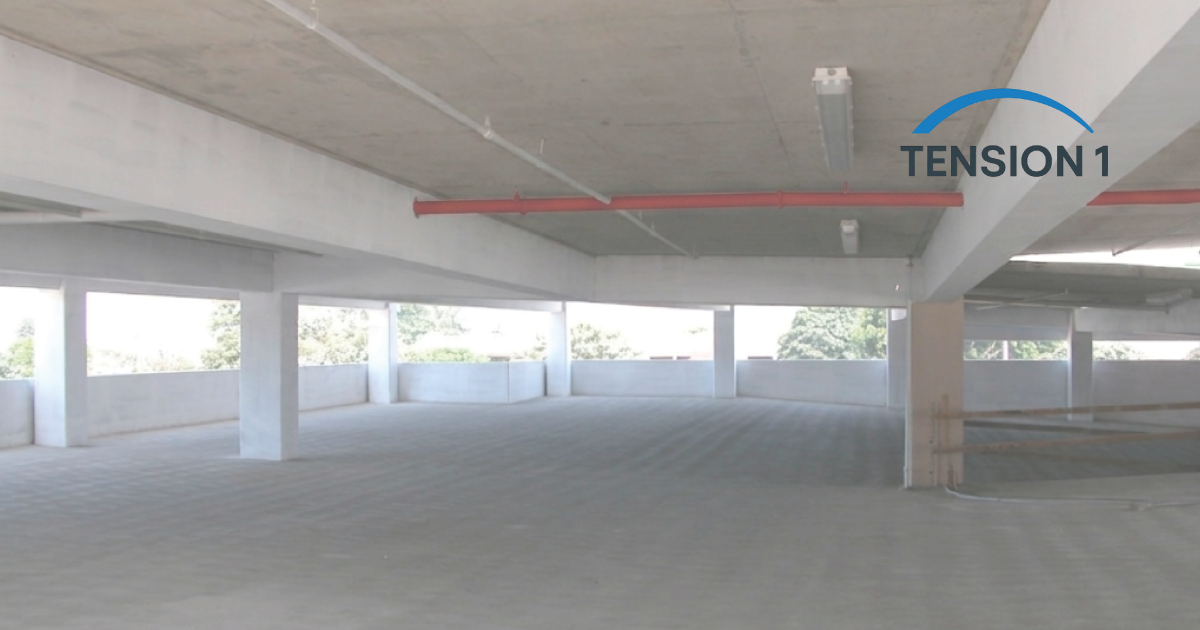
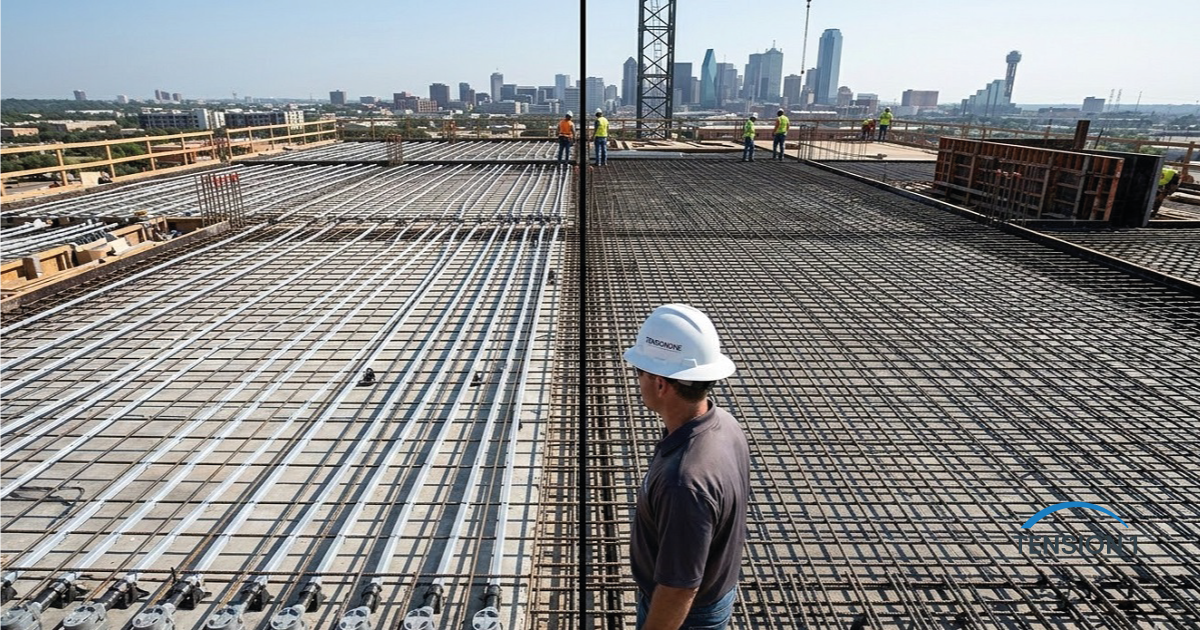
When a commercial builder in Dallas starts pricing a mid-rise parking structure or a large-span retail floor, the structural system on the drawings drives the bottom line. A post tension slab and a conventionally reinforced slab can carry the same bay, but their cost profiles, material demands and long-term behavior diverge under real project conditions.
We have evaluated both systems across multiple commercial projects in Texas, and the differences are not always where contractors expect them to be. Pick the wrong one and you pay for it in concrete, column sizes, partition cracks or a slower floor cycle. Here are the arithmetic, the published cost data and the field lessons, before the first cubic yard is ordered.
The Commercial Builder's Structural Problem
Rebar slabs are a known quantity. But familiarity is not efficiency, and on large commercial floor plates the gap costs real money.
Take a 25 ft square bay with 24 in columns, so a 23 ft (276 in) clear span. For a nonprestressed flat plate with Grade 60 bars, the minimum thickness table in ACI 318-19 (Table 8.3.1.1) gives ln/33 for interior panels, 8.4 in, and ln/30 for exterior panels without edge beams, 9.2 in. The same span as a post tension slab starts at about 7 in, using the span-to-thickness ratio of 45 for floors given in a Portland Cement Association design article (2005).
The consequence is not only financial. A heavier slab adds seismic mass under ASCE/SEI 7-22 and eats floor-to-floor height. We have seen these exact trade-offs surface during value engineering reviews on commercial projects where PT was initially excluded from the scope. The full framework is in our pillar guide, post-tension vs reinforced concrete: 6 criteria to choose the right system.
Post Tension Slab Material Costs: What the Numbers Show
Concrete volume and slab thickness
Thickness is the most direct cost lever. The PCA article reports PT slabs typically 25 to 35 percent thinner than mild reinforced slabs. On the 25 ft bay above:
| Parameter, 25 ft bay | PT flat plate | RC flat plate | Difference |
|---|---|---|---|
| Preliminary thickness | 7 in (L/45) | 9.2 in (ACI minimum, exterior panel) | About 24 percent thinner |
| Concrete per 100 ft2 | 2.16 yd3 | 2.84 yd3 | 0.68 yd3 less |
| Self-weight at 150 lb/ft3 | 88 lb/ft2 | 115 lb/ft2 | 27 lb/ft2 lighter |
These are starting points, not designs, and deflection checks often push the RC slab past its code minimum. On a 50,000 ft2 floor plate, 0.68 yd3 per 100 ft2 is about 340 yd3 of concrete per level, and the lighter slab carries through to columns and foundations.
Strand, stressing and the net cost
The offset is the PT system itself: Grade 270 strand per ASTM A416/A416M-26, sheathing, anchors, chairs, stressing labor and tendon shop drawings.
One published comparison shows how the balance can land. A Penn State architectural engineering study (2006) redesigned a PT flat plate condominium as a reinforced flat plate and estimated the slab at about $26 per ft2 for RC against $21 per ft2 for PT, roughly 24 percent more for rebar. Reinforcement material and labor alone more than doubled in the RC option. Those are 2006 figures for one building, not a quote for your post tension slab, but the drivers have not changed. Each driver is covered in post tension slab ROI on materials, formwork and timeline, and the carbon side in the green advantage of post-tensioned slabs.
Post Tension Slab Performance: Deflection and Crack Control
Deflection
In a post tension slab, draped tendons push up against the load. Designers typically balance 65 to 80 percent of the slab self-weight, per the PCA article, leaving little sustained load to drive long-term deflection. A rebar slab relies on thickness and the stiffness of an already cracked section.
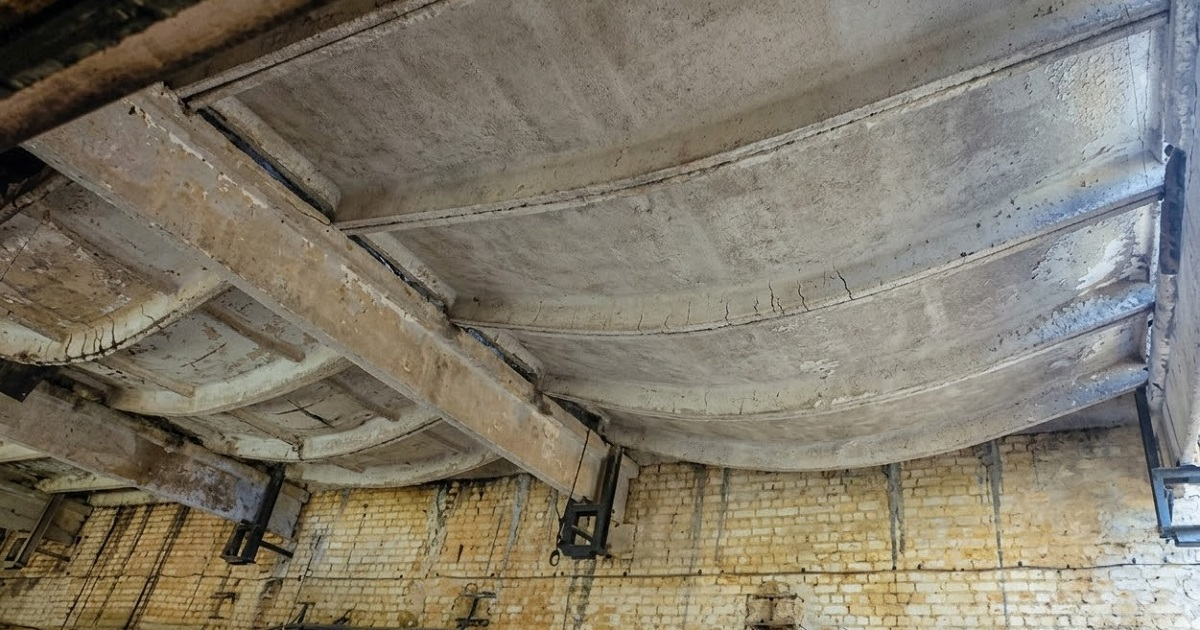
That matters on floors with partitions and facades. ACI 318-19 Table 24.2.2 limits the deflection occurring after attachment of nonstructural elements likely to be damaged to L/480. We have reviewed deflection reports on commercial projects where RC slabs exceeded L/480 under long-term sustained loads, triggering partition cracking and facade issues that required post-construction remediation.
Crack control
ACI 318-19 requires an average effective precompression of at least 125 psi in two-way PT slabs and designs them as uncracked, with service tension held to 6 times the square root of f'c. An RC slab is expected to crack, and controls crack width through bar spacing under ACI 318-19 Section 24.3. On parking decks and retail floors exposed to moisture and chlorides, that difference shows up in maintenance budgets. The parking case is covered in post tension slab ROI for parking garages.
Schedule and Field Execution: Where the Real Risk Sits
What worked on site
- Earlier form stripping: in field experience coordinating PT work on commercial slabs in Texas, initial stressing could typically begin when the concrete reached 3,000 psi to 3,500 psi, typically 3 to 5 days after the pour depending on mix design and ambient temperature. That compressed the multi-story pour cycle. The project specification sets the strength at stressing.
- Logged elongations: the elongation check required by ACI 318-19 Section 26.10 gives a hard record of the force in every tendon of the post tension slab.
What to watch
- Stressing access and coordination: on projects where architectural or MEP coordination was not final before tendon layout, we hit conflicts between tendon tails and embedded edge framing. The field fixes partially offset the schedule gain, so engage the PT subcontractor early.
- Per-floor cycle: PT is not automatically faster. The Penn State study scheduled 8 days per floor for PT against 7 for RC, for tendon placement and stressing.
If a priced scheme looks off, a technical consultation on PT vs rebar is a quick second opinion. Tall frames follow the same logic, see PT vs RC slab efficiency in high-rise construction.
When a Post Tension Slab Wins, and When Rebar Does
PT usually wins when
- Clear spans exceed about 20 ft in two-way flat plates or flat slabs.
- Lighter dead load pays off in columns and foundations.
- Long-term deflection and crack control are critical to the program.
- Expansive Dallas soils call for a stiffened PT foundation slab, a case we compare in post-tension vs rebar for residential construction.
Rebar may be the better call when
- Spans are short, under about 18 ft, and slab thickness is not a constraint.
- Thin local PT competition inflates installation prices.
- Re-entrant corners, large openings or irregular grids complicate tendon layout and anchorage detailing.
- The owner expects future coring without engineering oversight, which a PT slab cannot tolerate.
When neither fits, see our builder's guide to post tension slab alternatives.
Price Both Systems on Your Grid Before You Commit
Every number here is a preliminary benchmark. The governing ACI 318 edition adopted by your jurisdiction and the project documents take precedence, and sealing and approval belong to the licensed engineer of record. How we source and date figures is set out in our editorial policy.
We price a post tension slab and a rebar slab side by side on your grid and loads, with every assumption stated, as independent technical support for your engineer of record. See our post-tension slab design, optimization and diagnostics services.