In long-span concrete, the problems we meet most often are not about strength. They are about deformation. A post tension slab is the most dependable answer to the two service problems that dog conventionally reinforced slabs: excessive mid-span deflection and uncontrolled cracking under everyday loads.
Once a slab spans 30 ft or more between supports, bending moments grow with the square of the span, and rebar alone handles them inefficiently. The result is a slab that sags visibly and cracks in tension. That leads to cracked partitions, failed waterproofing and warranty claims months after handover.
The financial consequences are rarely abstract. On a mid-rise commercial project in the Dallas-Fort Worth area we consulted on, a 40 ft transfer slab designed with conventional reinforcement was showing measured deflections of L/280 at 18 months after construction, well beyond the ACI 318-19 serviceability limit of L/480 for elements supporting non-structural components. That triggered $190,000 in remediation costs before the tenant fit-out was complete.
Post-tensioning solves this by putting the concrete into compression before service loads arrive. This article explains how that works, how tendon profiles are chosen for long spans, and where site execution makes or breaks the result. For the full system overview, see The Ultimate Guide to Post-Tension Slabs: Advantages, Design, and Longevity.
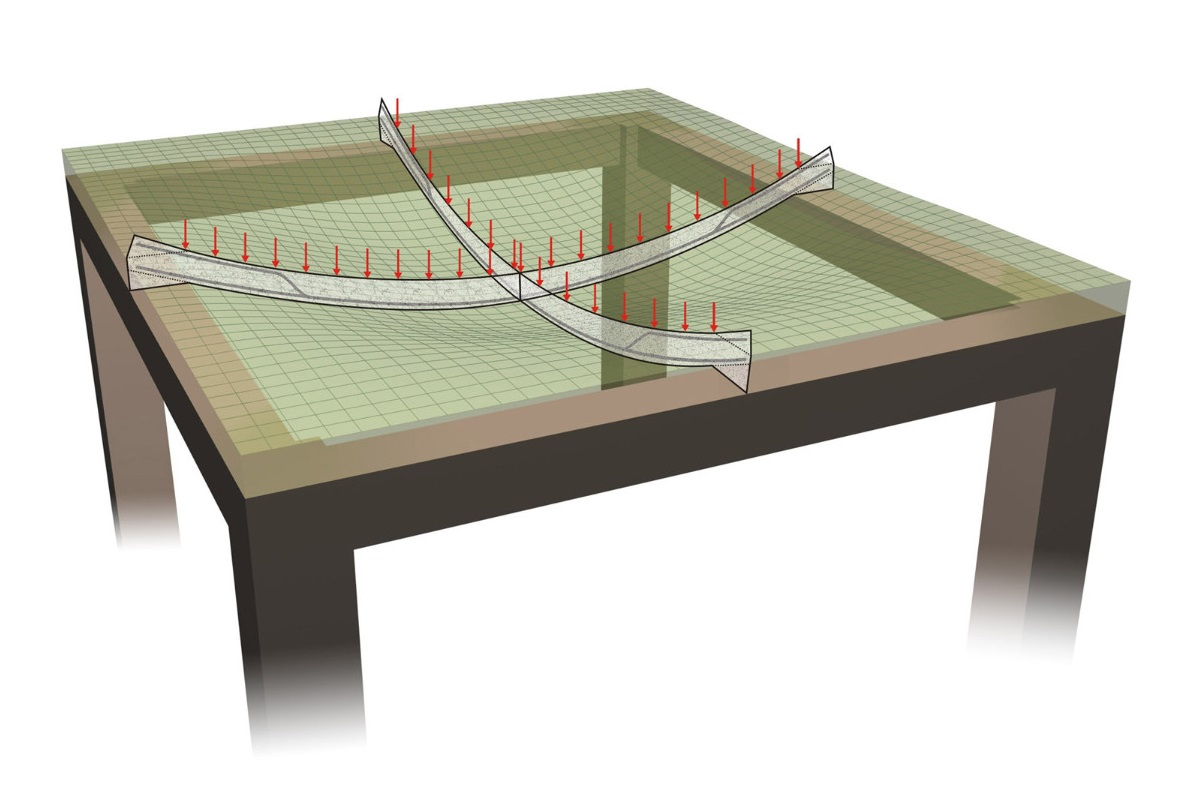
The Mechanics of Precompression: Why Concrete Needs Help in Tension
Concrete is strong in compression and weak in tension. ACI 318 takes its modulus of rupture as 7.5√f'c. For 4,000 psi concrete that is about 474 psi, roughly 12 percent of its compressive strength. Above that stress, a conventionally reinforced slab cracks, and from then on it relies on rebar crossing the cracks.
Post-tensioning changes the starting point. Each 0.5 in. strand is jacked to about 33 kip and keeps most of that force after losses. That force squeezes the slab, and ACI 318-19 requires at least 125 psi of average precompression in two-way slabs. The service tension that would have cracked the slab now has to overcome the precompression first.
The payoff is stiffness. ACI 318-19 Section 24.5 requires two-way prestressed slabs to be designed as Class U, which means uncracked, with service tension limited to 6√f'c, about 380 psi for 4,000 psi concrete. An uncracked slab works with its full gross moment of inertia, several times that of the same slab once cracked. That is why, according to a 2022 PTI Convention presentation on efficient PT design, PT flat plates typically span 25 to 40 ft.
Effective Prestress: The Number That Drives Serviceability
The parameter we track most closely is the effective prestress, fpe: the stress left in the strand after elastic shortening, friction, creep, shrinkage and relaxation. For unbonded monostrand systems common in Texas residential and commercial slab-on-grade construction, we typically design for fpe between 145 ksi and 175 ksi, depending on the tendon length and stressing configuration. On a 0.153 in.² strand, that is about 22 to 27 kip per tendon.
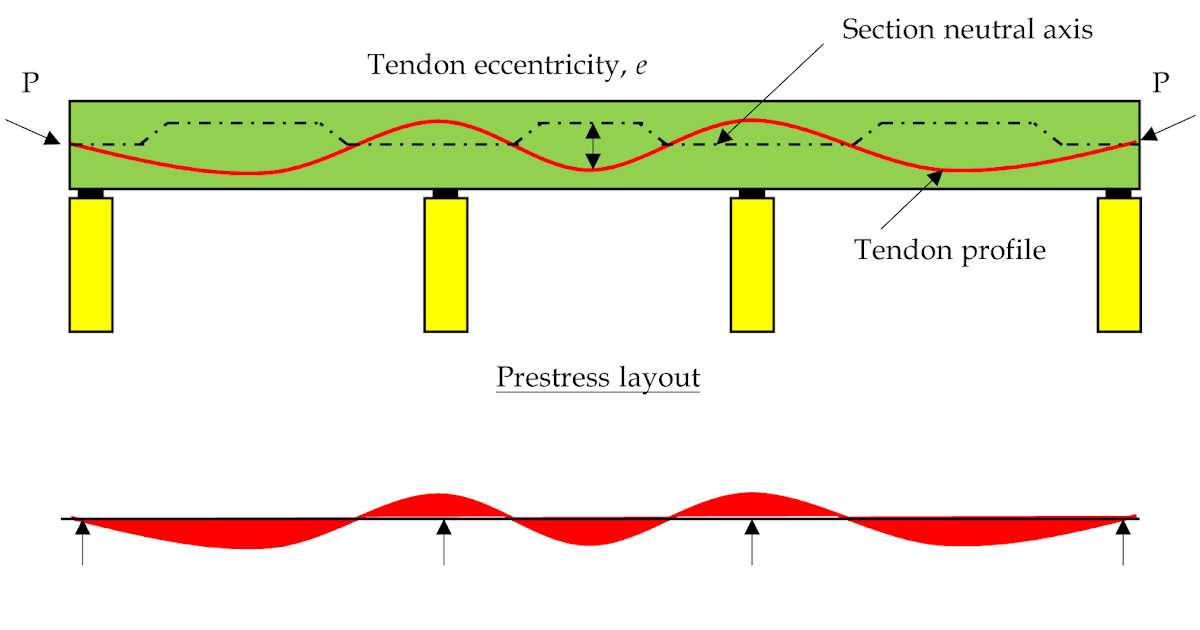
Load balancing, introduced by T.Y. Lin in the ACI Journal in 1963, is our primary design lever. The draped tendon pushes up on the concrete, and we size that uplift to roughly 60 to 80 percent of the sustained dead load. That neutralizes most of the long-term deflection from permanent loads. Live-load deflection remains, but it occurs on a stiff, uncracked section and recovers when the load is removed.
Tendon Profile Selection for Long Spans: Drape Is Everything
The uplift from a tendon depends on its curvature. For a parabolic profile, the balanced load is w = 8Pa/L², where P is the effective force, a the drape and L the span. A flat tendon has no drape and produces no uplift. The deeper the sag between supports, the more load the same force balances.
Continuity is what makes long spans work. Take a 10 in. slab with the strand's center held about 1.25 in. from each face. In a simple span anchored at the centroid, the drape is only about 3.75 in. In a continuous interior span, the tendon rises to the top over each support and drops to the bottom at mid-span, for a drape of about 7.5 in. At 26 kip over 40 ft, that is about 41 lb/ft of uplift per tendon in the simple span. The same tendon gives about 81 lb/ft in the continuous one: same force, same slab, twice the balancing.
The reverse curvature over supports is where field problems start. Getting this reverse-curvature profile detailed and constructed correctly is one of the most common sources of field deviation we see on Texas projects.
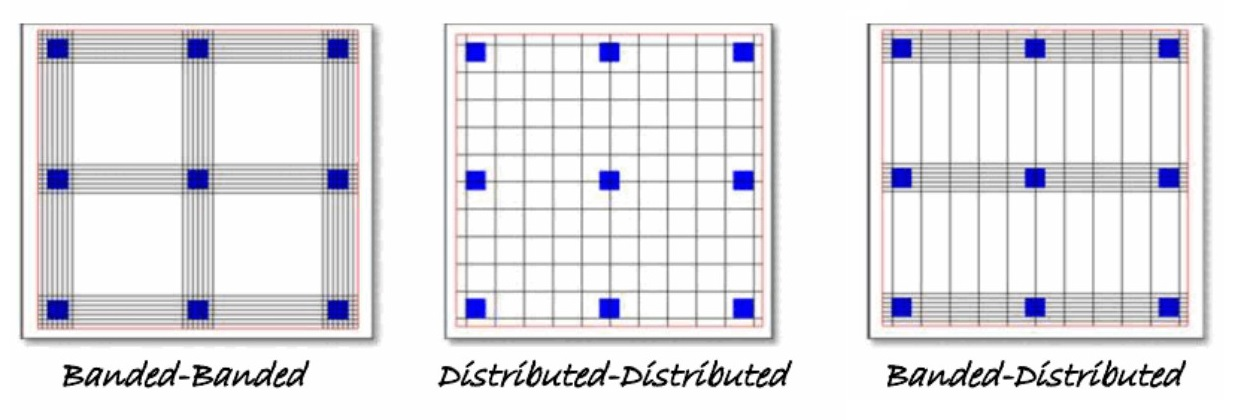
Banded and Distributed Layouts
For column-supported flat plates, we typically band the tendons over the column lines in one direction and distribute them across the panel in the other. ACI 318-19 permits this arrangement within limits. Distributed tendons are spaced no farther apart than 8 times the slab thickness or 5 ft, and at least two tendons must pass over each column for structural integrity. The banded direction carries load into the columns. The distributed direction supplies the minimum precompression across the full panel.
Banding also matters at the slab edge. The same profile logic is what lets PT carry large overhangs, as shown in our case study on post-tension slabs and architectural cantilevers.
On-Site Execution: Where PT Performance Is Won or Lost
We have reviewed PT slab designs that were structurally sound on paper but performed below expectation in the field. In almost every case, the deviation was not in the calculations: it was in the construction sequence, the stressing operations, or the as-built tendon geometry. The following field observations are drawn directly from site reviews and post-construction inspections we have conducted on PT slab projects in Texas.
We evaluated these conditions by reviewing as-built stressing records against engineer-calculated elongation tables, cross-checking measured tendon cover with shop drawings, and conducting visual inspections of pour sequences and joint locations.
| What Worked On-Site | What Did Not Work |
|---|---|
| Banded tendon layout in one direction concentrated force where punching shear was highest, reducing required rebar congestion. | Flat tendon profiles in low-span zones added unnecessary friction losses and reduced effective prestress at midspan. |
| Targeting an average effective prestress of 125 psi across the full slab panel controlled long-term creep deflections measurably. | Stressing from one end only on runs exceeding 120 ft produced elongation shortfalls of 8 to 12%, indicating excessive friction and wobble. |
| Coordinating pocket locations with the architectural reflected ceiling plan eliminated field conflicts and prevented accidental tendon cuts. | Skipping the intermediate temperature reinforcement bars in the short direction led to visible shrinkage cracks at construction joints within 30 days of pour. |
| Performing elongation checks against engineer-calculated theoretical values at every jack operation caught two draped tendons that were obstructed by embedded conduit. | Rushing the stressing sequence before concrete reached the specified 75% of design strength caused localized crushing at the anchorage zone. |
Stressing Sequence and Timing
Stressing cannot start until the concrete reaches the strength specified in the construction documents. That strength is commonly set at 75 percent of f'c or a fixed value such as 3,000 psi. On Texas summer pours, that can come in 48 to 72 hours. We always require a minimum of two cylinder breaks before authorizing stressing operations, regardless of schedule pressure.
Partial stressing, where some tendons are stressed to a reduced force at an early age, must be shown in the documents and reviewed for the project. We have used partial stressing successfully on large-footprint slabs to allow earlier form stripping without overloading the fresh concrete.
Elongation Checks: The Field Verification No PT Slab Should Skip
The designer calculates each tendon's theoretical elongation from its profile, the friction coefficients (μ for curvature, K for wobble) and the jacking force. ACI 318 requires the cause of any difference over 7 percent between measured and calculated values to be found and corrected.
On a Dallas office slab we reviewed, three tendons in a banded strip showed elongations 14 percent below theoretical. Investigation revealed that a bundle of 1.5 in. conduit runs had been routed directly beneath two tendons, physically blocking the intended drape geometry. The tendons were not achieving the designed sag, which reduced both the balance load and the effective eccentricity. The fix required the contractor to install supplemental mild reinforcement in the affected strip and revise the deflection calculations for that panel.
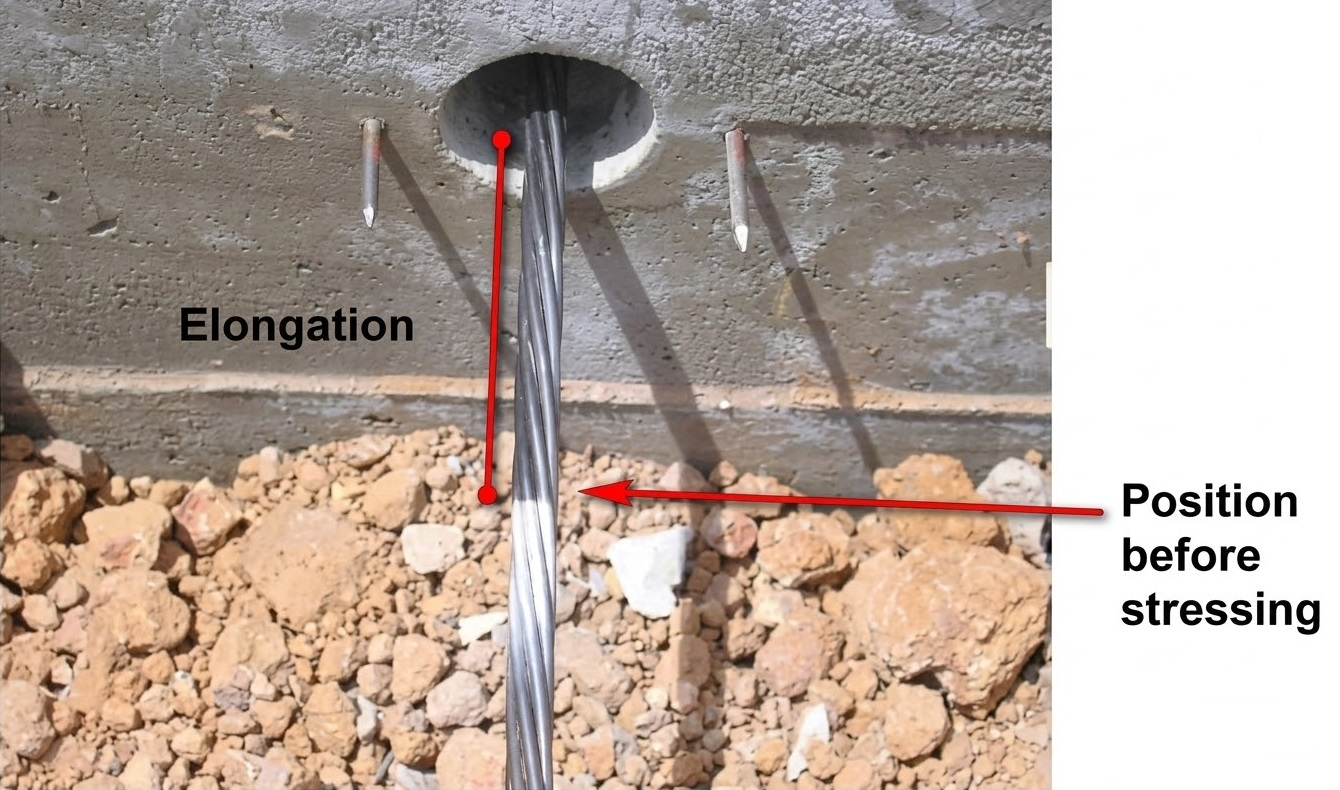
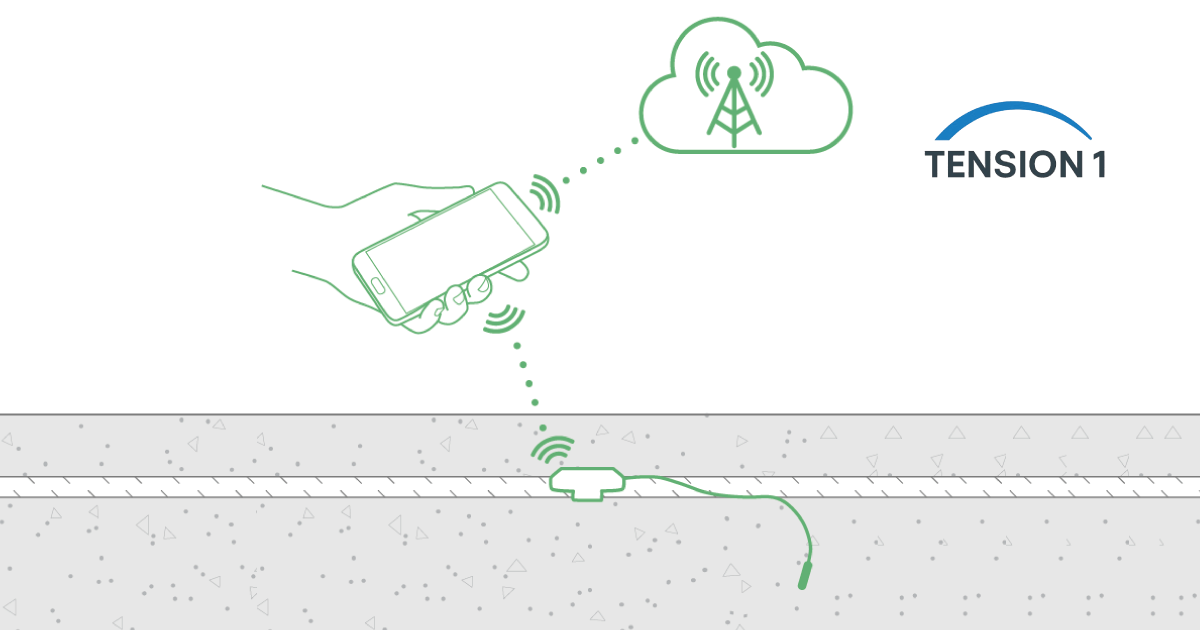
Continuous monitoring is starting to supplement these one-time checks on some structures. Our article on IoT and embedded sensors for post-tension slab monitoring covers what is actually deployed today.
Crack Control in Long-Span Post Tension Slabs
ACI 318-19 Section 24.5 sets the stress limits. Two-way slabs are designed as Class U, with service tension at or below 6√f'c, about 380 psi for 4,000 psi concrete. At transfer, tension is limited to 3√f'ci, or 6√f'ci at the ends of simply supported members, and compression to 0.60 f'ci. Loads and combinations come from ASCE 7-22.
Meeting those limits on paper is necessary but not sufficient. We also check that the banded force keeps the top fiber in compression over each support under pattern loading, with live load on alternate spans. Pattern loading is often underweighted in preliminary designs, yet it can govern top-fiber tension at interior columns.
Shrinkage and Temperature Reinforcement: The Overlooked Crack Initiator
PT slabs in Texas see large temperature swings between the pour and stressing. ACI 318-19 Section 24.4 allows tendons to count toward shrinkage and temperature reinforcement in one-way PT slabs when they provide at least 100 psi of average compression on the gross section. That allowance does not cover every direction or every stage. We have seen projects where the short-span reinforcement was omitted based on a misreading of the code, resulting in parallel shrinkage cracks at 6 to 10 ft spacing visible within 30 days of pour.
For long-span slabs with tendons in both directions, we specify minimum mild steel at 0.0018 times the gross cross-sectional area in each direction unless the applied average prestress exceeds 100 psi in that direction across the entire slab width. This provides a minimum crack width control mechanism even during the early-age shrinkage phase before stressing.
Cracking on slabs-on-ground follows different rules, because the soil moves too. That case is covered in our article on post-tension foundations in expansive clay soils. How the choice of bonded or unbonded tendons affects long-term cracking and durability is covered in bonded vs. unbonded post tension slab systems.
Deflection Control: Calculating Long-Term Performance
ACI 318-19 Table 24.2.2 sets the deflection limits. Immediate live-load deflection is limited to L/180 for flat roofs and L/360 for floors. The deflection that occurs after nonstructural elements are attached is limited to L/480 where those elements are likely to be damaged by large deflections, and L/240 where they are not.
Balancing is a calibration, not a maximum. Underbalance the dead load and creep deflection grows. Overbalance it and the slab cambers upward under dead load alone, which can lift floor finishes or create ponding on roofs. Long-term deflection is commonly estimated with the ACI time-dependent factor ξ: 1.0 at three months, 1.2 at six months, 1.4 at one year and 2.0 at five years or more, reduced where compression reinforcement is present.
A Simplified Deflection Check for a Continuous PT Slab
Given: interior span of a continuous slab, 1 ft design strip, 30 ft span, 9 in. thick, f'c = 4,000 psi (Ec ≈ 3,605 ksi). Self-weight 112.5 psf, superimposed dead load 20 psf, live load 50 psf. Tendons at 26 kip effective, 1.5 ft on center, with a 6.5 in. drape.
Precompression: 17.3 kip per ft over 108 in.² = about 160 psi, above the 125 psi minimum.
Balanced load: 8 × 17.3 × 0.54 / 30² = about 83 psf, or 63 percent of the 132.5 psf dead load.
Unbalanced sustained load: 132.5 − 83 = about 49 psf. With a fixed-end approximation, δ = wL⁴ / 384EI, the immediate deflection is about 0.07 in. The live load adds another 0.07 in.
After attachment of partitions: long-term increment 2.0 × 0.07 = 0.14 in., plus live load 0.07 in., for about 0.21 in. The L/480 limit is 360 / 480 = 0.75 in.
This is a strip approximation. A real two-way panel deflects more, because column-strip and middle-strip deflections add. Even at three times the strip value, about 0.63 in., this panel stays inside the limit. That margin is what balancing buys. This type of worked example is what we include in our detailed calculation packages, so every number can be traced from assumption to check.
The same slab also uses less concrete and steel than a conventionally reinforced one, which matters well beyond structure. See post tension slab vs. reinforced concrete: the embodied carbon comparison, and for the structural and cost comparison, post-tension vs. reinforced concrete: when PT wins.
Need a Deflection or Crack-Control Check on Your Slab?
Through our post-tension slab design, optimization and diagnostics services, we prepare tendon layouts, balanced-load calculations, stress and deflection checks and elongation tables for contractors, drafters and small engineering firms. Every assumption is stated so the package can be checked line by line. Sealing and approval remain with the licensed engineer of record.
This article is educational and does not constitute a PE-stamped structural opinion or a design for any specific project. The governing edition of ACI 318 and the project documents take precedence. Updated October 2026: the worked deflection example was revised. See our editorial policy for how corrections are handled.
References: ACI 318-19, Building Code Requirements for Structural Concrete (current edition ACI CODE-318-25), American Concrete Institute. ASCE 7-22, Minimum Design Loads and Associated Criteria for Buildings and Other Structures. ASTM A416, Standard Specification for Low-Relaxation, Seven-Wire Steel Strand for Prestressed Concrete. T.Y. Lin, "Load-Balancing Method for Design and Analysis of Prestressed Concrete Structures," ACI Journal, 1963. Post-Tensioning Institute, 2022 PTI Convention, "Design of Post-Tensioned Concrete Structures for Efficiency and Resilience."