
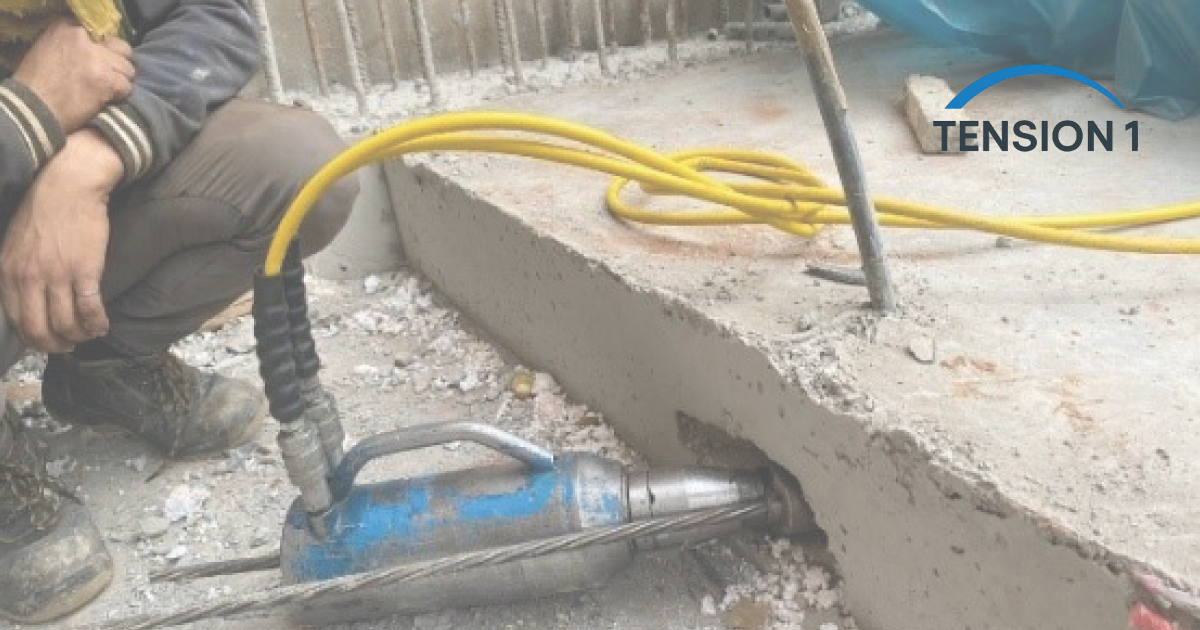
A failed tendon does not always announce itself. On a post tension slab, the high-force steel that holds the structure in compression can lose that force quietly, and by the time the damage is visible on the surface, the load path has often already shifted.
That uncertainty is the real problem. A snapped or corroded tendon that goes unread can lead to localized concrete spalling, progressive cracking, deflection, and in the worst documented cases, a concrete blowout that ejects an anchor at speed. The financial consequence is just as sharp: emergency post tension slab repair costs far more than a planned intervention caught during routine inspection.
This guide solves that. We walk through the visible signs of a post-tension cable failure in the order you are likely to encounter them on site, explain how we evaluate each one, and flag when a sign means stop work now versus monitor and document.
The Surface Signs You Can See Without Tools
Most post-tension cable failures give a visual warning before they become structural emergencies. The challenge is that these warnings are easy to mistake for ordinary concrete wear. When we inspect a post tension slab, we start with the parts of the failure that the naked eye can catch from a walking pace.
Concrete Blowouts and Spalling at the Anchor
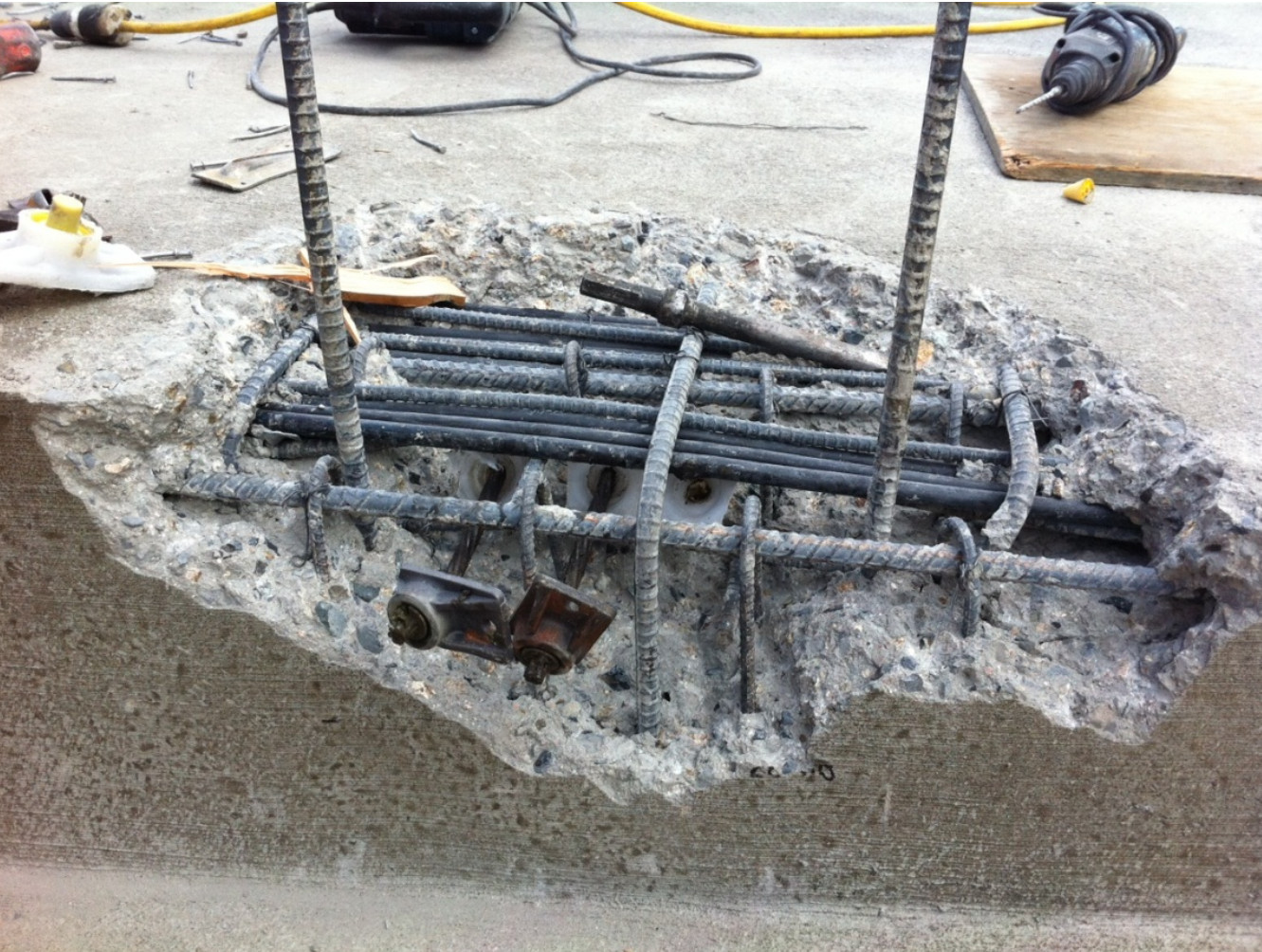
The most unmistakable sign is a blowout: a cone-shaped chunk of concrete pushed out at the slab edge or near an anchor pocket, sometimes with the wedge or anchor head exposed. This happens when a tendon loses its grip on the anchorage and the stored energy releases. Spalling, a milder cousin, shows up as flaking or delaminated concrete over the tendon path, often with rust staining at the crack mouth.
- What to look for: A circular or fan-shaped void at the slab perimeter, an exposed steel wedge, or a fresh impact crater near a stressing pocket.
- Why it matters: A visible blowout means a tendon has already released. Treat the area as a safety hazard and keep personnel clear of the tendon line.
A confirmed blowout or exposed anchor is not a monitor-and-wait condition. Restrict access to the affected zone immediately and consult the engineer of record before any work continues in that area. For emergency response procedures, see our guide on emergency protocol and repair techniques for damaged post-tension cables.
Post Tension Slab Cracking Patterns
Not all cracks signal cable failure, but certain patterns do. A working post-tension slab is held in compression, which suppresses cracking. When a tendon fails, the compression it provided disappears locally, and the slab begins to behave like an unreinforced or under-reinforced member in that zone.
We pay close attention to cracks that run roughly perpendicular to the tendon direction, cracks that widen over weeks rather than stabilizing, and cracks that radiate from an anchor pocket. Random, hairline, map-style cracking is usually shrinkage and not a cable issue. Directional, progressive cracking is the post tension slab cracking pattern that warrants investigation.
Reading the Signs That Hide Below the Surface
Once the obvious surface clues are logged, the harder analytical work begins. A tendon can be substantially corroded or even fully severed inside the slab while the surface above it looks almost normal. This is especially true for unbonded PT, where each strand sits inside a greased plastic sheath and corrosion can travel along the tendon away from the visible defect.
Deflection, Sag, and the Floor That Feels Wrong
A localized sag in a floor that was previously flat is a strong indicator that one or more tendons have lost effective force. We check this with a simple level or laser across the suspect bay and compare against the as-built camber the slab was designed to hold. A loss of camber, or a developing low spot under normal service load, points to reduced effective prestress.
Rust Stains, Grease Tracks, and Moisture
Brown rust bleeding from a hairline crack tells us water has reached the steel. On unbonded systems, a separate clue is a greasy residue weeping from a crack or pocket, which means the sheath has been breached and the corrosion protection is compromised. Both are early-warning signs that, left alone, progress toward a post tension cable snap.
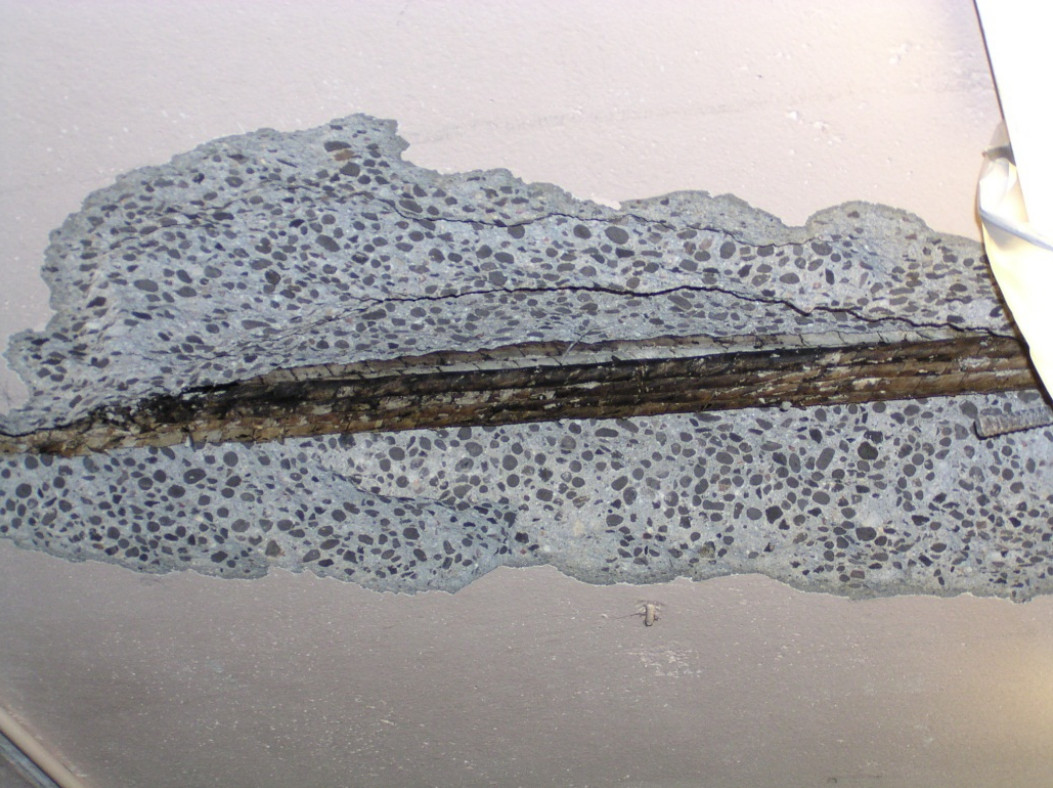
For example, in a project involving a parking structure exposed to repeated freeze cycles and deicing salts, corrosion that began at a single cracked anchor pocket traveled along several tendons before any surface sag appeared. The point is general: the visible defect is often smaller than the actual damage.
For a deeper treatment of how corrosion initiates and spreads through prestressing steel, see our full inspection guide: The Dangers of Corroded Tendons: A Guide to Post-Tension Slab Inspection and Preservation.
How We Evaluate a Suspected Tendon Failure
Catching these signs early is what separates a scheduled, budgeted post tension slab repair from an emergency shutdown. Our evaluation method is deliberately layered, moving from non-destructive observation to targeted investigation, so that we open the slab only where the evidence justifies it.
Our Inspection Sequence
- Visual walkover to map blowouts, spalling, staining, and crack direction against the tendon layout drawings.
- Level or laser survey of the bay to quantify deflection and loss of camber.
- Crack monitoring with gauges over time to separate stable shrinkage cracks from active, propagating ones.
- Cover survey or scanning to locate tendons before any coring, then selective opening only where indicators converge.
Per ACI 318 and the Post-Tensioning Institute guidance such as PTI DC80.3, the goal of inspection is to establish whether effective prestress and the load path are intact, not simply whether the surface is cosmetically sound. We document findings against the design intent rather than against a fresh appearance.
What Worked On-Site vs. What Didn't
| What Worked | What Didn't Work |
|---|---|
| Cross-referencing crack direction against the actual tendon layout drawing before drawing any conclusion. Direction is the single most useful free clue. | Relying on crack width alone. A tight crack over a corroded tendon can be far more serious than a wide, stable shrinkage crack. |
| Repeated level readings over several weeks to confirm whether a sag is active or static before committing to repair scope. | Coring before scanning. Cutting blind risks nicking an adjacent live tendon and turning an inspection into the incident. |
| Treating any greasy weep on unbonded PT as a breached sheath until proven otherwise. | Assuming a single visible defect is the full extent of corrosion. On unbonded strands it rarely is. |
When a Sign Means Stop Work Now
A confirmed blowout, an exposed anchor, or rapidly propagating radial cracking at a pocket are not monitor-and-wait conditions. In those cases the practical priority is to clear the tendon line, restrict load, and bring in qualified PT repair before reconstructing the prestress. A planned post tension cable snap repair, executed with the right anchorage hardware and re-stressing procedure, is routine. An unmanaged snap is not.
Building codes such as the International Building Code (IBC) and the ASCE 7 load standards set the load and serviceability baselines we evaluate against. Material acceptance references ASTM A416 for the prestressing strand itself.
If a tendon has already been cut or severed, the response protocol differs from a corrosion scenario. See our step-by-step breakdown: Cut a Tendon? Emergency Protocol and Repair Techniques for Damaged Post-Tension Cables. And before any future drilling or coring on a PT slab, review: Safety Protocol Checklist: How to Locate and Avoid Post-Tension Cables Before Drilling.
Frequently Asked Questions
Can a post-tension slab fail without any visible cracks?
Yes. Especially with unbonded PT, a tendon can corrode or even sever inside the sheath while the surface stays nearly intact. That is why we combine crack mapping with deflection surveys and tendon scanning rather than relying on visible cracking alone.
Is every crack in a post tension slab a sign of cable failure?
No. Most slabs show some shrinkage and map-pattern cracking that is benign. The cracks we investigate are directional (perpendicular to tendons), radial from anchor pockets, or actively widening over time. Pattern and progression matter more than the existence of a crack.
What does a tendon blowout actually look like?
A blowout typically appears as a cone or fan-shaped chunk of concrete pushed out at the slab edge or anchor zone, sometimes exposing the steel wedge or anchor head. It indicates a tendon has already released its force and should be treated as a safety hazard.
How urgent is post tension cable snap repair?
A confirmed snap, blowout, or exposed anchor is urgent. The load path has changed and adjacent tendons may be affected. The area should be cleared and load restricted until a qualified repair restores the prestress with proper anchorage hardware.
Can I core or drill into a post-tension slab to investigate?
Not without locating the tendons first. Cutting blind risks striking a live tendon. Always scan or perform a cover survey, then open the slab selectively only where multiple indicators point to a problem.
Need Drawings or Calculation Notes for a Post-Tension Slab?
If you are diagnosing a suspected failure or planning a repair, the difference between a clean fix and a costly one usually comes down to the documentation behind it. We prepare tendon layout drawings, calculation notes, and re-stressing documentation for post-tensioned slabs on a freelance basis, built to be read by both your engineer and your crew.
Tell us about your slab and the signs you are seeing, and we will scope the drawings and calculation notes you need.
Request Freelance PT Drawings and Calculation Notes
We prepare production-ready post-tension slab documentation for contractors, engineering firms, and architects across Texas, tailored to your repair or inspection scope.
- Tendon Layout Plans and Profiles — one-way and two-way systems
- Re-Stressing Schedules and Elongation Log Templates
- ACI 318 Flexural and Serviceability Calculation Notes
- Punching Shear Verification — at columns and slab edges
- As-Built Documentation — for engineer-of-record sign-off
If you are a structural drafter, engineering technician, or small firm seeking targeted PT slab support on a project in the Dallas area, contact us through our freelance services page to discuss your project scope and timeline.
TensionOne provides structural engineering support services. All deliverables are prepared for review and use by a licensed Professional Engineer. TensionOne does not provide PE-stamped documents directly.
References: ACI 318-19: Building Code Requirements for Structural Concrete, American Concrete Institute. PTI DC80.3: Specification for Unbonded Single Strand Tendons, Post-Tensioning Institute. ASTM A416: Standard Specification for Low-Relaxation Seven-Wire Strand for Prestressed Concrete, ASTM International. IBC 2021: International Building Code, International Code Council. ASCE 7: Minimum Design Loads and Associated Criteria for Buildings and Other Structures, American Society of Civil Engineers.
This article is intended as a technical reference and does not constitute a PE-stamped engineering opinion or project-specific structural recommendation. All design decisions should be reviewed and approved by the licensed engineer of record for your project.