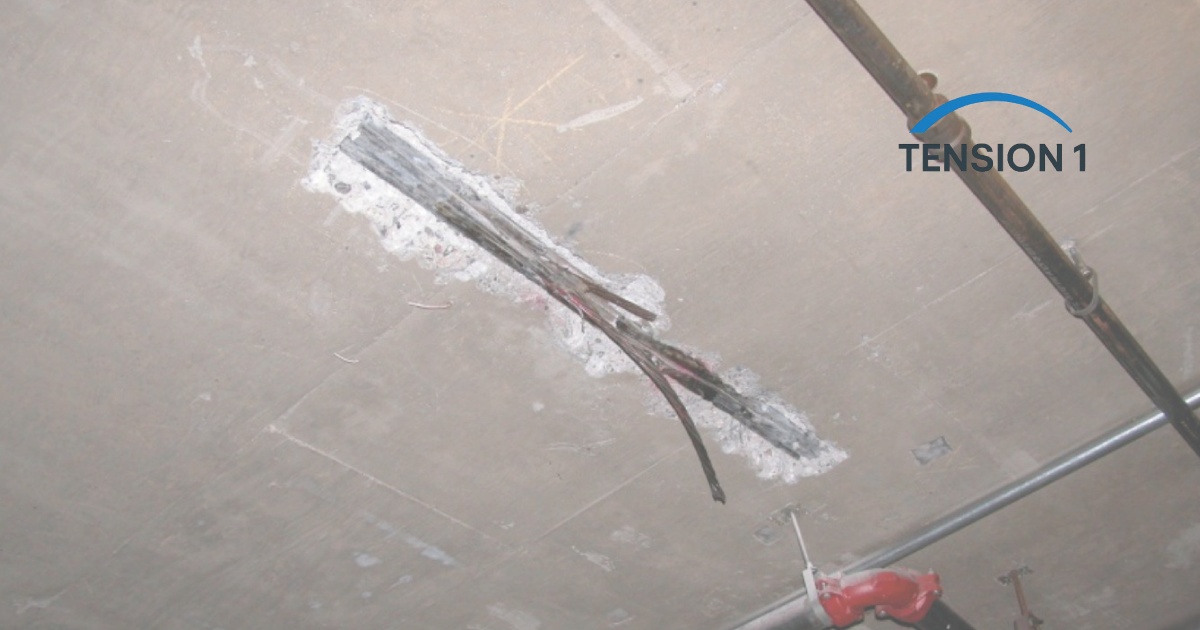
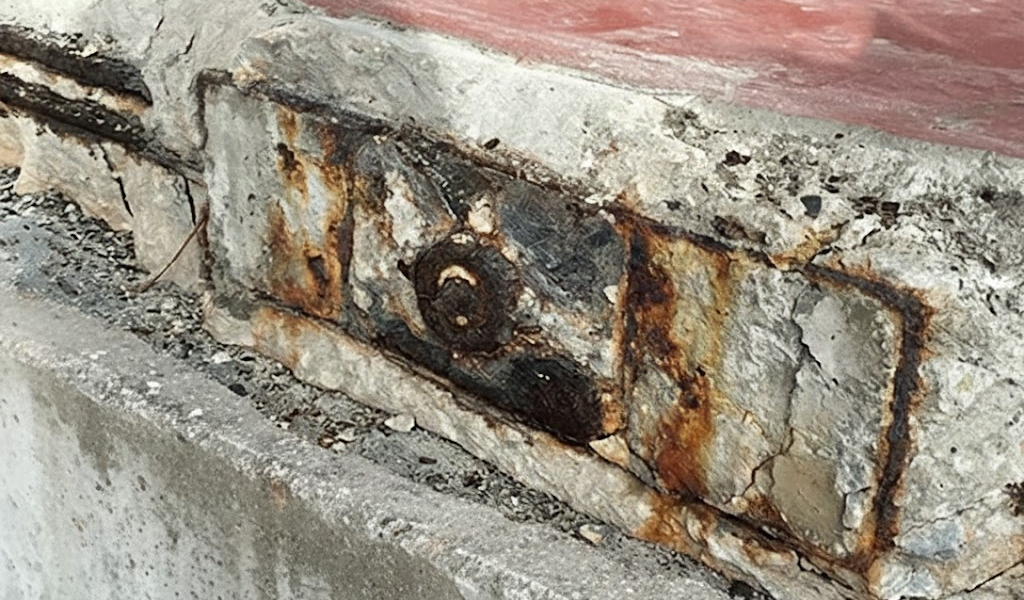
A post tension slab depends on steel it never shows. Each tendon, a high-strength cable running through the concrete, holds the slab in compression for its whole service life. When water reaches that steel, corrosion starts out of sight, and the first visible sign is often a rust stain at the slab edge or a strand bursting out of it.
By then the damage in the post tension slab is rarely limited to one tendon. A corroded tendon loses section, then force, and the slab around it loses the compression it was designed around: more cracking, more deflection, and a repair program instead of a maintenance visit.
This guide covers how tendon corrosion develops, how to inspect a post tension slab for it in a logical order, what drives repair cost, and the preservation steps that keep tendons dry. It draws on the published guidance of ACI and the Post-Tensioning Institute and on what we see on slabs in the field.
In this guide:
- Why tendon corrosion is a structural threat
- How corrosion gets into a post-tensioned slab
- What happens when a tendon breaks
- A five-step inspection sequence
- An interactive inspection severity checker
- What drives repair cost
- Preservation strategies that work
- The documents that govern evaluation and repair
Why Tendon Corrosion Threatens a Post Tension Slab
Most engineers understand corrosion in theory. Far fewer have stood over a stressing pocket during demolition and seen a 0.5 in strand corroded down to a fraction of its section. That sight makes the case better than any equation.
In an unbonded system, each tendon is a seven-wire, 270 ksi strand coated in a corrosion-inhibiting PT coating and enclosed in a plastic sheath. Nothing bonds it to the concrete. That has a consequence ACI 423.4R-14, Report on Corrosion and Repair of Unbonded Single-Strand Tendons, spells out: repairing and protecting the surrounding concrete may do nothing for the steel inside the sheath. If water gets inside, the coating stops protecting.
An older post tension slab carries more risk
Not all PT slabs were built the same way. ACI 423.4R-14 describes early unbonded systems from the 1950s with coatings and paper sheathing sometimes applied by hand, and corrosion problems surfacing in the 1970s. According to a PTI Journal article by Fulton and Trépanier (2015), extruded plastic sheathing arrived in the late 1970s, and fully encapsulated systems, plastic from anchor to anchor, from the early 1990s. Today, PTI Technical Note 18 (2014) states that all unbonded single-strand tendons in ACI 318 structures must be encapsulated. The age of the post tension slab tells you which system you are probably dealing with.
How Corrosion Gets Into a Post Tension Slab
- Anchor pockets: pockets left ungrouted, or grouted poorly, let water reach the anchor and the strand behind it. Across the Dallas metro area, this is the most frequent initiation site we observe.
- Sheathing damage during construction: chairs, vibrators and foot traffic can tear the sheath. A small puncture is enough to let water displace the coating.
- Chlorides: near the Gulf Coast, or wherever deicing salts reach a deck, chlorides accelerate corrosion sharply. Parking structures are the classic case.
- Water in service: the PTI Journal study above found that most wire breaks in the monitored structures came from moisture entering during the service life.
Chloride exposure and the protection it calls for are developed in protecting post-tension tendons from corrosion and chloride penetration.
What Happens When a Post Tension Slab Tendon Breaks
A strand is seven wires, and it does not usually fail all at once. The Fulton and Trépanier article notes it typically takes more than two individual wire breaks before the stress in the remaining wires exceeds the strand's strength and it ruptures. That redundancy buys time for inspection, if someone is looking.
When the strand does rupture, the stored energy releases at once. In residential slabs, owners report a loud bang, and the strand or anchor can burst out of the slab edge. The force that tendon carried is then lost to that part of the post tension slab, and the surrounding concrete and tendons pick up the difference. Over time that shows up as wider cracks and more deflection. The signs to watch for are covered in the visible signs of a post-tension cable failure.
How to Inspect a Post Tension Slab for Tendon Damage
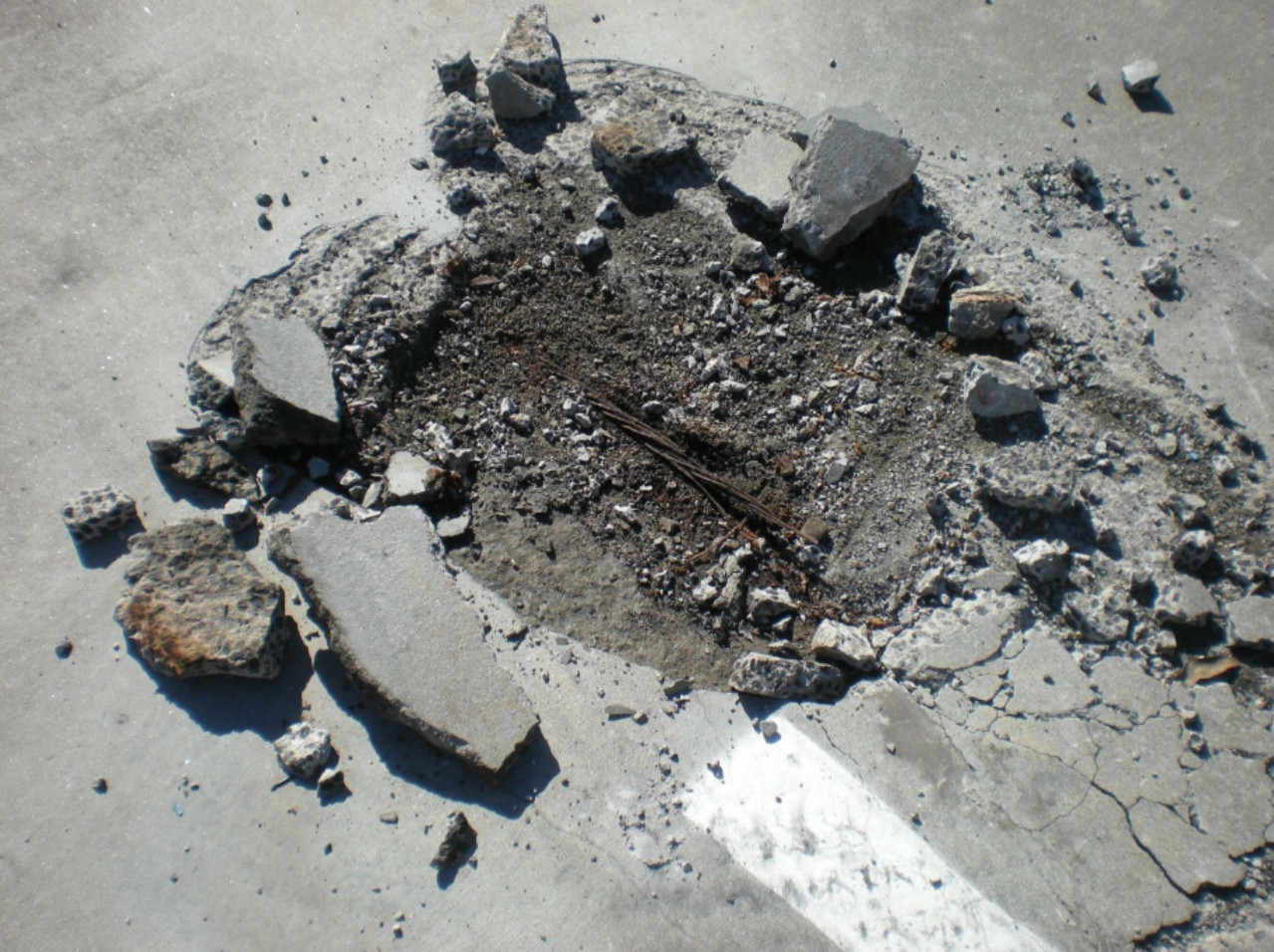
A good post tension slab inspection starts with documents, not concrete. Before we go on site, we request the original PT drawings, the stressing records and any previous repair logs. They set out tendon spacing, profiles and elongation targets. Without them, field observations are much harder to interpret.
ACI 423.4R-14 frames the assessment as a sequence: condition survey, nondestructive testing, exploratory openings, and strand removal where needed. Our five steps follow that order.
Step 1: Visual survey and crack mapping
Walk the post tension slab systematically and map every crack with a crack comparator. Record length, width, orientation and location, and photograph each one with a scale. Cracks running parallel to a tendon, rust staining and efflorescence near anchors deserve the most attention. This baseline is the comparison point for every future inspection.
Step 2: Anchor pockets and end caps
Examine every accessible anchorage: the presence and condition of the encapsulation cap, the quality of the pocket grout, rust staining or seepage around the anchor, and the condition of any exposed strand tail. Opening pockets is work for a qualified PT repair contractor, not for an owner.
We use a 10x hand magnifier at every anchor tail inspection. Confirmed pitting corrosion or measurable section loss at the tail is sufficient to escalate the investigation to nondestructive and invasive testing without further delay.
Step 3: Sounding
Chain drag and hammer sounding find delaminated concrete, where corrosion of embedded steel has fractured the cover. The method is standardized for decks in ASTM D4580. It is fast and cheap, and we run it across all panels before committing to more expensive testing.
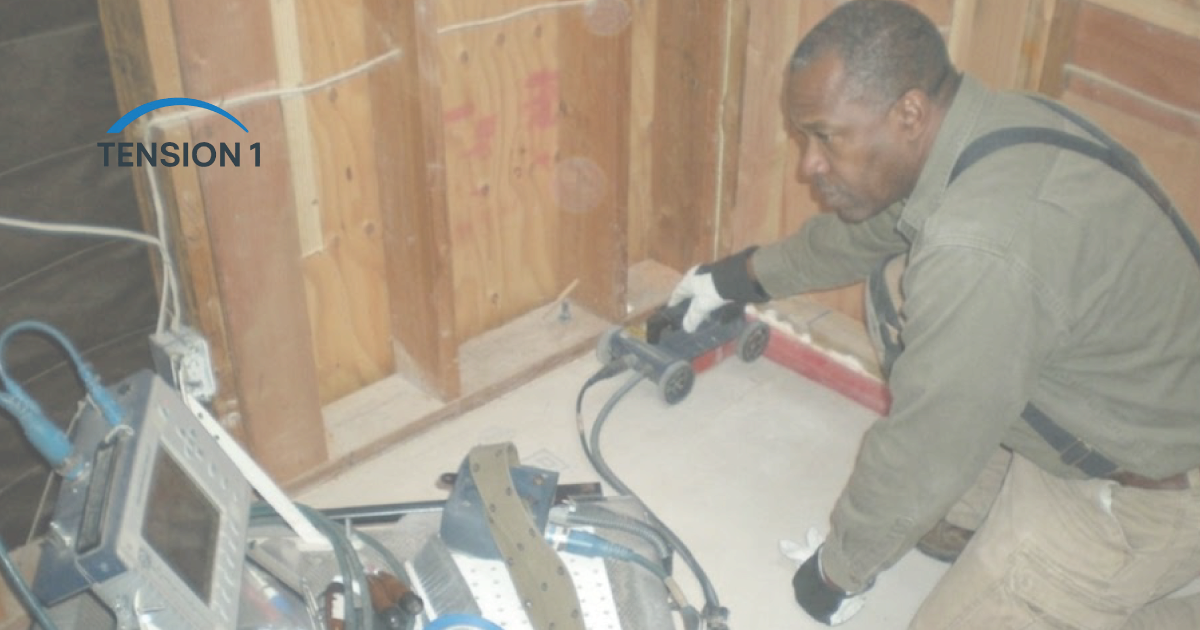
Step 4: Ground-penetrating radar
Where pocket inspection raises concerns, we specify a GPR scan. GPR maps tendons, flags discontinuities and anomalies near anchors, and tells you where to open the slab. It does not image corrosion directly; its job is to target the next step.
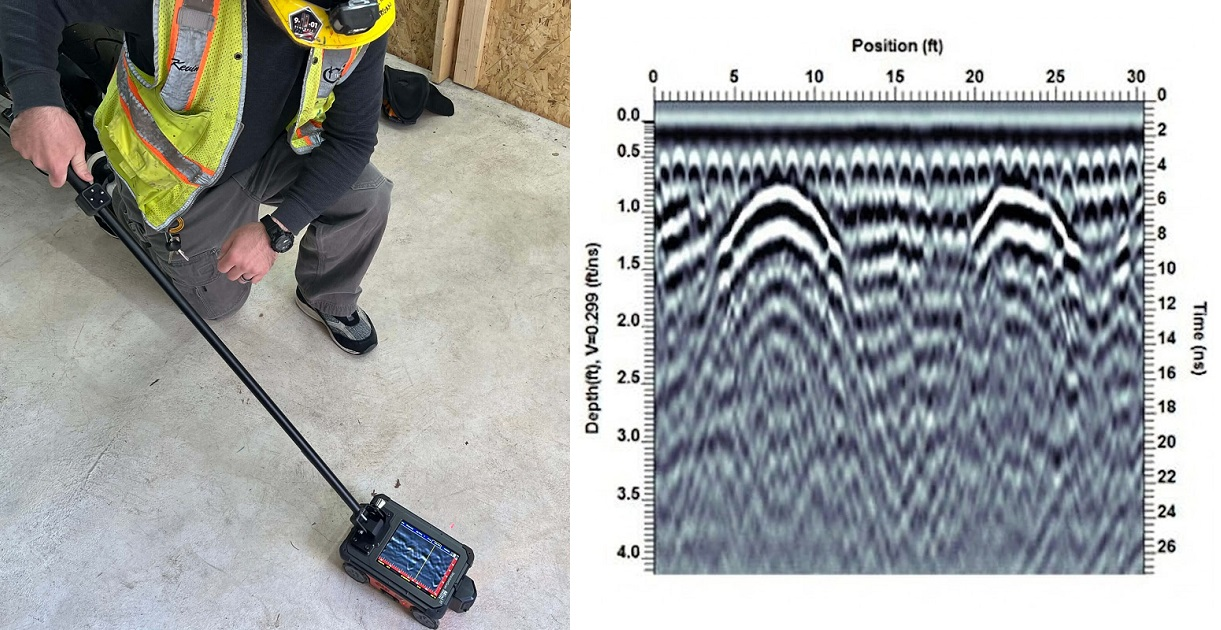
Step 5: Exploratory openings
Where GPR flags an anomaly, the tendon is exposed at that point and the strand and sheathing inspected directly: coating condition, sheathing integrity, wire surface and any broken wires. A single broken wire triggers immediate escalation in our practice: a full assessment of that tendon, and often its replacement. PTI DC80.3-12, the guide for evaluation and repair of unbonded PT structures, sets out the evaluation approach.
Triage Your Post Tension Slab: Inspection Severity Checker
Once you have read the five inspection steps, this checker helps you sort what you are seeing into one of three next steps. Answer six questions about the slab, its anchors and its exposure. It is a triage aid for deciding how urgently to call a professional, not an assessment of your slab.
[tool:pt-inspection-severity-checker]
What Drives Post Tension Slab Repair Cost
Repair is not one line item. It is a sequence: locating the damage, exposing the tendon, splicing or replacing strand, re-stressing, restoring corrosion protection, patching, and engineering at each step. ACI 423.4R-14 lists the main options: splicing, strand replacement, tendon replacement, external post-tensioning, external reinforcement and acoustic monitoring.
- Access: tendons under tile, hardwood or a topping slab mean demolition and reinstatement of finishes, often the largest cost.
- Extent: a corroded tendon rarely corrodes alone. Neighboring tendons in the same wet zone usually belong in the same scope.
- Anchor condition: on older slabs, re-stressing may require new anchors, which means cutting out and rebuilding the anchor zone.
- Engineering and records: an engineered repair scheme, elongation records for every re-stressed tendon, and an assessment report where the jurisdiction requires one.
Typical costs and the warning signs that call for expert repair are covered in our guide to 5 warning signs your post-tension slab needs immediate expert repair and how much it costs.
Preservation Strategies That Extend Post Tension Slab Life
The cheapest repair is the one you never need. Based on PTI and ACI guidance and our own field experience, this is the framework we recommend.
Anchor pocket maintenance
We recommend inspecting exposed anchor pockets at least every five years on enclosed residential slabs and every three years on commercial, exposed or parking slabs. At each cycle, a qualified contractor should check the caps, the pocket grout and any staining, and repair defective pockets with corrosion-inhibiting compound, a sound cap and a nonshrink grout such as one meeting ASTM C1107.
Joints and waterproofing
A post tension slab exposed to weather or irrigation is vulnerable at joints and edges, where water runs toward the anchors. Seal joints and cracks with sealants meeting ASTM C920, and use a traffic-bearing membrane on exposed decks where the exposure calls for it.
Drainage
Standing water at the edge of a post tension slab feeds anchor corrosion. The International Residential Code, Section R401.3, requires the ground around a house to fall at least 6 in within the first 10 ft. We routinely identify drainage failures as the primary contributing factor in anchor pocket corrosion on Dallas-area residential slabs.
Engineering inspections
Involve a structural engineer with PT experience in periodic post tension slab assessments, not only a waterproofing contractor. An engineer reads crack patterns in context, compares anchor conditions with design intent, and separates distress that needs action from distress that needs monitoring.
What worked on site
On a 2023 Dallas residential project, early anchor pocket regrout and end cap replacement at six compromised pockets totaled approximately $4,200. Deferring that scope would have exposed the owner to a repair program of $15,000 to $25,000 or more at the point of tendon failure.
What to watch
On a PT parking deck project, the owner applied a penetrating silane sealer without first addressing cracked joints or open anchor pockets. Within 18 months, moisture was again entering through the unaddressed penetrations. The sealer provided no measurable benefit at the anchor zones. Seal the openings first; coatings come second.
Protecting the Post Tension Slab Starts Before the Drill
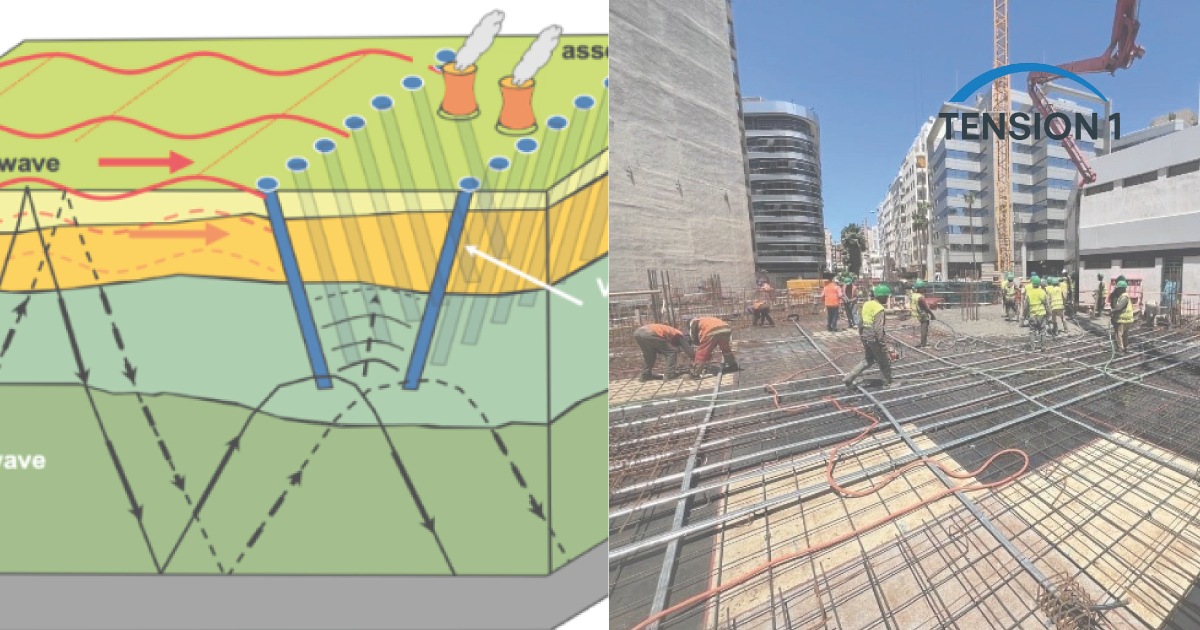
Many corrosion problems begin with a hole: a core or anchor that cut a sheath and let water in. Before any penetration, read is it safe to drill into a post tension slab without knowing where the cables are. For structures in seismic regions, how PT and RC slabs compare is covered in post-tension slab earthquake resistance vs conventional RC.
The Documents That Govern Evaluation and Repair
- ACI 423.4R-14: report on corrosion and repair of unbonded single-strand tendons.
- PTI DC80.3-12: guide for evaluation and repair of unbonded post-tensioned concrete structures.
- PTI DC80.4-18: guide specification for unbonded post-tensioning repair.
- ACI CODE-562-21: code requirements for assessment, repair and rehabilitation of existing concrete structures, where adopted.
- PTI Technical Note 18 (2014): encapsulation of unbonded tendons.
PTI documents are available from the Post-Tensioning Institute. This guide describes mechanisms and procedures; it does not diagnose any specific slab. The governing codes and an on-site evaluation by a qualified engineer take precedence. How we source and correct technical content is set out in our editorial policy.
Found Rust Stains or a Broken Tendon?
If an inspection has flagged corroded anchors, unexplained cracking or a tendon that failed, the next step is an engineering assessment before any repair is scoped or contracted. A technical consultation on tendon corrosion and repair reviews your inspection report, photos or repair quote and tells you what questions to ask next.
For repair scheme documentation, tendon layouts and calculations prepared as independent technical support for the engineer of record, see our post-tension slab design, optimization and diagnostics services.