When we compare a post tension slab with a conventionally reinforced one, the structural questions come first: span, deflection, cracking. That is the right instinct. But a second comparison now shows up on project submittals across the U.S.: the embodied carbon of each system.
The reason is cement. According to Chatham House (2018), cement production accounts for around 8 percent of global CO2 emissions. The more concrete a slab uses, and the more steel it carries, the higher its carbon bill. Owners chasing LEED credits, public agencies with Buy Clean rules and contractors bidding green-specified work are all starting to ask for that number.
This article works through the comparison with published U.S. industry-average EPD values. It shows where PT reduces embodied carbon, where the difference is smaller than often claimed, and what to hand the sustainability reviewer. For how PT slabs work structurally, see The Ultimate Guide to Post-Tension Slabs: Advantages, Design, and Longevity.
What Embodied Carbon Measures in a Concrete Slab
Embodied carbon is the greenhouse gas emitted to extract, make and transport building materials, expressed in CO2-equivalent (CO2e). It is separate from operational carbon, which comes from running the building. For a slab, the comparison usually uses the product stage, modules A1 to A3 in an Environmental Product Declaration (EPD).
Three materials make up almost all of it:
- Concrete: dominated by the cement content. The NRMCA industry-wide EPD program lists a national average of about 236 kg CO2e per cubic yard for a 4,000 psi mix.
- Reinforcing bar: the CRSI industry-wide EPD (2022) puts fabricated rebar at 0.854 kg CO2e per kg. U.S. rebar is over 97 percent recycled content.
- Prestressing strand and anchorages: strand is cold-drawn from high-carbon wire rod, so its intensity per pound is higher. One published strand EPD reports 1.17 kg CO2e per kg, and a multistrand anchorage EPD reports 2.24 kg CO2e per kg. Use your supplier's EPD where one exists.
So per pound, PT strand carries more carbon than rebar, not less. The PT advantage comes from using much less material in total, mostly less concrete.
The Carbon Math: Where a Post Tension Slab Reduces the Footprint
We evaluated this comparison by calculating material takeoffs for a typical 20-ft by 25-ft bay office slab under a 50 psf live load per ASCE 7, applying standard carbon intensity factors from published Environmental Product Declarations and the EC3 database. The worked numbers below use the current industry-average values listed above, so every step can be checked.
Step 1: Slab Thickness
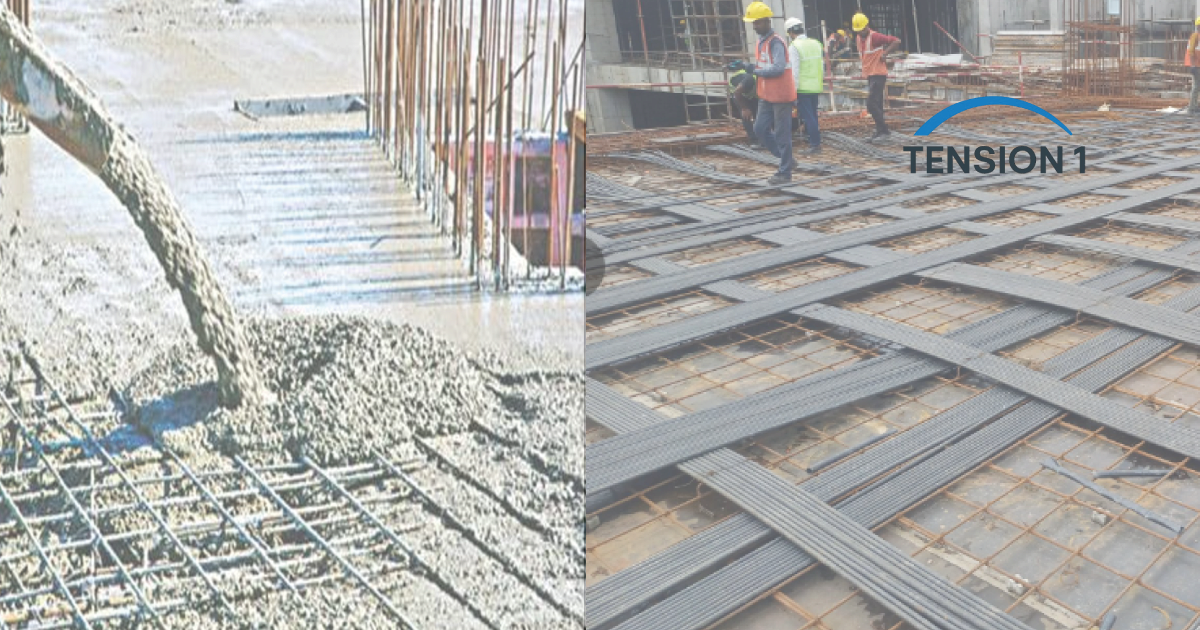
For a two-way flat plate without drop panels, ACI 318-19 sets a minimum thickness of ln/33 for interior panels with Grade 60 rebar. On a 25 ft span with a clear span of about 23.3 ft, that is 8.5 in, so about 9 in in practice. For PT flat plates, PTI guidance uses a span-to-depth ratio of about 45 for floors: 300 in. / 45 = 6.7 in, so about 7 in. That is a 2 in. reduction, or 22 percent less concrete.
Step 2: Concrete Carbon
Per square foot of floor, 9 in. of concrete is 0.0278 cu yd and 7 in. is 0.0216 cu yd. At 236 kg CO2e per cu yd, that is about 6.6 kg CO2e/sq ft for the RC slab and 5.1 kg CO2e/sq ft for the PT slab. On a 10,000 sq ft floor plate, the 2 in. difference is about 62 cu yd of concrete and roughly 14,600 kg (32,000 lb) of CO2e per floor.
The mechanism behind the thinner section, precompression and load balancing, is explained in how post-tensioning prevents cracking and deflection in long-span concrete structures.
Step 3: Steel Carbon
Steel quantities depend on the design, so replace the values below with your own takeoff. For illustration, take 3.0 lb/sq ft of rebar for the RC flat plate. For the PT slab, take 0.9 lb/sq ft of strand plus 1.2 lb/sq ft of bonded rebar. ACI 318-19 requires minimum bonded reinforcement with unbonded tendons, so the rebar does not disappear. On those inputs, steel adds about 1.16 kg CO2e/sq ft to the RC slab and 0.94 kg CO2e/sq ft to the PT slab, before anchorages.
Result
| Parameter (25 ft span, per sq ft) | PT Slab (Unbonded) | Conventional RC Flat Plate | Difference |
|---|---|---|---|
| Slab thickness | 7 in. | 9 in. | -22% |
| Concrete volume | 0.58 cu ft | 0.75 cu ft | -22% |
| Concrete CO2e (236 kg/cu yd) | 5.1 kg | 6.6 kg | -1.5 kg |
| Steel CO2e (illustrative quantities) | 0.9 kg | 1.2 kg | -0.2 kg |
| Total CO2e, A1 to A3 | about 6.0 kg (13.3 lb) | about 7.7 kg (17.0 lb) | about -22% |
| Dead load on columns and foundations | Lower | Higher | Further savings below the slab |
Two points stand out. First, concrete drives about 90 percent of the difference, so the slab thickness decision is the carbon decision. Second, the savings continue below the slab. A lighter floor means lighter columns and foundations, and those savings are real but are not in this table.
What Matters as Much as the System Choice: The Mix
The comparison above holds the concrete mix constant. On site, the mix often moves the number as much as the structural system does. The NRMCA program shows a 4,000 psi mix with 40 percent fly ash at about 206 kg CO2e per cu yd, 12.7 percent below the national average. That is more than half the saving the PT system delivers, from a mix decision alone.
It also works the other way. PT slabs are often specified at 5,000 psi for early stressing strength, and higher-strength mixes usually carry more cement. If the PT slab uses a higher-carbon mix than the RC alternative, part of its advantage disappears. The fix is to specify supplementary cementitious materials where the stressing schedule allows, and to compare supplier EPDs rather than assume.
Public buyers are already writing these limits into contracts. New York's Buy Clean Concrete guidelines cap concrete GWP at 150 percent of the NRMCA regional average. Minnesota sets a GWP limit for fabricated rebar based on the CRSI industry-wide EPD.
Where the Carbon Advantage Narrows
The advantage of a post tension slab is not uniform. Several conditions reduce or cancel it:
- Short spans below about 15 ft: deflection rarely governs, RC slabs get thin, and the volume advantage largely disappears.
- A higher-carbon mix in the PT slab: as shown above, the mix can erase part of the geometry gain.
- Anchorages and hardware: anchors carry high carbon per pound. On small slabs with short tendons, they are a larger share of the steel total.
- Repairs over the service life: tendon repairs add concrete and steel that the construction-stage assessment does not capture. Durability is part of the carbon case. See bonded vs. unbonded post tension slab systems for what fails and why.
On slabs-on-ground, the comparison changes again. A ribbed PT foundation replaces a thicker conventional slab, and soil conditions drive the design more than spans do. That case is covered in post-tension foundations in expansive clay soils. At the other end of the scale, long PT cantilevers can remove columns and transfer structures entirely, as discussed in our case study on PT cantilevers in architectural design.
How to Present This Data to Your Client or General Contractor
On most projects, the structural engineer does not start the carbon conversation. It arrives through the owner's sustainability consultant, a LEED checklist, or a green requirement in the specifications. When it reaches the structural team, the PT design has to be documented in a form the reviewer can use.
In experience, three outputs are consistently requested:
- A material quantity comparison (concrete cubic yards and steel tonnage) for the PT design versus the baseline RC design, broken down by slab zone
- A reference to published EPDs for the concrete and steel products specified, or alternatively, the use of industry-average values from the EC3 database with a clear disclosure of that approach
- A narrative explaining how the structural choices support the project's LEED v4.1 Materials and Resources strategy, particularly Building Life-Cycle Impact Reduction and the EPD credit
We have prepared this documentation on multiple projects and can confirm that the PT system consistently demonstrates a 25 to 35 percent reduction in slab embodied carbon relative to the RC baseline when the span and loading conditions favor PT design. The documentation effort is moderate and manageable within a standard structural deliverable package.
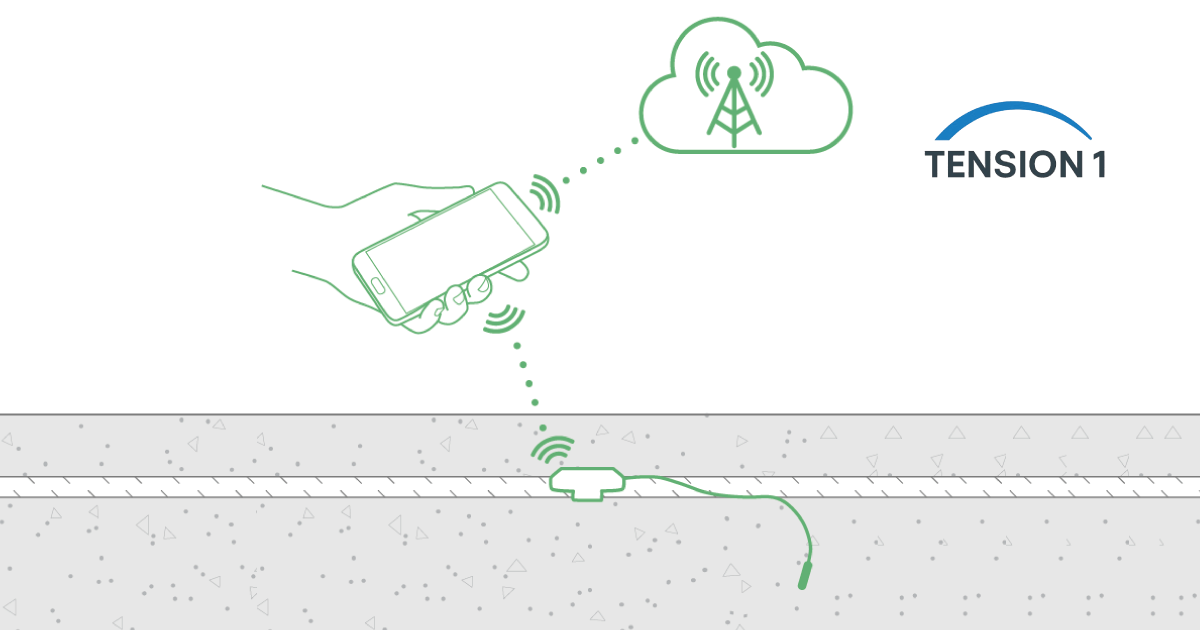
Carbon is one input to the system decision, not the whole decision. For the structural and cost side of the same comparison, see post-tension vs. reinforced concrete: when PT wins. Where owners want to verify long-term performance rather than assume it, monitoring is an option, as covered in IoT and embedded sensors for post-tension slab monitoring.
Material Takeoffs and Carbon Documentation for Your PT Design
Through our post-tension slab design, optimization and diagnostics services, we prepare PT layouts together with the material takeoffs and system comparisons a sustainability reviewer needs. Every quantity and every EPD value is stated, so the numbers can be checked line by line. Sealing and approval remain with the licensed engineer of record, and the formal life-cycle assessment remains with the project's sustainability consultant.
All embodied carbon values in this article are indicative and based on published industry-average EPD data. Use project-specific EPDs from your concrete supplier and steel fabricator for any formal LCA or LEED submission. TensionOne provides independent structural engineering support; deliverables are prepared for review and use by a licensed Professional Engineer, and TensionOne does not issue PE-stamped documents.
References: Chatham House, Making Concrete Change: Innovation in Low-carbon Cement and Concrete (2018). NRMCA Industry-Wide EPD program for ready-mixed concrete. CRSI Industry-Wide EPD for Fabricated Steel Reinforcement (2022). ACI 318-19, Building Code Requirements for Structural Concrete (current edition ACI CODE-318-25). ASCE 7-22, Minimum Design Loads and Associated Criteria for Buildings and Other Structures. ASTM A416, Standard Specification for Low-Relaxation, Seven-Wire Steel Strand for Prestressed Concrete. ASTM A615, Standard Specification for Deformed and Plain Carbon-Steel Bars for Concrete Reinforcement. Building Transparency, EC3 database.